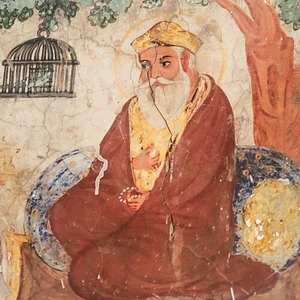

Gurū Nānak (1469-1539) was an Indian mystic and poet, the founder of Sikhism. He preached the oneness of God, the equality of all human beings, and the rejection of castes and formal rituals. The first of the ten Sikh Gurus, his hymns lie at the heart of the sacred book, the Gurū Granth Sahib.
Guru Nanak(1469 — 1539)
Gurū Nānak Dev
5 min read
Frequently asked questions
Famous Quotes
« There is no Hindu and no Muslim.»
Key Facts
- Born in 1469 at Talwandi (today Nankana Sahib, in Pakistan), in the Punjab.
- Underwent a foundational spiritual experience around 1499 marking the beginning of his preaching.
- Undertook long journeys (udasis) to spread his teaching across India and beyond.
- Founded the community of Kartarpur, where he established the langar (communal kitchen open to all).
- Died in 1539 after appointing Gurū Angad as his successor.
Works & Achievements
A foundational composition placed at the opening of the Gurū Granth Sahib, recited every morning by Sikhs. It sets out the essence of Nanak's thought.
A ballad sung at dawn, a collection of hymns that denounce ritual hypocrisy and celebrate equality and service.
A set of hymns composed after Babur's invasions, bearing witness to the suffering of the people and questioning divine justice.
A poetic dialogue with yogi ascetics (the Siddhas), in which Nanak defends a spirituality lived in the world rather than in renunciation.
A major social achievement: an egalitarian community founded on honest work, sharing, and meditation.
Choosing a disciple rather than a son, establishing the principle of the lineage of the ten gurūs and the continuity of the teaching.
Anecdotes
According to Sikh tradition, the young Nanak refused at the age of nine to wear the *janeu*, the sacred thread that Brahmins tie around high-caste Hindus. He declared that he would prefer a thread woven from compassion and truth, marking very early on his rejection of formal rituals and caste distinctions.
Tradition tells that one day, while he was working as an accountant at the governor's granary, Nanak was counting the sacks of grain and, having reached the number thirteen (“tera” in Punjabi), began repeating “tera, tera” — which also means “yours, yours” when addressing God — falling into mystical ecstasy.
Around 1499, Nanak is said to have disappeared for three days in the Bein river. Upon his return, he uttered his famous sentence: “There is no Hindu and no Muslim,” affirming the oneness of God beyond religions and the beginning of his mission as a preacher.
Nanak undertook long preaching journeys called *udasis*, which, according to tradition, are said to have taken him as far as Mecca, Baghdad, and Tibet. He travelled accompanied by Mardana, a Muslim who played the rebab while Nanak sang his hymns.
At the end of his life, Nanak founded the town of Kartarpur, where he established the *langar*, a free community kitchen where everyone, regardless of caste or religion, sat on the ground side by side to share the same meal — a practice still alive in Sikh temples today.
Primary Sources
There is but one God, whose name is Truth, the Creator, without fear, without hatred, immortal, unborn, self-existent.
There is neither Hindu nor Muslim; so which path shall I follow? I shall follow the path of God.
Traditional accounts recounting the birth, travels, and miracles attributed to the first gurū, composed and transmitted from the 16th-17th century onward.
Key Places
Nanak's birth village in the Punjab, today in Pakistan. A great gurdwara there commemorates his birth.
Town where Nanak worked as an accountant and where he lived his mystical experience on the Bein river.
Community founded by Nanak on the banks of the Ravi, where he established the langar and spent his final years. Place of his death in 1539.
According to Sikh tradition, Nanak travelled there during his great preaching journeys, holding dialogue with Muslim religious scholars.
Hindu holy city on the Ganges where, according to the Janamsakhis, Nanak challenged a ritual by throwing water in the opposite direction to show the absurdity of certain practices.
Typical Objects

Plucked string instrument played by Mardana, Nanak's companion, to accompany the singing of hymns. Music was at the heart of the nascent Sikh devotion.

Sacred book of Sikhism gathering the hymns of Nanak and the gurus who followed. Venerated as the eternal and living guru of the Sikh community.

A free meal shared by all, seated at the same level, with no distinction of caste or religion. A living symbol of the equality championed by Nanak.

A thread worn across the chest by high-caste Hindus. Nanak refused to wear it in order to denounce caste distinctions and meaningless rituals.

A rosary used for repeating the name of God (“Naam Japna”), a central practice of the devotion taught by Nanak.

A calligraphed symbol meaning “There is only one God,” opening the sacred book. It sums up the message of divine oneness preached by Nanak.
School Curriculum
Vocabulary & Tags
Key Vocabulary
Daily Life
Morning
At Kartarpur, Nanak would rise well before dawn for the ritual bath and meditation on the name of God. He recited and sang his hymns accompanied by the rebab, in the quiet contemplation preceding sunrise.
Afternoon
The day was divided between working the fields and welcoming visitors who came to hear him. Nanak championed *kirat karni*, honest labor with one's own hands, rejecting the begging of ascetics.
Evening
Evenings brought the community together for the collective singing of hymns (kirtan) and the sharing of the langar. Everyone sat at the same level, without distinction of rank, around the communal meal.
Food
Food was simple and vegetarian in the spirit of the langar: grains, lentils (dal), vegetables, and wheat flatbread (roti). Nanak emphasized moderation and sharing rather than rigid prohibitions.
Clothing
Nanak wore plain garments blending elements of the dress of Hindu ascetics and Muslim fakirs, refusing the ostentatious attire of any single tradition. The Janamsakhis often describe him with a long robe, a shawl, and a head covering.
Housing
He lived in a modest dwelling within the farming community of Kartarpur, built of earth and brick on the banks of the Ravi. The house opened onto the communal spaces where prayer and the shared meal took place.
Historical Timeline
Period Vocabulary
Liens externes & ressources
Références
Œuvres
Japji Sahib
début XVIe siècle
Asa di Var
XVIe siècle
Babur Vani
vers 1526
Sidh Gosht
XVIe siècle
Fondation du langar et de la communauté de Kartarpur
vers 1519
Désignation de Gurû Angad comme successeur
1539