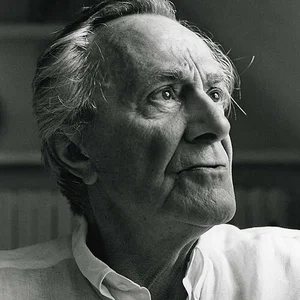

French philosopher, a major figure of postmodern thought. He analyzes the decline of the grand narratives that legitimized knowledge and modernity, and reflects on the transformations of knowledge in contemporary societies.
Jean-François Lyotard(1924 — 1998)
Jean-François Lyotard
France
5 min read
Frequently asked questions
Famous Quotes
« Simplifying to the extreme, I define postmodern as incredulity toward metanarratives.»
Key Facts
- Born in 1924 in Versailles and died in 1998 in Paris.
- In 1979 he published The Postmodern Condition, a report on knowledge that became a worldwide reference.
- In 1983, in The Differend, he developed a reflection on the irreducible conflicts between discourses.
- Taught philosophy at the University of Paris VIII (Vincennes) and took part in post-war French intellectual life.
- A central figure, alongside Derrida and Foucault, of the current of French thought known as postmodern.
Works & Achievements
His doctoral thesis, which confronts language and image and lays the groundwork for his thinking on art and the sensible.
A provocative work in which he explores the energies of desire; he would later disown it as his “evil book.”
A report on knowledge that became a worldwide classic; in it he announces the “end of grand narratives.”
His most accomplished philosophical work, on the impossibility of judging certain conflicts by a single shared rule.
A collection of teaching letters in which he clarifies and defends his notion of the postmodern.
Essays on technology, time, and what resists the inhuman within thought.
Anecdotes
In 1979, the government of Quebec asked Lyotard for a report on the state of knowledge in developed societies. What was meant to be an administrative commission became *The Postmodern Condition*, one of the most cited philosophy books of the 20th century, which popularized the word “postmodern” far beyond the universities.
Before becoming a great philosopher, Lyotard taught philosophy at the secondary school in **Constantine**, Algeria, in the early 1950s. This stay, amid rising colonial tensions, marked him deeply and pushed him to campaign actively against the Algerian War.
For about a dozen years, Lyotard was an activist in the small revolutionary group “Socialisme ou Barbarie” and wrote countless pamphlets and articles. He would later recount that, during this period, he had almost given up “scholarly” philosophy to devote himself to political action.
Lyotard was among the philosophers who founded, in **1968**, the philosophy department of the experimental University of Vincennes, where one could enroll without holding the baccalauréat. There he rubbed shoulders with **Gilles Deleuze** and **Michel Foucault** in an intellectual ferment born of May 1968.
As a teenager, Lyotard long hesitated about his path: he dreamed in turn of becoming a Dominican monk, a painter, then a writer, before choosing philosophy. This taste for art and the image never left him and nourished his book *Discours, figure*.
Primary Sources
Simplifying to the extreme, I define *postmodern* as incredulity toward metanarratives.
As distinguished from a litigation, a differend would be a case of conflict between two parties that could not be equitably resolved for lack of a rule of judgment applicable to both arguments.
Knowledge changes status at the same time as societies enter the so-called postindustrial age and cultures the so-called postmodern age.
The postmodern would be that which, in the modern, alleges the unpresentable in presentation itself.
Key Places
Lyotard's birthplace, in the western suburbs of Paris, in 1924.
Lyotard taught philosophy here in the early 1950s; the colonial experience fueled his political commitment.
An experimental university born of May 1968 where Lyotard taught philosophy alongside Deleuze and Foucault.
An institution he co-founded in 1983 and of which he was one of the first directors.
The city where Lyotard died in 1998 and where most of his intellectual career unfolded.
Typical Objects

As a high-school teacher in Constantine and later in France, Lyotard taught philosophy in front of a blackboard, the everyday tool of teaching in his day.

During his years as an activist, Lyotard wrote and printed leaflets on a mimeograph, the handcrafted duplicating machine typical of revolutionary groups in the 1950s and 1960s.

Before computers, Lyotard typed his manuscripts and articles on a mechanical typewriter, a central instrument of twentieth-century intellectual work.

“The Postmodern Condition” appeared in a small format from Éditions de Minuit, making philosophical thought accessible and widely circulated.

Lyotard analyzed the emerging computerization of society: the computer and databases became for him the symbol of the transformation of knowledge that he studied.

Passionate about painting, Lyotard amassed reproductions of artworks that he commented on, notably in “Discourse, Figure”.
School Curriculum
Vocabulary & Tags
Key Vocabulary
Daily Life
Morning
As an academic, Lyotard often devotes his mornings to reading and writing, filling notebooks and revising his manuscripts. He also prepares his lectures and seminars.
Afternoon
His afternoons are paced by university lectures, seminars and long discussions with colleagues and students, amid the intellectual ferment of post-1968 Paris.
Evening
In the evening, he continues his reading, writes his correspondence and takes part in public debates or lectures. He also enjoys visiting museums and art exhibitions.
Food
Lyotard leads the life of a twentieth-century French middle-class intellectual: ordinary meals, cafés where one puts the world to rights, with no particular taste for luxury.
Clothing
He wears the understated attire of the academic of his day: jacket, shirt, sometimes a tie, in a discreet style far from any extravagance.
Housing
He lives mainly in Paris and its region, in urban apartments, travelling extensively to teach, notably in the United States during the last decades of his life.
Historical Timeline
Period Vocabulary
Liens externes & ressources
Références
Œuvres
Discours, figure
1971
Économie libidinale
1974
La Condition postmoderne
1979
Le Différend
1983
Le Postmoderne expliqué aux enfants
1986
L'Inhumain. Causeries sur le temps
1988