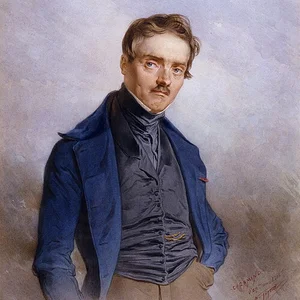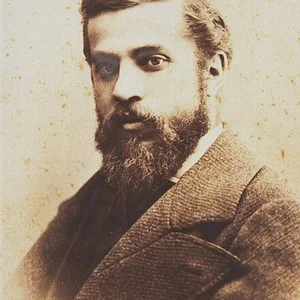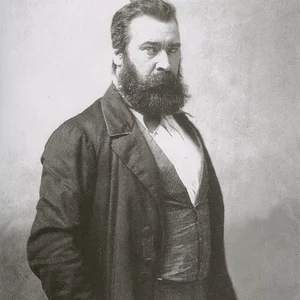

Jean-François Millet was a 19th-century French painter and a leading figure of the Barbizon school. He is famous for his scenes of peasant life, depicting the labour of the fields with dignity.
Jean-François Millet(1814 — 1875)
Jean-François Millet
France
6 min read
Frequently asked questions
Key Facts
- Born in 1814 in Gruchy, near Cherbourg, into a family of Norman peasants
- Settled in 1849 in Barbizon, where he became a central figure of the landscape school of the same name
- Painted 'The Gleaners' in 1857, implicitly denouncing rural poverty and stirring controversy
- Created 'The Angelus' between 1857 and 1859, one of the most reproduced works of the 19th century
- Died in 1875 in Barbizon; his work would notably influence Vincent van Gogh
Works & Achievements
His first major peasant canvas shown at the Salon, marking the beginning of his turn toward depicting rural life.
Monumental figure of a peasant casting seed, which became an icon of labor on the land.
Three women gathering ears of grain after the harvest; a major work seen as a testimony to the peasant condition.
A peasant couple praying at the sound of the evening bell; one of the most famous and reproduced images in French art.
An exhausted peasant leaning on his hoe, a striking image of the harshness of rural labor.
Preparatory studies revealing his method of constructing peasant figures.
A luminous landscape after the rain, reflecting his late interest in rendering nature and light.
Anecdotes
Millet grew up in a family of Norman peasants in Gruchy, near Cherbourg. As a young boy, he tended cows and worked in the fields while reading the Bible and Virgil. This rural childhood would feed his entire body of work: he painted peasants not as picturesque figures, but as the dignified laborers he knew intimately.
His painting “The Angelus” (1857-1859) became one of the most famous and widely reproduced images in the world. After his death, the work was resold several times at ever-higher prices, until it sparked a bidding war between France and the United States in 1889. The painter himself had sold it for a modest sum during his lifetime.
When “The Gleaners” was exhibited at the Salon of 1857, part of the critics were alarmed: showing three poor women gathering the ears of grain left behind after the harvest seemed to denounce poverty and was perceived as a dangerous political message, so soon after the revolution of 1848. Millet, however, claimed he wanted only to paint the reality of labor.
In 1849, fleeing a cholera epidemic in Paris, Millet settled with his family in the village of Barbizon, on the edge of the Fontainebleau forest. He would stay there for twenty-seven years, until his death, becoming one of the central figures of the school of landscape and rural-life painters that bears the village's name.
The painter lived much of his life in poverty, struggling to sell his canvases and feed his nine children. Official recognition came only late, shortly before his death in 1875. Much later, his peasants would deeply inspire Vincent van Gogh, who copied several of his works with admiration.
Primary Sources
They tell me I deny the charm of the countryside. I find far more than charm — infinite beauty. [...] But I also see, out in the plains, the steaming figures of those who have been bent over their work since morning.
The human side, the frankly human side — that is what touches me most in art.
A biography published by his friend and art dealer, gathering the painter's correspondence and memories — a major source for understanding his thinking on peasant labor and art.
Key Places
Hamlet in the Cotentin region where Millet was born in 1814 into a family of peasants. The landscapes and rural life of his childhood would leave a lasting mark on his work.
Town where the young Millet received his first painting lessons and obtained a municipal grant to continue his training.
Capital where Millet studied in Paul Delaroche's studio and exhibited at the Salon. It was also where he endured years of financial hardship.
Village on the edge of the Fontainebleau forest where Millet settled in 1849 and painted his masterpieces. He died there in 1875.
Wooded massif near Barbizon where the painters of the school of the same name came to work in the open air, a source of inspiration for landscape artists.
Typical Objects

The fundamental tools of the painter, which he sometimes took along to work on his sketches from nature. The bulk of his large canvases, however, was finished in the studio, from memory.

Implements of the harvesters and gleaners that Millet depicted again and again. The sickle appears notably in the hands of the peasant women gathering ears of grain.

The rustic footwear of peasants, carved from a single block of wood. They symbolize the humble condition of the figures painted by Millet.

The bag of seeds worn across the shoulder by the sower casting grain by hand. This is the central gesture of one of his most famous paintings.

Tools of the hay and the harvest present in many haymaking scenes. They embody the daily toil of the fields.

The village belfry bell that rings out the Angelus prayer, marking the peasants' pause in the painting of the same name. It structures the rhythm of the rural day.
School Curriculum
Vocabulary & Tags
Key Vocabulary
Daily Life
Morning
In Barbizon, Millet rises early, often to the sound of the village bell. He begins by observing the countryside and the peasants heading off to the fields, then makes his way to his modest studio to take up the canvases in progress. The morning light guides his first hours of work.
Afternoon
The afternoon is devoted to painting and drawing from memory, for he prefers to compose his scenes in the studio rather than outdoors. He reworks the gestures and postures of his figures at length. Money worries often force him to produce drawings in order to sell more quickly.
Evening
In the evening, Millet returns to his large family and reads, notably the Bible, Virgil, or authors he is fond of. He exchanges letters with his friend and dealer Alfred Sensier. Fatigue and financial concerns sometimes cast a shadow over these moments.
Food
The family's diet remains simple and frugal, much like that of the Barbizon peasants: bread, soup, vegetables from the garden, and occasionally a little meat. The hard years call for great austerity. The local wine accompanies their modest meals.
Clothing
Millet dresses plainly, in the manner of the village folk, in sturdy, unfussy work clothes. He often wore a wide hat and garments of hard-wearing canvas. His rustic appearance stood in stark contrast with the fashionable painters of Paris.
Housing
He lives in a modest house-studio in Barbizon, plain and far from comfortable, where his wife and nine children are crowded together. The studio serves both as a place of work and as a living space. This rural dwelling is today a museum dedicated to the painter.
Historical Timeline
Period Vocabulary
Liens externes & ressources
Références
Œuvres
Le Semeur
1850
Les Glaneuses
1857
L'Angélus
1857-1859
L'Homme à la houe
1860-1862
Des glaneuses (dessins et variantes)
vers 1855-1857
Le Printemps
1868-1873