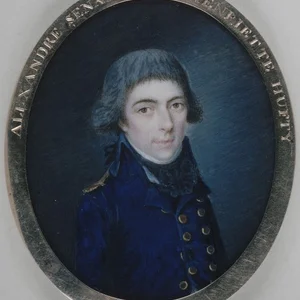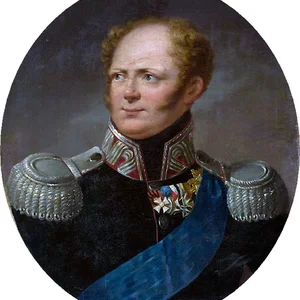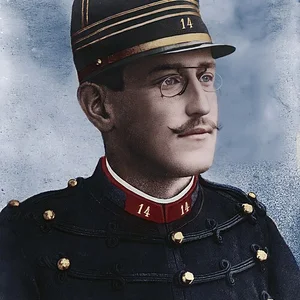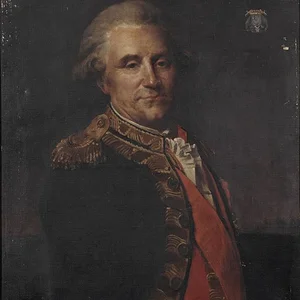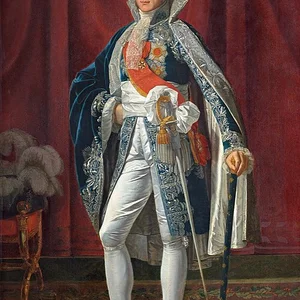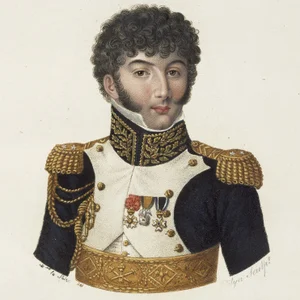

A French general of the Empire, Dorsenne was one of the most distinguished officers of the Imperial Guard. Colonel of the Foot Grenadiers, he covered himself in glory at Austerlitz, Jena, and Eylau before dying from his wounds in 1812.
Jean-Marie-Pierre-François Le Paige Dorsenne
Jean-Marie-Pierre-François Le Paige Dorsenne
8 min read
Frequently asked questions
Key Facts
- 1772: born in Arras
- Distinguished himself at the Battle of Austerlitz (1805) as colonel of the Foot Grenadiers of the Guard
- Took part in the battles of Jena (1806) and Eylau (1807)
- Appointed général de division and commanded the Army of the North in Spain (1811)
- 1812: died in Paris from wounds and illnesses contracted on campaign
Works & Achievements
Dorsenne brought this elite regiment to a level of near-perfect discipline throughout the great campaigns of the Empire (Jena, Eylau, Wagram). His exacting standards made it one of the most feared and admired units in Europe.
Dorsenne's first taste of combat came under Bonaparte, during the victories of Arcole and Rivoli. These formative campaigns established his reputation as a courageous soldier and opened the path to the Imperial Guard.
Dorsenne took command of the Army of the North, tasked with securing French rear lines in Castile and Asturias against the guerrilla insurgency. He maintained relentless pressure on the partisans despite his continuously failing health.
His conduct at Eylau — grenadiers standing motionless under a devastating cannonade and in the full fury of a blizzard — is cited in the military memoirs of the period as the ultimate example of discipline and composure under fire.
Anecdotes
At Eylau, on February 8, 1807, amid a snowstorm and devastating cannon fire, Dorsenne kept his Imperial Guard grenadiers in perfect stillness on the plateau for hours. An eyewitness reports that Napoleon, riding across the battlefield, stopped before their flawless line and declared he had never seen such discipline under fire. This legendary composure earned Dorsenne's grenadiers the nickname “marble statues.”
Dorsenne was renowned for his exceptional physical presence, to the point that Napoleon called him “the most handsome soldier in the army.” This reputation did not prevent him from being a model of strictness: even bivouacked at -20°C in Poland, he demanded of his grenadiers an impeccable bearing and gleaming weapons, believing that a unit's appearance directly reflected its morale.
At the Battle of Austerlitz, on December 2, 1805, Dorsenne and the Guard grenadiers remained in reserve throughout the day, motionless under shellfire, without being committed to combat. For elite soldiers who yearned for the glory of a charge, this ordeal of absolute patience under fire was in its own way as remarkable a display of military discipline as the victory itself.
Appointed commander of the Army of the North in Spain in 1811, Dorsenne had to contend with a ruthless guerrilla campaign in Castile while battling a brain tumor that caused him excruciating pain. He continued to direct operations on horseback, refusing to relinquish command until the final weeks of his life. He died in Düsseldorf on July 25, 1812, at just 39 years old, never having returned to France.
Primary Sources
The foot grenadiers of the Imperial Guard, held in reserve by the Emperor, presented to the enemy the spectacle of an elite force whose mere presence helped decide the outcome of the day.
Napoleon names Dorsenne among the senior officers who contributed most to maintaining discipline and morale within the Guard during the campaigns in Prussia and Poland.
Dorsenne commanded his grenadiers with absolute authority and a composure under fire that nothing seemed able to shake. His untimely death was felt as an irreparable loss by all who had served under his command.
Major General Dorsenne, commander-in-chief of the Army of Northern Spain, died in Düsseldorf on 25 July 1812, from an illness contracted in the service of His Majesty the Emperor.
Key Places
Dorsenne's birthplace, born on **7 February 1773**. A small town in northern France, it shaped his early years before he joined the revolutionary armies at the age of twenty.
Site of the battle of **2 December 1805**, Napoleon's tactical masterpiece against the Austro-Russian coalition. Dorsenne commanded the Grenadiers of the Guard held in reserve there, maintaining perfect order under shellfire throughout the entire engagement.
Site of the battle of **8 February 1807**, one of the bloodiest of the Empire. It was here that Dorsenne earned his legendary reputation by holding his grenadiers motionless under cannon fire and in the blizzard, without wavering for hours.
The main base of the Army of the North under Dorsenne's command in 1811–1812. It was from this city that he directed operations against the Spanish guerrilla while fighting the illness that would ultimately claim his life.
The city where Dorsenne died on **25 July 1812**, from a brain tumour. He had been transported there to receive medical treatment, continuing to follow military operations until his final weeks.
Typical Objects

Iconic headgear of the foot grenadiers of the Imperial Guard, made from black bearskin and standing roughly 30 cm tall with its red plume. A symbol of the Napoleonic elite, it inspired awe in allies and enemies alike on the battlefield.

Regulation saber with a slightly curved blade and brass guard, carried by officers and non-commissioned officers of the Imperial Guard. The quintessential close-combat weapon, it was worn on all occasions as a mark of rank and membership in the elite.

Regulation flintlock musket firing a 17.5 mm lead ball, effective up to 100 metres, fitted with a socket bayonet. The Guard grenadiers carried an improved version, distinguished by its finely finished fittings.

Ornaments of heavy gold bullion fringe worn on the shoulders of the uniform, denoting the rank of divisional general that Dorsenne attained in 1807. These gilded epaulettes embodied his meteoric rise from the armies of the Revolution.

Gilded bronze figure mounted atop the colours of each regiment of the Guard, presented by Napoleon in person at the Champ-de-Mars in 1804. Losing one's Eagle in battle was the ultimate disgrace; defending it, the noblest act of courage a grenadier could perform.

A manuscript or engraved map depicting the operational terrain, indispensable to any divisional commander. Dorsenne relied on such maps constantly during his command in Spain to plan operations against the guerrilla across the plains of Castile.
School Curriculum
Vocabulary & Tags
Key Vocabulary
Daily Life
Morning
The day of a division general of the Imperial Guard began before dawn with the review of troops. Dorsenne, known for his absolute exacting standards, personally inspected the state of uniforms, weapons, and equipment before dictating his orders of the day. He then received reports from his colonels around a campaign table.
Afternoon
The afternoon was devoted to tactical exercises, maneuvers, and the training of recruits. On campaign, Dorsenne rode at the head of his columns, staff map in hand, supervising movements and receiving scouts' reports. In garrison, he held council with his officers to plan upcoming operations.
Evening
In the evening at bivouac, senior officers shared a simple meal around a campfire. Dorsenne, a man of recognized austerity, was not known for feasting but for serious discussions on the art of war. He drafted his reports to the Emperor and corresponded with his subordinates before falling asleep on a camp bed.
Food
On Napoleonic campaigns, food was sparse: often stale army bread, vegetable soup, boiled or roasted meat depending on local resources. Senior officers enjoyed slightly better rations (wine, requisitioned poultry). In Spain, supply was particularly difficult as the guerrilla systematically cut French lines of communication.
Clothing
Dorsenne wore the imperial blue uniform of the Guard generals, with golden fringed epaulettes, white breeches, and riding boots. His attire was impeccable in all circumstances, in keeping with the image he demanded of his troops. On winter campaigns (Poland, East Prussia), a grey greatcoat and fur-lined boots completed the equipment.
Housing
In garrison in Paris, Guard generals had comfortable bourgeois lodgings, sometimes in private mansions in the Faubourg Saint-Germain. On campaign, Dorsenne slept in requisitioned houses or châteaux depending on availability. In Spain, his headquarters were established in palaces or convents in occupied towns such as Valladolid or Burgos.
Historical Timeline
Period Vocabulary
Liens externes & ressources
Références
Œuvres
Commandement du 1er régiment de grenadiers à pied de la Garde impériale
1806-1811
Participation aux campagnes d'Italie révolutionnaire
1796-1797
Commandement de l'Armée du Nord en Espagne
1811-1812
Conduite des grenadiers de la Garde à Eylau
8 février 1807