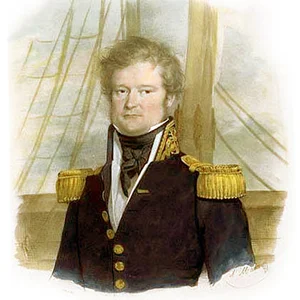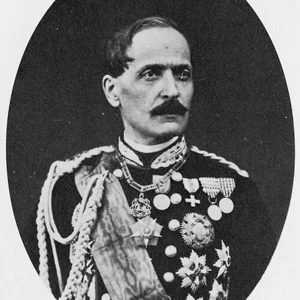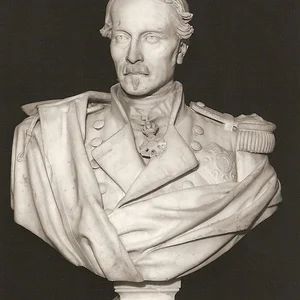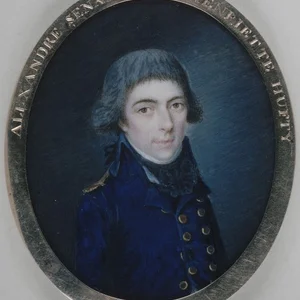

An artillery general of the First Empire, Hureau de Sénarmont distinguished himself at Jena and Friedland through his innovative offensive artillery tactics. He was killed at the Battle of Zaragoza in 1809.
Alexandre-Antoine Hureau de Sénarmont(1769 — 1810)
Alexandre-Antoine Hureau de Sénarmont
France
8 min read
Frequently asked questions
Key Facts
- 1769: born in Strasbourg
- 1806: distinguished himself at the Battle of Jena with a bold artillery charge
- 1807: played a decisive role at the Battle of Friedland with his massed artillery tactics
- 1809: killed during the Siege of Zaragoza, Spain
Works & Achievements
Sénarmont advanced his 38 cannons in successive echelons to within 60 paces of the Russian lines, pioneering a doctrine of short-range offensive artillery that revolutionized the use of field artillery across all European armies.
During the Prussian campaign, Sénarmont deployed his batteries with unprecedented mobility and aggression, contributing decisively to the collapse of the Prussian army in a single day of fighting.
Sénarmont restructured the tactical and logistical organization of the artillery under his command, improving the speed of battery deployment, coordination with the infantry, and ammunition management during battle.
Sénarmont adapted his field methods to the demands of urban combat and methodical siege warfare, overseeing heavy artillery operations against the ramparts and barricades of the Spanish city until his death in action.
Anecdotes
At the Battle of Friedland, on June 14, 1807, Sénarmont achieved one of the most audacious artillery feats of the Napoleonic era. He advanced his 38 guns in successive bounds, from 600 meters to within roughly 60 paces of the Russian lines, under enemy fire. This offensive close-range deployment, entirely contrary to the prevailing doctrine of keeping cannons out of harm's way, caused a complete rout of the Tsar's army and decided the French victory.
At the Battle of Jena in October 1806, Sénarmont committed his batteries to positions his fellow officers considered suicidal, far too exposed to Prussian counter-battery fire. His absolute composure under fire and his ability to direct his gun crews with precision at the height of the fighting earned him a personal commendation from Napoleon and contributed to the collapse of the Prussian army in a single day.
Sénarmont was known for refusing any preferential treatment over his men. In bivouac, he often slept under the same canvas as his non-commissioned officers rather than in a general's tent, and made sure his artillerymen received their rations before his own. This closeness to the ranks, unusual for a general of his standing, earned him extraordinary loyalty and devotion from his gun crews.
During the Siege of Zaragoza, Sénarmont regularly exposed himself in the open to personally direct the fire of his batteries against the city's fortifications. It was during one such reconnaissance that the courageous recklessness that had made his reputation proved fatal: struck by an enemy projectile, he died of his wounds, embodying to the last his principle of leading from the front.
After Friedland, European military men — including Napoleon's adversaries — studied Sénarmont's artillery charge with fascination. Prussian and Russian manuals after 1807 incorporated specific chapters on offensive short-range artillery, acknowledging that this obscure French general had invented a new doctrine that would transform the role of artillery on the battlefields of the 19th century.
Primary Sources
General Sénarmont, at the head of the artillery of the first corps, advanced with remarkable resolve and brought his guns to pistol range of the Russian battalions, whose fire was silenced by this bold maneuver.
You will inform the army that General Sénarmont rendered services of a superior nature at Friedland, and that his conduct should be held up as an example to all artillery officers.
I saw with my own eyes General Sénarmont advance his cannons at a walk, as though he were maneuvering on a training ground, while enemy grapeshot mowed down his gun crews; never have I witnessed such composure under fire.
I have the honor of informing you that Brigadier General Sénarmont, commanding the siege artillery, was mortally struck while personally directing the fire of his batteries against the ramparts of the city.
Key Places
The city where Sénarmont was born in 1769, a crossroads between France and the German states, and a traditional recruiting ground for the French Rhine artillery. Its border environment gave him an early awareness of military realities.
The site of Napoleon's victory over Prussia on 14 October 1806, where Sénarmont deployed his batteries with a boldness that caught the Emperor's attention, foreshadowing his future exploits.
The scene of the French victory over Russia on 14 June 1807, where Sénarmont led his bold offensive artillery charge at point-blank range — a feat that entered every European military textbook.
The Spanish city besieged by French forces in 1808–1809, scene of a fierce and heroic resistance. It was before its walls that Sénarmont was mortally wounded while personally directing the fire of his batteries.
A premier military institution where French artillery officers were trained. Sénarmont received there a rigorous technical and scientific education — ballistics, mathematics, logistics — that laid the foundation for his future tactical innovations.
Typical Objects

Artillery piece standardized by General Gribeauval under the Ancien Régime and used extensively during the Empire. Sénarmont made this 12-pound cannon the spearhead of his offensive charges, most notably at Friedland where his 38 guns advanced to pistol range of the Russian lines.

Portable optical instrument used by artillery officers to observe enemy positions, identify targets, and adjust fire at range. Sénarmont used it from the front line, often under fire, to personally direct his batteries.

Regulation sidearm carried by general officers of the Empire, serving both as a badge of rank and a weapon of last resort. In the artillery, it was a symbol of command authority far more than an instrument of close combat.

Detailed cartographic representation of terrain including relief, roads, and positions, essential for Sénarmont when selecting battery emplacements and planning his offensive artillery movements before each battle.

Sturdy frame on which the gun barrel rested, enabling transport by draft horses and vertical aiming. Gribeauval's improvements to gun carriages — making them lighter and more durable — had made possible the rapid mobility that Sénarmont exploited to such effect.

Dark blue uniform embroidered in gold on the black facings and epaulettes, distinctive of the Grande Armée's artillery corps. It marked the officer's presence to his gun crews on the battlefield and symbolized membership in the imperial army's technical elite.
School Curriculum
Vocabulary & Tags
Key Vocabulary
Daily Life
Morning
Sénarmont's day began before dawn, as was customary in the imperial artillery. He personally inspected his guns, checked the state of the ammunition and the condition of his draft horses, on which the entire mobility of his batteries depended. He held his staff meetings very early to plan the day's movements before the first shots rang out.
Afternoon
The afternoon was devoted to terrain reconnaissance, telescope in hand, to identify favorable positions for the batteries and observe enemy movements. On active campaign, he rode in the front line, exposed to the same danger as his gun crews. He also dedicated time to training his non-commissioned officers, emphasizing speed of maneuver and accuracy of aim.
Evening
In the evening, Sénarmont wrote his reports to the high command and studied maps by candlelight to anticipate the next day's positions. He often shared the bivouac of his artillerymen around the campfires, preferring this closeness to the isolation of a distant headquarters. Maintenance of the gun carriages and counting the remaining powder charges also occupied his campaign evenings.
Food
Like all officers of the Grande Armée on campaign, Sénarmont subsisted on a frugal and unpredictable diet: hardtack, salt or smoked meat, vegetables requisitioned from villages along the way, and army-issue brandy. In winter quarters, the fare improved with fresh bread, roasted meat, and local wine. The artilleryman's ration included an extra portion to compensate for the intense physical effort of serving the guns.
Clothing
On duty, Sénarmont wore the regulation uniform of a brigadier general of artillery: a blue coat with black lapels embroidered in gold, epaulettes with gold fringe, white breeches, and riding boots. In the field, he often donned a grey greatcoat to protect himself from the elements. He sported the bicorne hat in the French style and the insignia of the Légion d'honneur established by Napoleon in 1804.
Housing
On campaign, Sénarmont lodged in a campaign tent or requisitioned a farmhouse in villages along the route, as was customary for general officers. His field headquarters amounted to a few trunks containing maps, sighting instruments, and military correspondence. In garrison between campaigns, he had official quarters in the cantonment town of his army corps.
Historical Timeline
Period Vocabulary
Liens externes & ressources
Références
Œuvres
Charge d'artillerie offensive à Friedland
14 juin 1807
Engagement d'artillerie à Iéna
14 octobre 1806
Réorganisation de l'artillerie du 1er corps de la Grande Armée
1806-1807