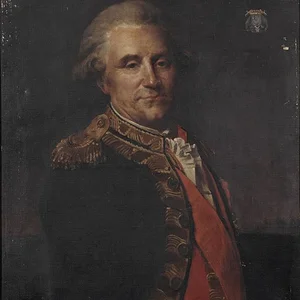

French admiral born in 1733, he distinguished himself during the American War of Independence before becoming Minister of the Navy under the Revolution (1791-1792). A senator under the Napoleonic Empire, he embodies the continuity between the Old Regime's naval tradition and the revolutionary institutions.
Antoine-Jean-Marie Thévenard(1733 — 1815)
Antoine-Jean-Marie Thévenard
France
9 min read
Frequently asked questions
Key Facts
- Born on July 2, 1733, in Saint-Malo
- Took part in the American War of Independence alongside the insurgents (1778-1783)
- Appointed Minister of the Navy and Colonies from 1791 to 1792 under the Revolution
- Elevated to the rank of senator under the Consulate and the Napoleonic Empire
- Died on March 13, 1815, on the eve of the Hundred Days
Works & Achievements
As Minister of the Navy under the Legislative Assembly, Thévenard attempted to preserve the operational cohesion of the French fleet in the face of the mass departure of émigré officers and the growing insubordination of revolutionary crews.
Thévenard took part in French naval operations in support of the American insurgents, commanding vessels in the Atlantic and the Caribbean and contributing to maritime pressure on Great Britain.
Over more than forty years of active service, Thévenard rose through every rank of the naval hierarchy to the grade of flag officer, taking part in the colonial wars and European conflicts of the second half of the eighteenth century.
Appointed senator under the First Empire, Thévenard sat in the Napoleonic upper chamber, embodying the continuity between the naval institutions of the Ancien Régime and the new political structures born of the Revolution.
Anecdotes
Born in Saint-Malo in 1733, Thévenard grew up in a city of privateers and sailors where the smell of tar and the clamor of shipyards shaped his childhood. This city of Duguay-Trouin instilled in him an early maritime vocation, and he joined the Royale as a teenager, following a path laid down by generations of Breton sailors.
During the American War of Independence (1778–1783), Thévenard commanded several ships and took part in naval operations in the Atlantic and the Caribbean, alongside the French squadron supporting the American insurgents. These campaigns earned him recognition from his superiors for his composure and leadership qualities during engagements against the British Royal Navy.
Appointed Minister of the Navy in October 1791 under the Legislative Assembly, Thévenard faced an explosive situation: the officers of the Royale, many of them from the nobility, had emigrated en masse, leaving the French fleet without experienced officers. He strove to maintain the discipline and operational coherence of a corps decimated by the revolutionary wave — a nearly insurmountable challenge.
After his brief stint as minister (he left the post in March 1792), Thévenard navigated the years of the Terror with remarkable caution, avoiding the guillotine that claimed so many officers of the Ancien Régime. His discretion allowed him to survive where colleagues with comparable service records perished, illustrating how navigating the revolutionary political waters required as much skill as the Atlantic storms.
Under the Consulate and then the Empire, Napoleon recognized the value of this seasoned sailor-administrator by appointing him senator. Thévenard thus embodied the continuity of the French state: born under Louis XV, an officer under Louis XVI, a minister under the Revolution, he now sat in the imperial Senate — spanning half a century of upheaval without ever losing the regard of those in power.
Primary Sources
The letters and circulars addressed by Thévenard to the commanders of the ports of Brest, Rochefort, and Toulon between October 1791 and March 1792 document his efforts to maintain discipline and manage the vacant posts resulting from the emigration of noble officers.
Thévenard's service records trace his successive campaigns from his entry into the Royale, his successive ranks and commands, including his missions during the American War (1778-1783).
The session registers of the Imperial Senate record Thévenard's attendances and votes among the senators of the Napoleonic Empire, attesting to his institutional role under the Napoleonic regime.
The reports transmitted by the Ministry of the Navy to the Legislative Assembly during Thévenard's tenure reflect the state of the French fleet and the difficulties in recruiting officers to replace those who had emigrated.
Key Places
A Breton corsair city where Thévenard was born in 1733. A historic port with a deep maritime tradition, it shaped generations of sailors and officers of the Royale, including Thévenard himself, who grew up steeped in the culture of privateering and maritime trade.
The main arsenal and base of the French Royal Navy, Brest was the home port for many of Thévenard's campaigns. It was here that expeditions to the Americas were planned, ships of the line fitted out, and the crews of the Royale trained.
The seat of the Ministry of the Navy, located on the Place de la Révolution (formerly the Place Louis XV, now the Place de la Concorde), where Thévenard served as minister from October 1791 to March 1792. This building housed the central administration of the entire French fleet.
Thévenard sailed in Caribbean waters during the naval operations of the American War of Independence (1778–1783). These islands were major strategic prizes contested between France and Britain, and the scene of significant naval engagements.
The seat of the Conservative Senate of the Napoleonic Empire, where Thévenard served as a senator. This palace symbolized the upper institution that ratified the acts of imperial power, and where the notables who had rallied to Napoleon gathered.
Typical Objects

An indispensable optical instrument for every officer of *la Royale*, the spyglass allowed them to scan the horizon, spot enemy vessels, and read flag signals. Thévenard used one daily during his sea commands to assess the tactical situation.

Produced by the *Dépôt des cartes et plans de la Marine*, these charts depicted coastlines, seabeds, and navigable routes. Essential for planning naval campaigns and avoiding hazards, they were the fundamental working tool of every admiral.

The blue coat with red facings and gold braid distinguished flag officers of *la Royale*. Under the *Ancien Régime*, it marked membership in the royal military elite; during the Revolution, its insignia were modified to erase monarchical symbols, before being reformed under the Empire.

A navigation instrument used to measure the altitude of celestial bodies in order to calculate a ship's position at sea. Introduced in the 18th century, it revolutionized deep-sea navigation and was standard equipment on all ships of *la Royale* during Thévenard's transatlantic campaigns.

The gold-hilted sword was both the symbolic and actual weapon of the officer of *la Royale*, worn in all circumstances while in uniform. It represented military honor and rank; during boarding actions, it could become a genuine weapon of combat.

During his tenure as Minister of the Navy (1791–1792), Thévenard drafted and signed numerous circulars organizing naval administration in the midst of the revolutionary crisis: officer appointments, arsenal provisioning, and disciplinary regulations for crews stirred up by the new revolutionary ideas.
School Curriculum
Vocabulary & Tags
Key Vocabulary
Daily Life
Morning
Aboard a ship of the line, the flag officer rose before dawn to attend the morning watch maneuvers and inspect the state of the vessel before receiving reports from his lieutenants. Ashore, during his Parisian ministry, Thévenard sorted through dispatches that had arrived overnight from the maritime prefects of Brest, Rochefort, and Toulon, separating urgent matters from less pressing ones.
Afternoon
At sea, the afternoon was devoted to artillery drills and squadron maneuvers — essential for maintaining crew efficiency and testing the tacticians. As minister, he received officers reporting for duty, arsenal suppliers, and port delegations, presiding over councils to settle urgent supply and appointment issues.
Evening
At sea, the admiral kept table with his senior officers, an occasion for discussions about upcoming operations and for maintaining morale within the staff. In Paris under the Revolution and then the Empire, the minister's or senator's evenings were spent at dinners with government colleagues and social receptions where political affairs were quietly transacted.
Food
A flag officer's table was far better supplied than that of ordinary sailors: at sea, he enjoyed fresh provisions at departure (meats, wines, cheeses), which gave way to preserved stores on long voyages (hardtack, salt meat, dried pulses). In Paris, he lived on refined bourgeois fare: roasts, stews, market vegetables, and wines from Bordeaux or Burgundy.
Clothing
On active service, Thévenard wore the blue uniform with gold braid and epaulettes of the Royal Navy, modified during the Revolution to remove monarchical emblems. As minister, he donned the official embroidered coat with the dress sword; as an imperial senator, he wore at ceremonies the grand costume of crimson velvet and gold prescribed by Napoleonic ceremonial.
Housing
During his active naval career, Thévenard divided his time between the commander's quarters aboard ships and official lodgings in the arsenals. Appointed minister, he resided in Paris in a private mansion suited to his office; as a senator of the Empire, he received an endowment that allowed him to maintain a proper Paris residence, between occasional visits to his Breton roots.
Historical Timeline
Period Vocabulary
Liens externes & ressources
Références
Œuvres
Carrière militaire dans la Marine royale
1749-1792
Mandat de sénateur de l'Empire
1804-1814
Rechercher
See also
Related Characters
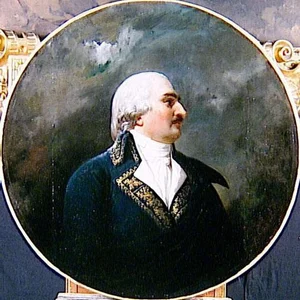
Auguste Marie Henri Picot de Dampierre
1756 — 1793
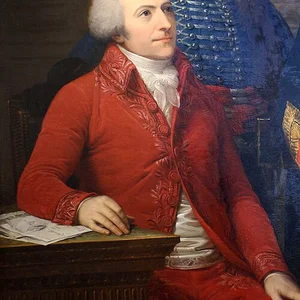
Claude-Louis Petiet
1749 — 1806
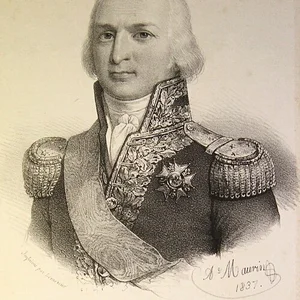
Justin Bonaventure Morard de Galles
1741 — 1809
Lazare Carnot
1753 — 1823
François Séverin Marceau
1769 — 1796
Jean-Paul Marat
1743 — 1793