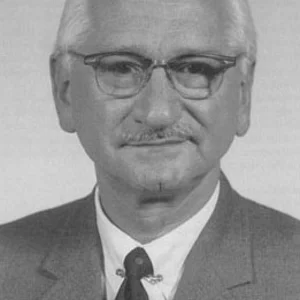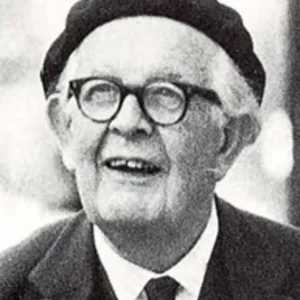

Jean Piaget was a Swiss psychologist, biologist, and epistemologist, the founder of developmental psychology and genetic epistemology. His work on the stages of children's intellectual development profoundly reshaped pedagogy and the educational sciences in the twentieth century.
Jean Piaget(1896 — 1980)
Jean Piaget
Suisse
6 min read
Frequently asked questions
Famous Quotes
« Intelligence is not what you know but what you do when you don't know.»
Key Facts
- Born in 1896 in Neuchâtel, Switzerland, he published his first scientific work on mollusks while still a teenager.
- From the 1920s onward, he developed a theory of the stages of children's cognitive development (sensorimotor, preoperational, concrete operational, and formal operational).
- In 1955 he founded the International Center for Genetic Epistemology in Geneva.
- He authored numerous works, including *The Language and Thought of the Child* (1923) and *The Origins of Intelligence in Children* (1936).
- He died in 1980 in Geneva, and his work has had a lasting influence on pedagogy and the educational sciences.
Works & Achievements
His first major work, which reveals the existence of an “egocentric” mode of thinking specific to the child. It made him famous around the world.
A study of how the child explains the world, often attributing life or intention to objects and to the stars (childhood animism).
An analysis of the very first stage of intelligence, known as the sensorimotor stage, based on the observation of his own babies.
A synthesis of his theory presenting intelligence as a form of adaptation and laying out the major stages of development.
A model explaining that the child passes through successive stages (sensorimotor, preoperational, concrete operational, formal). It profoundly transformed teaching.
The creation in Geneva of an interdisciplinary research center studying how knowledge is built. There he brought together researchers from all over the world.
Piaget directed this Geneva-based organization for nearly forty years; it later became part of UNESCO. There he defended the right of all children to an education.
Anecdotes
A precocious child, Piaget published a short scientific note at just 11 years old, in 1907, about an albino sparrow he had observed in a park in Neuchâtel. This one-page text was his very first published article, a sign of a very early passion for natural history.
As a teenager, he developed a passion for mollusks and became a recognized specialist in shells. At 15, a museum curator offered him a job, unaware that he was addressing a high-school student! Piaget had to decline in order to finish his studies.
It was while giving intelligence tests to children, in Alfred Binet's laboratory in Paris, that Piaget had a revelation: he became less interested in the correct answers than in the children's mistakes, because these revealed a way of thinking different from that of adults.
Piaget meticulously observed his own three children, Jacqueline, Lucienne, and Laurent, noting all their gestures and reactions. These family observations fed his great theories about the earliest stages of a baby's intelligence.
To study children's logic, Piaget would show children two identical glasses of water, then pour one into a narrower, taller glass. The youngest ones would then believe there was “more water”: this famous experiment on the conservation of quantities has become a classic of psychology.
Primary Sources
The child does not speak only for others, but also for himself in all sorts of ways: he thinks aloud.
Intelligence begins neither with knowledge of the self nor with knowledge of things as such, but with knowledge of their interaction.
Intelligence is an adaptation. To grasp its relationship with life in general is to understand how it extends biological adaptations.
For the young child, the sun and the moon follow us on our walks: everything in nature seems made and conceived for the sake of human beings.
Key Places
Swiss city where Jean Piaget was born in 1896 and where he studied natural sciences. It is there that he published his first works on mollusks.
City where Piaget spent most of his career, at the Jean-Jacques Rousseau Institute and later at the University. He died there in 1980.
French capital where Piaget worked around 1920 in Alfred Binet's laboratory, administering tests to children. This experience determined his calling.
Geneva center for educational sciences where Piaget was recruited in 1921 by Édouard Claparède. There he developed his research on children's thinking.
One of the Swiss universities where Piaget taught psychology and sociology during his career. He held several chairs simultaneously.
Typical Objects

Notebooks in which Piaget meticulously recorded the behaviors and responses of children, especially his own. They were his raw scientific material.

Containers of different sizes used to test whether a child understands that the quantity of liquid does not change when it is poured from one to another. An emblematic object of his experiments.

Shells and snails that Piaget collected and classified from his teenage years onward. His passion as a naturalist shaped his biological view of intelligence.

Piaget smoked a pipe constantly, and it became a recognizable feature of his scholarly figure. He was rarely seen without it during his lectures.

A cap that Piaget often wore, contributing to his familiar image as a professor. Along with his white hair and his pipe, the beret was part of his distinctive look.

Piaget loved to cycle and walk in nature, true to his naturalist roots. His mountain walks were an important time for reflection.
School Curriculum
Vocabulary & Tags
Key Vocabulary
Daily Life
Morning
An early riser, Piaget got up at dawn to write alone in the quiet, often as early as four in the morning. He would write several pages of his books before classes began.
Afternoon
His afternoons were devoted to teaching at the university, to research meetings, and above all to interviews with children. He questioned them patiently to understand the way they reasoned.
Evening
In the evening, Piaget read, exchanged ideas with colleagues, and reread his observation notes. He also set aside time for his family and for scientific discussion.
Food
Like many Swiss people of his time, he had a simple and regular diet, based on bread, cheese, soups, and dairy products. He enjoyed modest meals that did not disturb his concentration.
Clothing
Piaget wore the plain suits of a professor, completed by his famous beret and his pipe. With his tousled white hair, he presented the reassuring image of the old scholar.
Housing
He lived in Geneva in comfortable middle-class lodgings, near the university. A lover of the mountains, he regularly spent his summers in the Alps to write and to take walks.
Historical Timeline
Period Vocabulary
Liens externes & ressources
Références
Œuvres
Le langage et la pensée chez l'enfant
1923
La représentation du monde chez l'enfant
1926
La naissance de l'intelligence chez l'enfant
1936
La psychologie de l'intelligence
1947
Fondation du Centre international d'épistémologie génétique
1955
Direction du Bureau international d'éducation
1929-1968