
Jean Tinguely (1925–1991) was a pioneering Swiss sculptor of kinetic art and the Nouveau Réalisme movement. His famous absurd machine-sculptures, such as the Méta-Matics, questioned industrial society and the role of the machine in art.
Jean Tinguely(1925 — 1991)
Jean Tinguely
Suisse
9 min read
Frequently asked questions
Famous Quotes
« Movement is the only permanent thing.»
Key Facts
- Born in Fribourg (Switzerland) in 1925
- Created the Méta-Matics (drawing machines) in 1959
- Joined the Nouveau Réalisme movement founded by Pierre Restany in 1960
- Created Homage to New York, a self-destructing sculpture at MoMA, in 1960
- Died in Berne in 1991; the Tinguely Museum in Basel is dedicated to him
Works & Achievements
A series of motorized drawing machines presented in Paris, capable of automatically producing abstract drawings. They radically challenged the notion of the unique artwork, the artist's signature, and creative genius.
A self-destroying sculpture presented in the garden of MoMA in New York, built from scrap metal, a piano, and a bathtub, which destroyed itself in twenty-seven minutes before a live audience. A founding event of ephemeral art and performance.
A second large-scale self-destroying sculpture, staged in the Nevada desert and filmed live for American television. It cemented the spectacular and media-driven dimension of Tinguely's artistic approach.
A large kinetic sculpture presented at the Venice Biennale to represent Switzerland. It marked Tinguely's international consecration and his entry into the world's major artistic institutions.
A monumental collaborative work standing 22 meters tall, installed in the forest of Milly-la-Forêt (Essonne) and created with Niki de Saint Phalle and other artists over more than twenty years. It stands as Tinguely's most ambitious artistic testament.
A monumental fountain installed on the Place Igor-Stravinsky in Paris, created in collaboration with Niki de Saint Phalle. Its sixteen mobile, colorful sculptures pay tribute to the composer's work and have become an emblem of public art in the urban landscape.
A monumental sculpture evoking the *Danse macabre*, created in reference to the Nazi war criminal Josef Mengele. One of Tinguely's darkest and most politically committed works, reflecting his meditation on death and the barbarity of the twentieth century.
Anecdotes
On March 17, 1960, Tinguely installed a giant sculpture called 'Homage to New York' in the garden of the Museum of Modern Art in New York, designed to destroy itself. The machine, assembled from salvaged parts, produced a chaotic spectacle of noise, smoke, and flames for twenty-seven minutes before firefighters were forced to intervene. The event made front-page news across America and established Tinguely as a major figure of the international avant-garde.
In 1959, Tinguely hired a plane to fly over Düsseldorf and drop 150,000 tracts printed on yellow paper from the air. This manifesto, titled 'Für Statik' ('For Statics'), called on artists to abandon static art and embrace movement and impermanence. It remains one of the most spectacular gestures of postwar avant-garde art.
His Méta-Matics — drawing machines first presented in July 1959 at the Galerie Iris Clert in Paris — allowed visitors to feed in a sheet of paper and receive a mechanically produced 'abstract' drawing. Tinguely had the mischievous idea of signing some of these drawings, and they sold to collectors, serving as a sharp critique of the speculation surrounding informal art.
In 1983, Tinguely created the Stravinsky Fountain with his partner Niki de Saint Phalle, installed on Place Igor-Stravinsky in Paris, beside the Centre Pompidou. The sixteen colorful, moving sculptures — blending humor with homage to the composer — immediately became a popular attraction worldwide. The project perfectly embodies the artistic and romantic collaboration that bound the two artists for more than thirty years.
Tinguely was renowned for his 'scrap hunts' in junkyards and along roadsides, collecting bicycle wheels, springs, gears, and worn-out electric motors. He liked to say that the materials he used had already 'lived' — that they carried their own history and energy. His workshop in Soisy-sur-École, in the Paris region, looked far more like a mechanic's garage than a traditional artist's studio.
Primary Sources
Stop resisting change and take part in it. Stop painting time. Live in time. Be in movement. Be the movement.
The Nouveaux Réalistes have become aware of their collective singularity. Nouveau Réalisme = new perceptual approaches to the real.
I want the machine to be free, to make mistakes, to be human. A machine that always succeeds is boring. I wanted it to be imperfect, to struggle, to die.
Movement is the only form of honesty in art today. Everything that is static is false. Life is movement, death is stillness.
Key Places
Jean Tinguely's birthplace, born on May 22, 1925 in this bilingual French-German-speaking city. His working-class childhood gave him a direct, unselfconscious relationship with machines and industrial materials.
The school where Tinguely received his artistic training from 1941 to 1945. There he discovered Dadaism, met his first mentors, and developed his passion for formal experimentation in a Swiss environment highly receptive to the avant-garde.
Tinguely settled in Paris in 1953 and spent the greater part of his career there. The French capital was the setting for his landmark exhibitions, his meeting with Niki de Saint Phalle, and his integration into the circles of Nouveau Réalisme.
Place Igor-Stravinsky, next to the Centre Pompidou, where the fountain created by Tinguely and Niki de Saint Phalle in 1983 stands. Its sixteen moving, colorful sculptures are today one of the most photographed works of public art in the world.
The site where Tinguely set up his studio at Soisy-sur-École and embarked on the titanic project of *Le Cyclop* from 1969 onward. This monumental sculpture, 22 meters tall and created with several artists including Niki de Saint Phalle, stands as his artistic testament.
A museum inaugurated in October 1996 in Basel, designed by architect Mario Botta on the banks of the Rhine. It houses the world's largest collection of Tinguely's kinetic sculptures and serves as the principal memorial to his work.
Typical Objects

A motorized drawing machine built from salvaged parts that automatically produces abstract drawings on paper. It invites viewers to participate by inserting their own sheet of paper, challenging the notion of creative genius.

A used motor retrieved from junkyards or industrial workshops, the basic building block of nearly all of Tinguely's kinetic sculptures. It is the beating heart of the machine-sculpture, giving it life and movement.

An iconic element of Dada assemblage (borrowed from Duchamp) incorporated into Tinguely's sculptures as a gear or moving component. It symbolizes the recycling of industrial culture and the blurring of boundaries between art and everyday life.

Springs, gears, pipes, and metal plates collected from junkyards and construction sites make up the raw material of all of Tinguely's work. In his hands, these industrial cast-offs become a noble medium charged with memory.

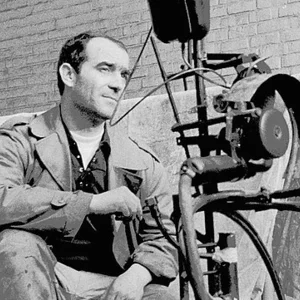
The main tool of Tinguely's studio practice, used to join salvaged metal parts into complex structures. Welding sits at the heart of his everyday sculptural work.

A manifesto printed on yellow paper, dropped in 150,000 copies from an airplane over Düsseldorf in 1959. The document calls for moving beyond static art in favour of perpetual motion and impermanence.
School Curriculum
Vocabulary & Tags
Key Vocabulary
Daily Life
Morning
Tinguely rose early and began his day with an inspection of his studio, overrun with metal parts. He would often head out alone on 'scrap-hunting' expeditions to nearby junkyards and flea markets, returning with arms full of motors, springs, and gears. This ritual of collecting was, for him, as fundamental as the creative work itself.
Afternoon
Afternoons were devoted to studio work: torch welding, mechanical assembly, and fine-tuning motorized mechanisms. Tinguely often worked under artificial light, surrounded by the noise of running engines and the smell of heated metal, oblivious to the passing hours. He occasionally received visitors — journalists or collectors — without ever truly interrupting his labor.
Evening
In the evenings, Tinguely was often out attending openings or cultural events in Paris. A man who embraced life to the full, he relished lively conversations in cafés and artists' studios, keeping company with Yves Klein, Arman, and Niki de Saint Phalle. He would sometimes work late into the night, swept up in the energy of an ongoing project.
Food
Tinguely had an unstructured lifestyle and often ate on the go between welding sessions. He appreciated simple, unpretentious food and meals taken in good company at Parisian bistros. He was known for his generosity at the table, readily inviting collaborators and friends to share informal meals at the studio.
Clothing
Tinguely most often wore overalls or worn-out clothes stained with grease and weld marks. His unkempt appearance stood in stark contrast to the upscale openings he sometimes attended in his work clothes. This outfit was both practical and a deliberate assertion of his identity as an artist-worker.
Housing
Tinguely long lived in hybrid spaces that blurred the line between studio and home, notably in Soisy-sur-École in the Paris region. His living quarters were overrun with machines, spare parts, and works in progress, the boundary between private life and creation having been deliberately erased. Later, he shared studios and residences with Niki de Saint Phalle, splitting his time between France and Switzerland.
Historical Timeline
Period Vocabulary
Liens externes & ressources
Références
Œuvres
Méta-Matics
1959
Le Cyclop
1969–1994