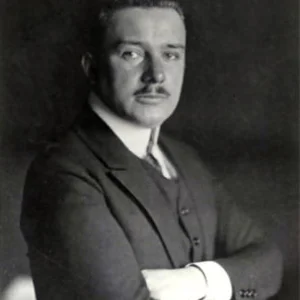

Austrian architect and co-founder of the Vienna Secession, Olbrich is one of the masters of Art Nouveau. He designed the Secession Building in Vienna (1897–1898) and went on to develop an artists' colony in Darmstadt from 1899.
Joseph Maria Olbrich(1867 — 1908)
Josef Maria Olbrich
grand-duché de Hesse, Cisleithanie
7 min read
Frequently asked questions
Key Facts
- 1867: born in Troppau (Opava, in present-day Czech Republic)
- 1897: co-founded the Vienna Secession with Gustav Klimt and Josef Hoffmann
- 1897–1898: designed the Secession Building in Vienna, an iconic landmark of Art Nouveau
- 1899: invited by Grand Duke Ernst Ludwig to Darmstadt to create the Mathildenhöhe artists' colony
- 1908: died prematurely in Düsseldorf at the age of 40
Works & Achievements
Iconic building of the Viennese Secessionist movement, with its golden laurel dome and geometric white façade adorned with plant motifs. Designed in under a year by a 30-year-old architect, it immediately drew 57,000 visitors to its first exhibition.
Central building of the Mathildenhöhe artists' colony, serving as a collective workspace for the artists invited by the Grand Duke. Olbrich applied the principle of *Gesamtkunstwerk* here to an avant-garde communal architecture.
Olbrich's personal residence at the Mathildenhöhe, conceived as a living manifesto of his aesthetic principles. It combines a fully decorated interior, bespoke furniture, and a harmoniously integrated garden.
One of the private villas of the Darmstadt colony, commissioned by merchant Julius Glückert. A remarkable example of Olbrich's style applied to bourgeois residential architecture, combining comfort and Art Nouveau ornamentation.
A private villa in the outskirts of Vienna and one of Olbrich's first major residential commissions. It demonstrates his early mastery of Art Nouveau aesthetics applied to the bourgeois home.
Olbrich's last major project, commissioned to celebrate the wedding of Grand Duke Ernst Ludwig. Its five distinctive "fingers" have made it the symbol of the city of Darmstadt; the entire Mathildenhöhe complex was inscribed as a UNESCO World Heritage Site in 2021.
Anecdotes
At just 30 years old, Olbrich designed the Secession Building in Vienna in 1897–1898. The building, crowned with a dome of 3,000 gilded wrought-iron laurel leaves, was immediately nicknamed “the golden cabbage” by the ironic Viennese. Yet this bold work became the international symbol of artistic renewal in the face of official academicism.
Above the entrance of the Secession Building, Olbrich had the movement’s founding motto engraved: “Der Zeit ihre Kunst, der Kunst ihre Freiheit” — “To every age its art, to every art its freedom.” Proposed by the critic Ludwig Hevesi, this phrase summed up the ambition of the Secessionists, who refused the rules imposed by the Viennese artistic establishment.
In 1899, Grand Duke Ernst Ludwig of Hesse invited Olbrich to Darmstadt to build an artists’ colony on the Mathildenhöhe hill. Olbrich designed nearly all of its buildings, transforming an ordinary hillside into a laboratory of modern art. The inaugural exhibition of 1901, “Ein Dokument deutscher Kunst,” attracted visitors from across Europe and established Olbrich as a leading figure of the new architecture.
The Wedding Tower (Hochzeitsturm) in Darmstadt, Olbrich’s last major work, was inaugurated on June 24, 1908. Less than two months later, on August 8, Olbrich died of leukemia in Düsseldorf, at just 40 years old. This tower with its characteristic five-fingered crown, inscribed on the UNESCO World Heritage List in 2021, remains the city’s emblem and its creator’s architectural testament.
Primary Sources
A collection of drawings and architectural projects published by Olbrich himself, presenting his villas, interiors, and ornamental decorations, accompanied by brief notes on his artistic intentions and his relationship to plant-based forms.
A monthly arts journal to which Olbrich contributed drawings and decorative projects. It proclaimed: "We recognize no distinction between high art and minor art, between art for the rich and art for the poor."
The official catalogue of the inaugural exhibition of the Darmstadt Artists' Colony, in which Olbrich presents his houses and his principles of the Gesamtkunstwerk as applied to residential and community architecture.
A serial publication of Olbrich's major projects, gathering plans, elevations, and photographs of his Viennese and Darmstadt works, distributed among professional circles across Europe.
Key Places
Olbrich's birthplace, a major industrial and cultural city in Austrian Silesia. He spent his childhood there before moving to Vienna to study architecture.
Olbrich's masterpiece, completed in 1898, and the headquarters of the Viennese Secession movement. Still standing today, it is one of the most iconic monuments of European Art Nouveau and continues to host contemporary art exhibitions.
The hill where Olbrich began building an artists' colony in 1899, commissioned by Grand Duke Ernst Ludwig of Hesse. There he created the Ernst Ludwig House, his own studio-home, and the Wedding Tower — an ensemble inscribed on the UNESCO World Heritage List in 2021.
The institution where Olbrich received his architectural training before joining Otto Wagner's studio, where he was introduced to the principles of an architecture that was both functional and ornamental.
The city where Olbrich died on 8 August 1908 from leukemia while overseeing construction projects. He was buried there before his remains were transferred to Darmstadt.
Typical Objects

Precision instruments essential to Olbrich's daily work for drawing blueprints and finalizing his ornamental designs. He used them to conceive his façades with their characteristic Art Nouveau curves.

A spherical structure composed of 3,000 gilded wrought-iron laurel leaves, crowning the Secession Building in Vienna. A symbol of Secessionist artistic triumph, it earned the building its popular nickname "the golden cabbage."

The monthly publication of the Vienna Secession (1898–1903), to which Olbrich contributed decorative drawings. Blending poetry, graphic arts, and architecture, it spread the ideals of Austrian *Jugendstil* across educated Europe.

Olbrich personally designed the furniture, lighting fixtures, and decorative objects for the Darmstadt houses, applying the principle of *Gesamtkunstwerk*: architecture, decoration, and furnishings form a coherent, indivisible whole.

Olbrich built plaster or cardboard models to present his projects to clients and verify the harmony of volumes before construction. These three-dimensional models allowed him to validate the overall aesthetic coherence of each design.
School Curriculum
Vocabulary & Tags
Key Vocabulary
Daily Life
Morning
Olbrich began his day early at his drafting table, making the most of natural light to work on his blueprints and ornamental designs. In Darmstadt, he often supervised the Mathildenhöhe construction sites from the early hours, conferring with craftsmen to ensure the precision of every decorative detail.
Afternoon
Afternoons were devoted to meetings with the other artists of the colony — painters, sculptors, goldsmiths — to coordinate all the works in the spirit of the Gesamtkunstwerk. Olbrich regularly visited the construction sites to verify that the building work faithfully adhered to his drawings, imposing his exacting standards on workers and contractors.
Evening
Evenings at the Darmstadt colony were often an opportunity for lively intellectual and artistic debates among the residents. Olbrich read European art and architecture journals — Ver Sacrum, Dekorative Kunst, Deutsche Kunst und Dekoration — and corresponded by letter with his Viennese patrons and colleagues to advance his projects from afar.
Food
Like most members of the cultivated Austro-German bourgeoisie of his era, Olbrich followed a hearty diet: rye bread, charcuterie, cheeses, vegetable soups, roasted meats, and light beers. In Darmstadt, he frequented the city's restaurants and cafés with the other colony artists during leisure time.
Clothing
Olbrich wore the bourgeois lounge suit of his era: a lapelled jacket, waistcoat, trousers, and tie. At official inaugurations or the Grand Duke's receptions, he donned formal attire. Unlike some Secessionist artists who affected provocative dress, he preferred an elegant but conventional appearance.
Housing
In Darmstadt, Olbrich lived in the studio-house he had himself designed on the Mathildenhöhe, a true manifesto of his aesthetic ideas. The spaces were adorned with vegetal motifs, stained glass, and custom-designed furniture, embodying in every respect the Gesamtkunstwerk he championed in his public projects.
Historical Timeline
Period Vocabulary
Liens externes & ressources
Références
Œuvres
Palais de la Sécession, Vienne
1897-1898
Maison Ernst Ludwig, Darmstadt
1901
Maison-atelier personnelle (Haus Olbrich), Darmstadt
1901
Maison Glückert, Darmstadt
1901
Villa Friedmann, Hinterbrühl
1898-1900
Tour des Noces (Hochzeitsturm), Darmstadt
1908