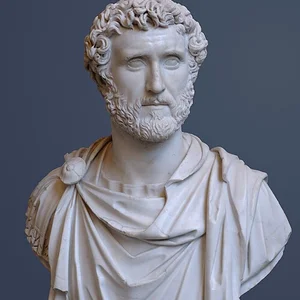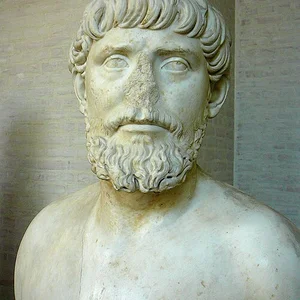

A Greek architect and engineer of Syrian origin, active under the emperor Trajan in the early 2nd century. The designer of Trajan's Forum and Trajan's Column in Rome, he was one of the greatest builders of Roman antiquity.
Apollodorus of Damascus(50 — 120)
Apollodorus of Damascus
Rome antique
6 min read
Frequently asked questions
Key Facts
- Born in Damascus (province of Syria), he became emperor Trajan's favourite architect around AD 100
- Designed the bridge over the Danube during the Dacian Wars (around AD 105), a feat of military engineering
- Built Trajan's Forum and the famous Trajan's Column in Rome (inaugurated in AD 113)
- Is also said to have worked on the Baths of Trajan and the odeon
- According to ancient tradition, he was exiled and then executed under Hadrian following a dispute
Works & Achievements
The longest bridge of antiquity, whose stone piers allowed the Roman armies to cross the river and conquer Dacia.
The largest imperial forum in Rome, a manifesto of Roman power at the height of its expansion.
A marble column nearly 30 metres high, decorated with a spiralling frieze depicting the Dacian Wars and housing an internal staircase.
A vast civic basilica in the Forum of Trajan, one of the largest roofed halls in Rome, devoted to justice and business.
A complex of brick-vaulted halls terraced into the hillside, often regarded as a distant ancestor of the shopping arcade.
Immense public baths on the Esquiline, a model of symmetrical layout later adopted by Rome's subsequent bathhouses.
A technical treatise on siege engines, attesting to Apollodorus's dual expertise as both a civil and military engineer.
Anecdotes
Apollodorus of Damascus designed a gigantic bridge over the Danube to allow Trajan's army to invade Dacia. More than a kilometre long, this bridge rested on enormous stone piers and was regarded as the greatest engineering feat of Roman antiquity.
According to the historian Cassius Dio, Apollodorus once rebuffed the future emperor Hadrian, then a young man, telling him to go back and tend to his 'pumpkins' rather than meddle in architecture. Hadrian supposedly never forgave him for this humiliation.
Again according to Cassius Dio, once he had become emperor, Hadrian sent Apollodorus the plans for his Temple of Venus and Roma to show that one could build without him. The architect frankly criticised the project, pointing out that the seated statues were too large for their niche: 'if the goddesses want to stand up, they will bump their heads'.
Apollodorus is credited with a military treatise, the 'Poliorcetica', addressed to an emperor, which describes siege machines: battering rams, mobile towers, assault bridges and incendiary devices intended to capture fortified cities.
Trajan's Column, which he designed, is hollow: a spiral staircase of 185 steps climbs up inside the marble shaft to the top, from which one could once survey the entire forum.
Primary Sources
Hadrian first banished Apollodorus the architect, then put him to death, on the pretext of some offense, but in reality because, in Trajan's time, when a project was being discussed, he had told him: “Go away and paint your gourds, for you understand nothing of these matters.”
Addressed to an emperor, the treatise describes the construction of battering rams, tortoises, rolling towers, and gangways for crossing walls and ditches.
Procopius mentions the stone bridge built over the Ister (the Danube) by Apollodorus of Damascus for the emperor Trajan, a work he describes as a marvel surpassing all the other achievements of that ruler.
Key Places
Great city of the Roman province of Syria, considered to be the birthplace of Apollodorus and a center of Hellenistic architecture.
The last and largest of the imperial forums, a masterpiece by Apollodorus comprising the Basilica Ulpia, two libraries and Trajan's Column.
A monumental bridge of stone and wood built near present-day Drobeta-Turnu Severin to carry the legions across into Dacia.
Capital of the Empire where Apollodorus spent most of his career in the service of Trajan, directing the city's greatest construction projects.
A complex of shops and offices tiered along the slope of the Quirinal, often attributed to Apollodorus and regarded as an ancestor of the shopping mall.
Typical Objects

Surveying instrument made of a horizontal cross fitted with plumb lines, used to lay out right angles and align streets, forums and foundations.

Architectural plan incised on a marble slab or drawn on papyrus, used as a reference for the construction of large public buildings.

A heavy beam capped with a metal head, sheltered beneath a wooden tortoise shed, described in the treatises of Apollodorus for smashing through enemy walls.

A curved wooden framework used as a temporary support for building stone vaults and arches before the keystone is set in place.

Bronze compass and graduated rule used to draw the proportions of columns, pediments and scale plans.

White marble quarried at Luni-Carrara, the material of choice for columns, statues and the frieze of Trajan's Column.
School Curriculum
Vocabulary & Tags
Key Vocabulary
Daily Life
Morning
Up early, the architect received clients and foremen at his home before heading to the construction site. There he examined the plans engraved on marble or drawn on papyrus and gave his instructions to the master masons.
Afternoon
He toured the building sites of the forum or the baths, checked the alignment of the walls with the groma and the quality of the marble blocks. Part of the afternoon might be spent conferring with Emperor Trajan on the progress of the works.
Evening
In the evening, he dined modestly, then worked on his calculations and treatises by the light of oil lamps. A man of his rank also frequented banquets and learned circles where people discussed art and Greek philosophy.
Food
Like well-off Romans, he ate bread, olive oil, vegetables, fish and fruit, all washed down with wine diluted with water. Meat, rarer, appeared mainly at banquets.
Clothing
A Greek architect established in Rome, he wore a tunic of linen or wool and, in public, perhaps the Greek pallium rather than the toga. On the building sites, simple clothes and sturdy sandals were better suited.
Housing
A wealthy member of the technical elite, he most likely lived in a comfortable domus in Rome, organized around an atrium and a peristyle. The walls were adorned with frescoes and the floors with mosaics, as was the fashion of the time.
Historical Timeline
Period Vocabulary
Liens externes & ressources
Références
Œuvres
Pont de Trajan sur le Danube
105 apr. J.-C.
Forum de Trajan
112 apr. J.-C.
Colonne Trajane
113 apr. J.-C.
Basilique Ulpia
112 apr. J.-C.
Marché de Trajan
vers 110 apr. J.-C.
Thermes de Trajan
109 apr. J.-C.
Poliorcétiques
IIe siècle apr. J.-C.