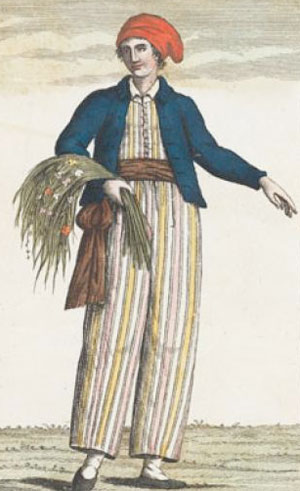
Jeanne Baret(1740 — 1807)
Jeanne Barret
France
8 min read
The first woman to circumnavigate the globe (1766–1769), Jeanne Baret disguised herself as a man to board Bougainville's expedition. An accomplished botanist, she contributed to the collection of thousands of plants, including the bougainvillea.
Frequently asked questions
Key Facts
- 1740: born in Autun, Burgundy
- 1766: boards Bougainville's La Boudeuse disguised as a man
- 1766–1769: first woman to circumnavigate the globe
- Collected more than 6,000 botanical specimens during the expedition
- 2012: a plant species is named in her honor, Solanum baretiae
Works & Achievements
By joining the Bougainville expedition disguised as a man, Jeanne Baret became the first woman to circumnavigate the globe — an achievement officially recognized by the French Navy. This historical fact remains her most emblematic legacy.
Working alongside Commerson, Jeanne Baret helped collect and prepare more than 6,000 specimens representing around 3,000 plant species. Part of this herbarium is today preserved at the Muséum national d'Histoire naturelle in Paris.
During the stopover in Brazil, Jeanne Baret took part in gathering the first samples of this ornamental climbing plant, previously unknown to European botanists. Bougainvillea is now cultivated throughout the world.
In tribute to her essential contribution to botany, Commerson named a plant genus "Baretia" in her honor. This gesture symbolizes the recognition — belated but genuine — of Jeanne Baret's scientific role.
Anecdotes
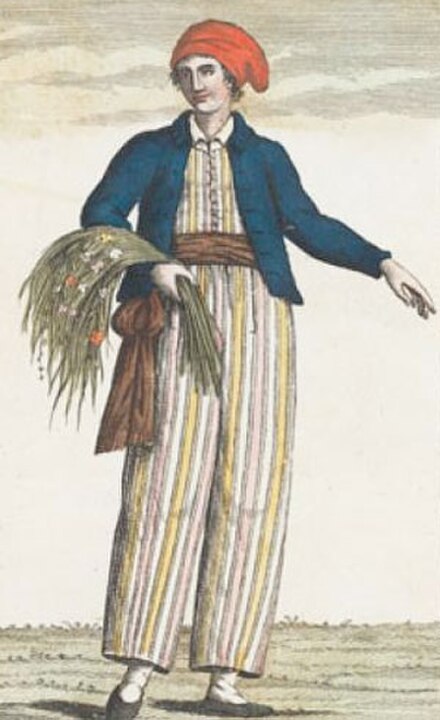
To circumvent the royal ban forbidding women from boarding French Navy vessels, Jeanne Baret disguised herself as a man and went by the name 'Jean Baret'. She presented herself as the valet of naturalist Philibert Commerson in Rochefort and managed to deceive the crew for many months. Her true identity was only revealed in April 1768, during the stopover in Tahiti.
It was in Tahiti that Jeanne Baret's secret was discovered. According to Bougainville's account, the Polynesian islanders immediately identified her as a woman the moment she stepped onto the beach. Bougainville recorded the episode in his ship's log with undisguised admiration, highlighting the extraordinary courage of a woman who had “surpassed in adventures most navigators.”
During the voyage, Jeanne Baret helped Commerson collect more than 6,000 plant specimens, many of which were unknown to European botanists. She personally carried the heavy plant-collecting equipment during shore expeditions — physically grueling work. Commerson paid tribute to her courage and skill in his botanical notes.
The bougainvillea, that climbing plant with its vivid bracts now cultivated around the world, was collected during the expedition in Brazil. Jeanne Baret played an active role in gathering and identifying it. Yet the plant was named in honor of Commander Bougainville — not in honor of the woman who had helped bring it back to Europe.
After being unmasked, Jeanne Baret was not sent away: she remained with Commerson on the Île de France (present-day Mauritius) until his death in 1773. She then married a French soldier, Jean Dubernat, and returned to France with him. The Ministry of the Navy officially granted her a pension in recognition of her services, formally recognizing her as the first woman to have circumnavigated the globe.
Primary Sources
Baret, who had never left France, had already, in this single voyage, surpassed most navigators in adventure. It is certain that she is the first woman to have circumnavigated the globe.
La Baret confessed to me that she was a woman, that from Rochefort she had deceived her master by presenting herself to him in men's clothing, that she had known in Rochefort that it was to be a voyage around the world, and that this voyage had tempted her.
The plants collected during this voyage form an herbarium of several thousand species, a great number of which are entirely new. I owe a considerable share of these discoveries to the tireless zeal of my companion in botanizing.
In consideration of the services rendered to botany and navigation during the circumnavigation voyage commanded by M. de Bougainville, an annual pension is hereby granted to Dame Baret, wife of Dubernat.
Key Places
A village in Burgundy where Jeanne Baret was born in 1740 into a peasant family. These humble origins make her destiny as the first woman to circumnavigate the globe all the more remarkable.
A major naval port from which the flute *L'Étoile* set sail in November 1766. It was here that Jeanne Baret boarded the ship disguised as a man to join the circumnavigation expedition.
A French Polynesian island where the expedition stopped in April 1768. The Polynesian inhabitants recognized Jeanne Baret as a woman, bringing months of concealment to an end.
An island in the Indian Ocean where Jeanne Baret settled with Commerson from 1768 onwards, and where she continued to live after his death in 1773 before returning to France.
A town in the Périgord region where Jeanne Baret settled with her husband Jean Dubernat after returning to France, and where she died in 1807.