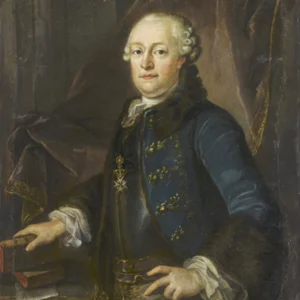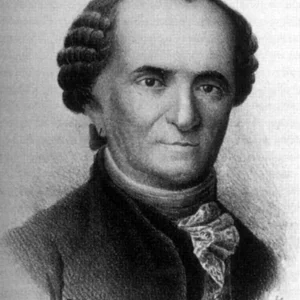

French physician, naturalist, and explorer (1727–1773), Commerson took part in Bougainville's circumnavigation (1766–1769) as the official botanist. He described thousands of plant and animal species unknown to Europe, including the bougainvillea, which he named in honour of his expedition commander.
Philibert Commerson(1727 — 1773)
Philibert Commerson
France
9 min read
Frequently asked questions
Key Facts
- 1727: born in Châtillon-les-Dombes (Ain)
- 1766–1769: embarks on the Bougainville expedition as official botanist and naturalist
- 1768: discovers and describes the bougainvillea (Bougainvillea) in Rio de Janeiro
- Describes more than 5,000 species new to science in the course of his travels
- 1773: dies on Île de France (Mauritius) before returning to France
Works & Achievements
More than 6,000 herbarium specimens gathered from plants collected during the round-the-world voyage and on the Île de France. These collections formed the basis for numerous descriptions of new species published after his death, notably by Antoine Laurent de Jussieu and Jean-Baptiste Lamarck.
The first manuscript description of this ornamental Brazilian vine, named in honour of Bougainville. The name was formally published by Jussieu in 1789 in *Genera Plantarum*, but it is Commerson who deserves intellectual credit for this now world-famous name.
Notes and descriptions covering several hundred fish species collected during the voyage, many of them entirely unknown to European naturalists. These manuscripts served as a direct source for Lacépède's monumental *Histoire naturelle des poissons* (1798–1803).
A body of letters sent from on board ship and from the Île de France, reporting previously unrecorded naturalist and ethnographic observations. These letters helped fuel French naturalist encyclopaedism and circulated among scholars across Europe.
Notes written during stopovers in Polynesia in which Commerson describes Tahitian and Melanesian societies with admiration, contributing to Enlightenment philosophers' reflections on human nature and the ideal society.
Anecdotes
Commerson boarded the Boudeuse with Jeanne Barret, his housekeeper and scientific assistant, who had disguised herself as a man under the name “Jean Baré.” Since women were forbidden aboard French naval vessels, this deception allowed Jeanne to become the first woman to circumnavigate the globe — a fact officially recognized by the French Navy only many years later.
In 1768, during the stopover in Tahiti, the island's inhabitants almost immediately recognized Jeanne Barret's true identity. Bougainville notes in his journal that the Tahitians, crying “Aïno!” (a woman!), unmasked a secret that had been kept for months on the open sea, much to the embarrassment of Commerson and his crewmates.
In Brazil, during the stopover at Rio de Janeiro in 1767, Commerson discovered a climbing vine with strikingly vivid violet bracts, which he named Bougainvillea spectabilis in honor of his expedition leader. This plant, now cultivated in tropical and Mediterranean gardens the world over, still bears the name he gave it — a living botanical monument to the glory of the expedition.
Over five years of exploration, Commerson assembled a herbarium of more than 6,000 dried plants and described several thousand animal and plant species previously unknown to Europeans. Too ill to return to France with Bougainville in 1769, he settled on the Île de France (present-day Mauritius), where he continued his research until his death in 1773, never seeing his homeland again.
Commerson maintained an active correspondence with the greatest naturalists of his time, including Buffon and Linnaeus, regularly sending them crates of specimens from the far side of the world. He died before he could publish the bulk of his work, but his collections, bequeathed to the Muséum national d’Histoire naturelle in Paris, served as the basis for dozens of species descriptions published by other scholars in the decades that followed.
Primary Sources
M. Commerson, the King's physician-botanist, was among their number; his zeal for the sciences and the ardor with which he fulfilled his duties had earned him widespread esteem. In the course of the voyage, he had collected a prodigious quantity of plants and animals unknown in Europe.
I find myself in a land where nature seems to have delighted in multiplying its most singular productions. Each day brings me new species which I hasten to describe and illustrate, convinced that these materials will one day prove useful to science.
The collections comprise more than 6,000 herbarium specimens and hundreds of pages of handwritten notes describing new species of plants, fish, mollusks, and insects gathered during Bougainville's voyage and the subsequent stay at the Île de France.
I have the honor of sending you a new crate of dried plants from the islands of the South Sea, together with the descriptions I have had time to write up. I ask that you make use of them for the forthcoming volumes of your great work, hoping that these materials may contribute to the advancement of Natural History.
Key Places
Commerson's birthplace, where he was born in 1727 and made his first botanical observations on the Dombes plain, a landscape rich in ponds and varied vegetation that awakened his calling as a naturalist.
The Parisian scientific institution (today the Muséum national d'Histoire naturelle) where Commerson prepared his expedition and to which he shipped his collections from the far side of the world; his herbaria and manuscripts are still held there and consulted by researchers today.
A port of call for the Bougainville expedition in June–July 1767, where Commerson carried out numerous botanical collections, including the discovery of the bougainvillea in the Brazilian coastal forests.
The Polynesian island where the expedition stopped in April 1768; Commerson was struck by the richness of its fauna and flora and wrote admiringly of Tahitian society, contributing to the myth of the "noble savage" so dear to Enlightenment philosophers.
The Indian Ocean island where Commerson settled from 1769 until his death in 1773, welcomed by the administrator Pierre Poivre; he continued his explorations there and undertook missions to Réunion and Madagascar before dying on the island, never having returned to France.
Typical Objects

An instrument made of two wooden boards tightened with straps, between which plants are placed to dry and preserve them. Commerson made extensive use of one to build his herbarium of over 6,000 specimens, now held at the Muséum national d'Histoire naturelle in Paris.

Essential optical tools for any 18th-century naturalist, used to examine the fine structures of plants and animals. Commerson relied on them to describe floral organs and anatomical details of the new species he discovered at each port of call.

Handwritten notebooks in which Commerson recorded his daily observations, species descriptions, sketches, and field notes. These manuscripts, partly preserved at the MNHN, are the primary record of his scientific work and the source of many posthumous publications.

Glass containers filled with alcohol used to preserve animals (fish, mollusks, insects) collected during port stops. Commerson regularly shipped crates of these jars to the Jardin du Roi in Paris to enrich the national collections.

The essential reference work that every 18th-century naturalist carried on their travels, providing the method for naming and classifying species according to the binomial system. Commerson used it to identify known genera and formally establish the names of the new species he encountered.

Tools shared with the ship's officers, allowing Commerson to record the precise geographic coordinates of his discoveries. This rigor was essential so that other naturalists could later locate and confirm the species he had described.
School Curriculum
Vocabulary & Tags
Key Vocabulary
Daily Life
Morning
On board the Boudeuse, Commerson rose early to make the most of the morning light, observing from the deck the coastlines, seabirds, and the surface of the ocean. At ports of call, he set out at dawn with his specimen box and plant press, often accompanied by Jeanne Barret, who carried part of the heavy scientific equipment across difficult terrain.
Afternoon
Afternoons at sea were devoted to describing and cataloguing the specimens collected in the morning: Commerson wrote up his notes in his cabin, crammed with crates and jars, drew the plants and fish before they deteriorated, and prepared consignments of crates destined for the Jardin du Roi in Paris.
Evening
In the evenings, Commerson would sometimes join the officers' table to discuss the day's discoveries with Bougainville. At Île de France, his evenings were studious: he wrote his manuscripts by candlelight, sorted his herbaria, and exchanged ideas with the intendant Pierre Poivre, himself a passionate botanist and gracious host.
Food
On board, the diet was that of 18th-century sailors: sea biscuits, dried vegetables, salted meat, and rainwater in distant seas. At tropical ports of call, Commerson discovered exotic fruits (bananas, papayas, coconuts) with wonder, sometimes as much for scientific purposes as for the pleasure of eating them. At Île de France, he enjoyed a more varied diet thanks to the carefully tended tropical gardens maintained by Poivre.
Clothing
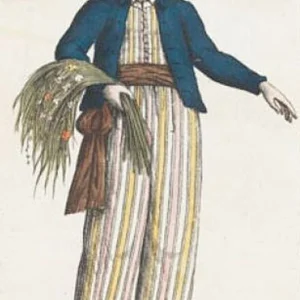
At sea, Commerson wore the practical attire of an embarked man of science: a sturdy broadcloth coat, breeches and stockings, and a wide-brimmed hat to shield him from the tropical sun. In the field, he adopted light, functional clothing that allowed him to push through undergrowth and marshy areas without damaging his precious observation notebooks.
Housing
On board the Boudeuse, Commerson occupied a narrow cabin so cluttered with crates and specimen jars that the crew marveled at it. At Île de France, he first lived with the intendant Pierre Poivre, then in a modest dwelling near the famous Pamplemousses garden, where he was able to pursue his research in considerably more comfortable conditions than on the ship.
Historical Timeline
Period Vocabulary
Liens externes & ressources
Références
Œuvres
Herbier Commerson (collections MNHN, Paris)
1766-1773
Description du Bougainvillier (Bougainvillea spectabilis)
1767
Manuscrits ichtyologiques (poissons des mers du Sud)
1768-1773
Correspondance scientifique avec Buffon, Jussieu et Linné
1766-1773
Observations ethnographiques sur les peuples de la mer du Sud
1768