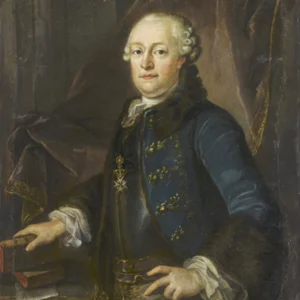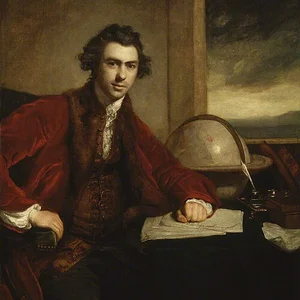

British naturalist and botanist (1743–1820), Joseph Banks took part in James Cook's first voyage around the world (1768–1771) aboard the Endeavour. He brought back thousands of previously unknown plant specimens and served as President of the Royal Society for 41 years.
Joseph Banks(1743 — 1820)
Joseph Banks
Royaume-Uni de Grande-Bretagne et d'Irlande
9 min read
Frequently asked questions
Key Facts
- 1768–1771: takes part in James Cook's first circumnavigation aboard the Endeavour
- 1770: lands at Botany Bay (Australia), a name he helped inspire through his accounts of the site's exceptional botanical richness
- Brings back over 30,000 natural specimens, including 1,400 plant species previously unknown in Europe
- 1778–1820: President of the Royal Society of London for 41 years
- Founder of the Royal Botanic Gardens, Kew, as a world centre for scientific research
Works & Achievements
A daily account combining botanical observations, ethnographic descriptions, and personal impressions. A founding document of Pacific natural history, it was not published until two centuries after it was written.
A set of 743 engraved plates based on drawings made during the Endeavour voyage, depicting the flora of Australia and the Pacific. A masterpiece of botanical illustration, these plates were not published in their entirety until 1990.
One of Banks's greatest achievements: he transformed the royal gardens at Kew into a global network for collecting and studying plants, sending collectors to the Americas, Africa, and Asia. Kew remains today one of the world's largest herbaria and botanical gardens.
Banks arranged the shipment of the first Spanish merino sheep to New South Wales, laying the foundations of the Australian wool industry. This initiative, grounded in his agronomic knowledge, lastingly transformed the colony's economy.
More than 50,000 letters exchanged with Linnaeus, Buffon, Humboldt, and hundreds of other scholars. This correspondence is a key source for the history of the natural sciences in the 18th century and bears witness to the central coordinating role Banks played in world science.
Anecdotes
Aboard the Endeavour (1768–1771), Banks brought at his own expense a team of eight people, including two artists tasked with drawing the species discovered. He spent around £10,000 of his personal fortune to fund the expedition's scientific equipment, making himself the voyage's principal patron and transforming what was a naval mission into a genuine naturalist expedition.
In April 1770, during the landing on Australia's east coast, Banks and his colleagues collected over 1,400 plant species unknown to European botanists in just a few days. James Cook decided to name the spot 'Botany Bay' in tribute to these extraordinary discoveries — this very site would become in 1788 the landing point for the first British colonial fleet, on Banks's own recommendation.
Banks was supposed to join Cook's second voyage (1772–1775), but he withdrew at the last moment after a spectacular falling-out with the Admiralty. He insisted on bringing a retinue of fifteen people — musicians and servants included — and on having the ship's structure altered to accommodate them. The Admiralty refused; Cook set sail without him, and Banks never returned to the Pacific.
It was Banks who persuaded the British government to send an expedition to find the breadfruit tree in Tahiti, convinced that this nourishing fruit would provide cheap food for slaves on Caribbean plantations. This project gave rise to the famous Bounty voyage (1787–1789), commanded by Captain Bligh, which ended in the most celebrated mutiny in British naval history.
Elected president of the Royal Society in 1778, Banks held the post until his death in 1820: forty-two years at the head of Britain's most prestigious scientific institution, an absolute record. He used this position to fund expeditions to the four corners of the globe and to transform the royal gardens at Kew into the world's leading centre of botany.
Primary Sources
The industry of Man! Here we saw an instance of it… We found growing here a most beautiful tree covered with white blossoms… I can scarce express the pleasure the sight of these new objects gives me.
Botany Bay on the coast of New South Wales affords the most eligible situation… The climate is temperate, the soil fertile, and the natives very few.
The object of your voyage is to carry the breadfruit-plant from Otaheite to the West Indies. You are to remain at Otaheite until you have got as many plants as you can conveniently stow.
I have the honour to transmit to you a small specimen of the plants I have brought from our voyage round the world. I beg you will favour me with your opinion on their classification.
Key Places
The Banks family estate, inherited in 1761, where Joseph grew up and developed his interest in nature. He returned there regularly between expeditions and carried out experimental farming on the land.
Banks's London residence, transformed into a true intellectual and scientific hub where he received the greatest scholars in Europe. He kept his herbaria there, along with a library of several thousand volumes and his natural history collections.
Banks was the driving force behind Kew Gardens' rise to global prominence, sending collectors to every corner of the world during his 41 years at the helm of the Royal Society. Under his leadership, the gardens became the world's greatest botanical centre.
The landing site of Banks in April 1770, named in tribute to the wealth of plant species collected there. Banks made its reputation across Europe and recommended the site to the British government as a location for a penal colony.
A major stopover for the Endeavour in 1769, where Banks studied Polynesian culture, flora, and people with great fascination. His notes on Tahiti rank among the earliest serious ethnographic and botanical descriptions of the island.
Visited during Cook's first voyage (1769–1770), New Zealand was the site of significant botanical collecting. Banks produced the first scientific descriptions of many Māori plants there, some of which still bear his name.
Liens externes & ressources
Références
Œuvres
Journal de bord de l'Endeavour
1768-1771 (publié intégralement en 1896)
Banks Florilegium
Dessins 1768-1771, gravures 1771-1784, publication 1980-1990
Développement des jardins botaniques de Kew
1778-1820
Introduction du mouton mérinos en Australie
1797
Correspondance scientifique internationale
1760-1820