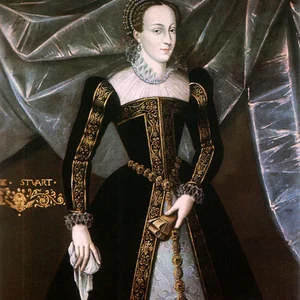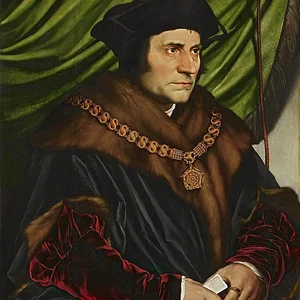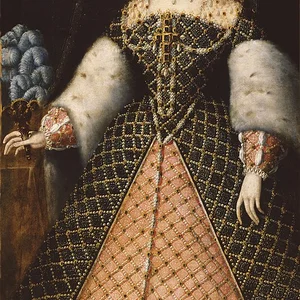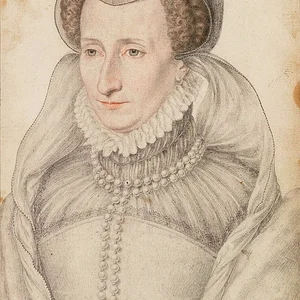

Queen of Navarre from 1555 to 1572, Jeanne d'Albret was one of the leading figures of the Protestant Reformation in France. Mother of Henry IV, she imposed Calvinism in her territories and played a decisive political role in the Wars of Religion.
Jeanne d'Albret(1528 — 1572)
Jeanne d'Albret
royaume de Basse-Navarre
7 min read
Frequently asked questions
Famous Quotes
« I do not wish to disinherit my children, but I cannot constrain my conscience.»
Key Facts
- 1528: born in Pau, daughter of Margaret of Navarre and Henry II of Albret
- 1548: marriage to Antoine de Bourbon
- 1555: ascends to the throne of Navarre upon the death of her father
- 1560: officially converts to Calvinism
- 1572: dies in Paris shortly before the St. Bartholomew's Day Massacre, leaving the kingdom to her son Henry
Works & Achievements
An edict by which Jeanne d'Albret banned the Catholic Mass in her territories of Béarn and imposed Reformed worship. It is the most radical act of her religious policy, unique in France.
An autobiographical account in which Jeanne describes the ordeals of her forced marriage to the Duke of Cleves and asserts her determination never to act against her conscience. An exceptional document on the life of a female sovereign in the 16th century.
Financed and commissioned by Jeanne, this translation allowed Basque-speaking populations to read the Scriptures in their mother tongue. It is one of the earliest printed texts in the Basque language.
A gathering of delegates from all the Reformed Churches of France, convened and presided over by Jeanne d'Albret. This synod unified Protestant ecclesiastical discipline and strengthened the political cohesion of the Huguenot cause.
A series of ordinances that progressively restricted Catholics' rights, leading up to the total prohibition of the Mass in 1571. Jeanne methodically built a model territory for the Calvinist Reformation.
Anecdotes
At just 13 years old, Jeanne d'Albret was forced to marry the Duke of Cleves for diplomatic reasons. She protested so violently that she had to be carried into the ceremony hall. The marriage was annulled four years later, allowing her to marry Antoine de Bourbon in 1548, a union that would produce the future Henry IV.
In 1560, Jeanne d'Albret publicly converted to Calvinism, a political and religious act of extraordinary boldness for a queen. She then gradually imposed the Reformation across her lands of Béarn and Navarre, banning the Catholic Mass in her domains from 1571 onward, making her one of the most resolute Protestant rulers in Europe.
An accomplished Latinist and woman of letters, Jeanne d'Albret had the Calvinist catechism translated into Basque and Béarnese so that her subjects could practice the new religion in their own language. She also funded the translation of the New Testament into Basque, a pioneering work for that language.
In 1572, Jeanne d'Albret traveled to Paris to negotiate her son Henri's marriage to Margaret of Valois, daughter of Catherine de' Medici. She died suddenly on June 9, 1572, at just 44 years old, a few weeks before the St. Bartholomew's Day Massacre decimated the Parisian Protestants. Her premature death fueled suspicions of poisoning, which were never proven.
During the Third War of Religion, Jeanne d'Albret did not content herself with supporting the Protestant cause in words alone: she traveled through towns across southern France to raise troops and funds, backing Condé and Admiral de Coligny. Often in poor health, this woman displayed an energy and political courage that commanded admiration even from her Catholic adversaries.
Primary Sources
I protest before God and before men that this marriage is not made with my consent, but wholly against my will.
We most expressly forbid each and every one of our subjects, of whatever quality and condition they may be, from practicing the papist religion in our lands, territories, and lordships.
Madam, I humbly beseech you to believe that my will is to live and die in the religion I have embraced, and to raise my son in it.
It is I who have convened you, and I ask you to establish the unity of our Reformed Church of France, so that we may stand together against those who seek to destroy us.
Key Places
The main residence of Jeanne d'Albret and the cradle of the House of Albret. It was here that her son Henri was born in 1553, and where she exercised her power as Queen of Navarre.
The secondary residence of the Kings of Navarre in Gascony, Nérac became under Jeanne d'Albret an important center of humanist and Protestant culture, attracting reformed pastors and intellectuals.
The foremost Protestant stronghold in France. In 1571, Jeanne d'Albret held the national synod there that unified the French Reformed Churches, and she also arranged her son's marriage to Margaret of Valois from there.
It was in Paris, where she was staying to negotiate her son Henri's marriage, that Jeanne d'Albret died suddenly on 9 June 1572, leaving Protestant diplomacy in disarray.
Calvin's city and the international center of the Reformation. Jeanne d'Albret maintained close ties with Geneva, from which she brought pastors to evangelize her lands and train the reformed clergy.
Typical Objects

French translation of the Bible, the cornerstone of Calvinist piety. Jeanne d'Albret read the Scriptures herself and encouraged her subjects to do the same in the vernacular, so that they could practice their faith directly.

A collection of psalms set to music by Claude Goudimel, using texts by Clément Marot and Théodore de Bèze. The singing of psalms was at the heart of the Reformed worship that Jeanne practiced and spread throughout her lands.

The official seal used to authenticate royal ordinances and decrees. Jeanne used it notably to promulgate the edicts imposing the Reformation across her territories.

A Reformed religious instruction text written by Calvin. Jeanne had this catechism translated into Basque and Béarnais so that all her subjects could learn the fundamentals of the Protestant faith.

Jeanne d'Albret maintained an intense correspondence with Protestant princes across Europe, the French royal court, and Reformed pastors. Her letters reveal a stateswoman of remarkable political acumen.

During the Wars of Religion, Jeanne personally raised funds to finance the Protestant armies, collecting taxes and donations from her lands in Béarn and Navarre.
School Curriculum
Vocabulary & Tags
Key Vocabulary
Daily Life
Morning
Jeanne d'Albret began her day with prayer and the reading of Scripture, in keeping with Calvinist piety. Each morning she attended the sermon delivered by the court pastor before receiving reports from her secretaries on the affairs of the kingdom.
Afternoon
The afternoon was devoted to governance: audiences with her councillors, reading and signing ordinances, and receiving ambassadors and delegations from the towns of Navarre and Béarn. She also oversaw political correspondence with Huguenot leaders and Protestant courts across Europe.
Evening
In the evenings, Jeanne often gathered Reformed pastors and humanists around her for theological and political discussions. She personally attended to the education of her son Henri, teaching him the principles of the Reformed faith and of statecraft.
Food
The table at the court of Navarre reflected the richness of the Gascon and Béarnais countryside: poultry, game, fish from the mountain rivers, garden vegetables, and wines from the South-West. As Calvinism advocated sobriety, Jeanne avoided the excessive splendour of the great Catholic courts.
Clothing
As queen, Jeanne wore gowns of velvet or silk in restrained colours — blacks, greys, and deep greens — in keeping with Protestant austerity. She wore the headdress and ruff fashionable in her era, but without the ostentatious jewellery of the French court.
Housing
Jeanne resided chiefly at the Château de Pau, a vast medieval fortress transformed into a Renaissance residence by her predecessors. There she fitted out a Reformed chapel and a well-stocked library, symbols of her religious and intellectual commitments.
Historical Timeline
Period Vocabulary
Liens externes & ressources
Références
Œuvres
Ordonnance de Mauléon
1571
Mémoires et poésies
vers 1565
Traduction du Nouveau Testament en basque
1571
Organisation du synode national de La Rochelle
1571
Édits de tolérance du Béarn
1564-1568