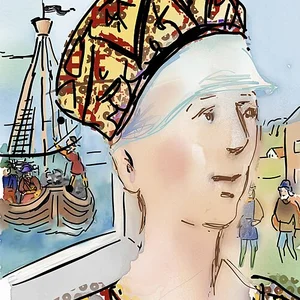

A 14th-century Breton noblewoman, Jeanne de Clisson became a privateer after the execution of her husband Olivier IV de Clisson by the King of France in 1343. Nicknamed “the Lioness of Brittany,” she armed a fleet to wage a war of vengeance in the English Channel during the Hundred Years' War.
Jeanne de Clisson(1300 — 1359)
Jeanne de Belleville
France
6 min read
Frequently asked questions
Key Facts
- Born around 1300 into a family of the Poitevin and Breton nobility (the Belleville family)
- Married Olivier IV de Clisson, a powerful Breton lord, in 1330
- 1343: Olivier IV was beheaded in Paris for treason on the orders of Philip VI, sparking Jeanne's revolt
- Armed a fleet of ships (the “Black Fleet”) and scoured the English Channel to attack French vessels, allied with the Anglo-Montfortist camp
- Died around 1359, after retiring to England and remarrying an English captain
Works & Achievements
After her husband's execution, Jeanne sold her jewels and lands to equip several warships, founding one of the few fleets ever commanded by a woman in the Middle Ages.
Before taking to the sea, she is said to have led land attacks against strongholds and garrisons loyal to the king of France and to Charles de Blois.
For more than a decade she harassed the shipping and coasts of the French camp, disrupting maritime communications during the Hundred Years' War.
Her ships supported the war effort of the Montforts and the English by securing routes and striking the enemy at sea.
Her marriage to the English captain Walter Bentley sealed her political alliance and marked the end of her privateering career.
Anecdotes
In 1343, the King of France Philip VI had Jeanne's husband, Olivier IV of Clisson, beheaded in Paris, accused of treason with the English during the War of the Breton Succession. His head was then mounted on a pike at one of the gates of Nantes, as a warning.
According to the tradition recorded in the Breton chronicles, Jeanne is said to have led her two young sons before their father's displayed head to make them swear vengeance against the King of France. This scene, which became legendary, sealed her transformation from court lady into war leader.
To fund her revenge, Jeanne sold her jewels and part of her lands in order to arm several ships. Having become a privateer, she roamed the English Channel and preyed on vessels and coastlines loyal to the King of France, which earned her the nickname “Lioness of Brittany.”
The chronicles describe a fleet of ships painted black, with sails dyed red, spreading terror across the English Channel. It is said that she sometimes spared one or two sailors so that they could carry the account of her attacks back to the king.
After years of privateering, Jeanne settled down: around 1356 she married an English captain, Gautier (Walter) Bentley, and retired to Hennebont, in Brittany, where she died around 1359.
Primary Sources
In that year, the king had Sir Olivier de Clisson and several barons of Brittany seized, and had them beheaded in Paris because they were suspected of treason and of dealings with the English.
The king of France had the head struck off Sir Olivier de Clisson and other knights of Brittany and Normandy, who were said to take the part of the king of England.
Several Breton lords accused of having turned to the English were beheaded in Paris, and their possessions were confiscated for the benefit of the king.
Key Places
Cradle of the lordship of Belleville, of which Jeanne was the heiress, located in Bas-Poitou. It is from this domain that she took her name, Jeanne de Belleville.
Stronghold of the Clisson family, on the borders of Brittany, where Jeanne lived as a lady after her marriage to Olivier IV de Clisson.
Ducal capital of Brittany where the head of Olivier de Clisson was displayed on a pike after his execution, triggering Jeanne's revenge.
Site of the public execution of Olivier IV de Clisson in August 1343, on the orders of King Philip VI for alleged treason.
Stretch of sea between France and England, the theater of Jeanne's privateering war, in which she attacked the ships and coasts of the French camp.
Breton town where Jeanne retired at the end of her life alongside her English husband Walter Bentley, and where she died around 1359.
Typical Objects

A medieval sailing ship, sturdy and high-sided, used for transport and naval combat. Jeanne fitted out several of them to scour the English Channel; tradition describes them painted black with red sails.

A bladed weapon with a straight, double-edged blade, a symbol of noble status and a tool of close combat. Indispensable in hand-to-hand fighting during boarding actions.

A short, handy axe used to cut through ropes and grappling hooks and to fight on crowded decks. An essential tool of privateering warfare.

A standard bearing a lord's coat of arms, raised on ships and fortresses to rally the men and signal one's side. A tool of recognition and authority.

A document issued by a sovereign authorizing a private individual to arm a ship to attack enemies: it is what distinguishes the privateer from the pirate. Jeanne enjoyed the support of the Anglo-Montfortist camp.

A defensive tunic made of interlinked iron rings, worn to protect the body from sword blows. The protective garment of the medieval fighter.
School Curriculum
Vocabulary & Tags
Key Vocabulary
Daily Life
Morning
When she was the lady of Clisson, Jeanne would rise to attend Mass, then give her orders to the castle's stewards and receive guests. Once she had become a privateer, she began the day on deck, scanning the horizon of the English Channel in search of a sail to intercept.
Afternoon
As a noblewoman, she managed the estates, the accounts and the affairs of the household. As a fleet commander, the afternoon could be spent hunting down a ship: approach manoeuvres, throwing grappling hooks and boarding, sword and axe in hand.
Evening
In the evening, the castle's great hall gathered the household around the fire, with stories and music. At sea, they dropped anchor in a safe cove, divided up the loot and kept watch against a surprise attack.
Food
On land, the noble table offered white bread, roasted meats, game, fish and wine. At sea, the everyday fare turned harsh: ship's biscuit, salted fish and meat, cheese and water or watered-down wine, provisions chosen to keep well during the crossings.
Clothing
The lady wore long gowns of fine cloth, belts, veils and headdresses in the fashion of the 14th century, marks of her rank. On board, she adopted more practical clothing and, in battle, protection such as a coat of mail.
Housing
She first lived in the fortress of Clisson, with its thick walls and halls hung with tapestries. During her years as a privateer, her dwelling became the cramped sterncastle of a ship; she ended her days in a peaceful home in Hennebont.
Historical Timeline
Period Vocabulary
Liens externes & ressources
Références
Œuvres
Armement d'une flotte corsaire
1343
Campagnes contre les garnisons françaises de Bretagne
1343-1344
Guerre de course dans la Manche
1343-1356 (environ)
Ravitaillement du camp anglo-montfortiste
années 1340-1350
Ralliement durable au camp anglais
vers 1356