
Jane Seymour was the third wife of King Henry VIII of England and queen consort from 1536 to 1537. She gave birth to the long-awaited male heir, the future Edward VI, but died a few days later from complications of childbirth.
Jane Seymour(1508 — 1537)
Jane Seymour
royaume d'Angleterre
6 min read
Frequently asked questions
Key Facts
- Becomes a maid of honour at court, serving Catherine of Aragon and later Anne Boleyn
- Marries Henry VIII on 30 May 1536, shortly after the execution of Anne Boleyn
- Gives birth to the future Edward VI on 12 October 1537, Henry VIII's only legitimate male heir
- Dies on 24 October 1537 from complications of childbirth (puerperal fever)
- The only one of Henry VIII's six wives to receive a queen's funeral and to be buried beside him at Windsor
Works & Achievements
Her major achievement in the eyes of the court: giving Henry VIII the legitimate male heir he had awaited for nearly thirty years, securing the Tudor succession.
Jane worked to bring Henry VIII closer to his eldest daughter Mary, who had been sidelined after the divorce of Catherine of Aragon, partly restoring her place at court.
She begged the king to spare certain monasteries in the face of the religious uprising in the north, revealing traditional sympathies, though without altering royal policy.
Through her discreet and pious demeanour, she embodied the model of the ideal wife according to Henry VIII, a counter-model to Anne Boleyn, lastingly celebrated after her death.
The official commissioned portrait fixed her image for posterity and contributed to the memory of a model queen within the Tudor dynasty.
Anecdotes
Jane Seymour's motto was « Bound to obey and serve », a striking contrast with Anne Boleyn's, « The most happy ». This choice sums up Jane's strategy: to appear gentle and submissive where her rival had been flamboyant and provocative.
Jane had served as a lady-in-waiting to Henry VIII's first two wives, Catherine of Aragon and then Anne Boleyn, before becoming queen herself. She had thus closely known the women she replaced, in a court where fortunes shifted quickly.
Henry VIII married Jane on 30 May 1537, barely eleven days after the execution of Anne Boleyn, who was beheaded on 19 May 1536. The speed of the remarriage shows the king's dynastic urgency, obsessed as he was with the idea of having a legitimate male heir.
When she finally gave birth to Prince Edward on 12 October 1537, bonfires were lit throughout London and 2,000 cannon shots were fired at the Tower. But Jane died twelve days later, probably from a puerperal infection linked to the childbirth.
Jane was the only one of Henry VIII's six wives to receive a queen's funeral, and the king chose to be buried beside her in St George's Chapel at Windsor. It is a sign that, in his eyes, she remained “the” queen, the one who had given him a son.
Primary Sources
The king announces that the queen has been “delivered and brought forth of a prince conceived in most lawful matrimony.”
Chapuys describes Jane Seymour as being “of middle stature and no great beauty,” while noting her reputation for gentleness and virtue.
The account details the funeral procession carrying the queen's body from Hampton Court to Windsor, with Princess Mary as the chief mourner.
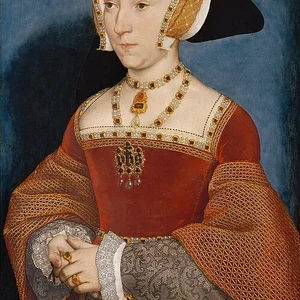
A primary visual source showing the queen in a richly embroidered court gown, gable hood, and jewels — evidence of Tudor royal costume.
Key Places
Manor of the Seymour family where Jane grew up. Henry VIII stayed there during a royal progress, an occasion said to have encouraged their growing closeness.
Royal residence on the banks of the Thames where Jane gave birth to Prince Edward and where she died shortly afterwards.
Place where Jane quietly married Henry VIII on 30 May 1536. The center of Tudor royal power.
Burial place of Jane Seymour, where Henry VIII chose to be buried by her side himself.
Royal fortress where Anne Boleyn was executed just before Jane's rise, and from which the cannons rang out to salute the birth of Edward.
Typical Objects

A stiff hood shaped like the gable of a house, typical of English fashion under Henry VIII, framing the face with gemstones and dark fabric. Jane wore it, preferring this traditional style to Anne Boleyn's French hood.

Gold jewellery set with pearls and precious stones given by the king, a sign of favour and wealth. Holbein's portrait shows her adorned with these royal ornaments.

A heavy gown of velvet and silk with wide sleeves, embroidered with gold thread and trimmed with fur, worn by the queen consort. It signalled both the wealth of the crown and the decorum of the Tudor court.

A heraldic emblem combining the royal arms of England with those of the Seymour family, used to authenticate her acts. It symbolised the dynastic union sealed by the marriage.

An illuminated collection of prayers that noblewomen carried and read for daily devotion. An object of piety as much as a mark of culture and status.

A ceremonial cradle prepared for the long-awaited heir, surrounded by care and ceremony. It embodied the central dynastic stake of Henry VIII's reign.
School Curriculum
Vocabulary & Tags
Key Vocabulary
Tags
Daily Life
Morning
A Tudor court lady's day began with prayer and Mass, followed by a toilette assisted by maidservants who helped her into her heavy garments. She was then dressed according to protocol, for the queen never clothed herself alone.
Afternoon
Afternoons were divided between embroidery, reading devotional books, music, and walks in the palace gardens. The queen also received petitions and maintained her network of ladies-in-waiting.
Evening
Court evenings blended banquets, dancing, card games, and entertainments. Jane, known for her discretion, took part in the royal pageantry without seeking the splendour that had been the undoing of her rival Anne Boleyn.
Food
The royal table was rich in meats (beef, venison, poultry, game), fish on lean days, white bread, and spiced wine. Fruits and vegetables were considered less noble; sugar, rare and costly, was a mark of luxury.
Clothing
Jane wore gowns of velvet and silk with wide sleeves, adorned with gold embroidery and furs, over a rigid corset. She adopted the English gable hood, more austere than the French hood that had been fashionable under Anne Boleyn.
Housing
She lived in royal palaces such as Hampton Court and Whitehall, vast complexes of stone and brick whose apartments were hung with tapestries and warmed by great fireplaces. The queen had her own apartments and a retinue of ladies.
Historical Timeline
Period Vocabulary
Liens externes & ressources
Références
Œuvres
Naissance du prince Édouard (futur Édouard VI)
12 octobre 1537
Réconciliation de la princesse Marie avec la cour
1536
Intercession lors du Pèlerinage de Grâce
1536-1537
Image de la reine vertueuse et soumise
1536-1537
Portrait par Hans Holbein le Jeune
vers 1536-1537