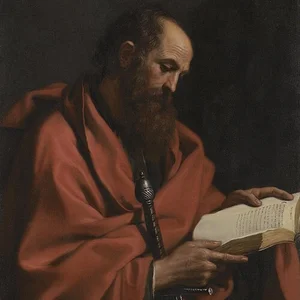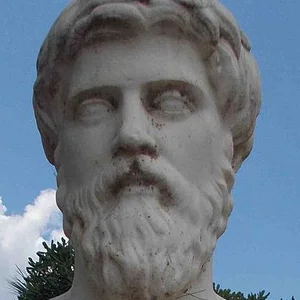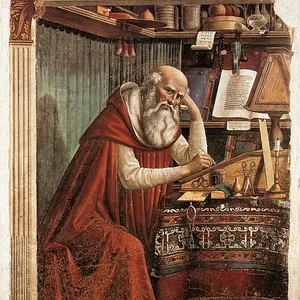

A Christian monk and scholar of the 4th century, Jerome of Stridon is celebrated for translating the Bible into Latin, producing the Vulgate. A Doctor of the Church, he was also a prolific letter writer and a passionate advocate of the ascetic life.
Jerome of Stridon(345 — 420)
Jerome of Stridon
Rome antique
9 min read
Frequently asked questions
Famous Quotes
« Ignorance of Scripture is ignorance of Christ.»
« The ease of forgiveness encourages sin.»
Key Facts
- Born around 345 in Stridon, in Dalmatia (present-day Croatia or Slovenia)
- Translated the Bible into Latin (the Vulgate) between 382 and 405, at the request of Pope Damasus I
- Lived as an ascetic in Bethlehem from 386, where he led a monastery
- Wrote numerous letters and biblical commentaries that shaped Christian theology
- Died in 420 in Bethlehem; declared Doctor of the Church, feast day on September 30
Works & Achievements
A translation of nearly the entire Bible into Latin, commissioned by Pope Damasus I. It remained the official version of the Catholic Church for over a thousand years and was confirmed as such by the Council of Trent in 1546.
A corpus of more than one hundred and twenty letters addressed to correspondents from across the known world — theologians, Roman noblewomen, and emperors. They stand as a primary historical and literary source on the intellectual and spiritual life of Late Antiquity.
A biographical collection covering one hundred and thirty-five Christian authors, from Saint Peter to Jerome himself. It is the first systematic attempt at a history of Christian literature.
Jerome wrote detailed commentaries on nearly all the prophetic books of the Old Testament (Isaiah, Jeremiah, Ezekiel, Daniel) and on several of Paul's epistles. These works laid the foundations of medieval Latin biblical exegesis.
A Latin adaptation and continuation of the universal chronicle of Eusebius of Caesarea, providing a comparative chronological framework between biblical history and Greco-Roman history, widely used throughout the Middle Ages.
A polemical treatise defending the perpetual virginity of Mary, written against a theologian who claimed that Mary had other children after Jesus. It illustrates Jerome's role as a passionate defender of Christian orthodoxy.
Anecdotes
Jerome of Stridon was famous for his passionate and sometimes caustic temperament. During his stay in Rome, he criticized the morals of the clergy and of overly worldly Christian noblewomen so sharply that his enemies contrived to drive him from the city after the death of his patron, Pope Damasus I, in 384. He left Rome for good, not without declaring that he preferred Bethlehem to the imperial court.
To learn Hebrew, Jerome sought out a rabbi who had converted to Christianity and subjected himself to daily exercises of extreme difficulty. He described this process as a form of penance, so harsh did the language seem to him after Latin and Greek. This extraordinary effort allowed him to consult the Scriptures in their original tongue — something no Western Christian scholar had accomplished with such rigor before him.
In the 370s, Jerome settled as a hermit in the desert of Chalcis, in Syria. He lived in a cave, fasting and mortifying his flesh, but brought his books with him and continued to study and write. In his letters, he complained that even in the desert, his imagination conjured visions of young Roman women dancing — proof that the discipline of the mind was even harder than that of the body.
A persistent legend, taken up by generations of painters, holds that Jerome removed a thorn from the paw of a wounded lion that had dragged itself to the entrance of his monastery in Bethlehem. The grateful beast supposedly remained by his side until his death. While the story is almost certainly apocryphal, it perfectly captures the image of the scholarly saint — solitary, and in harmony with creation — that the medieval Church wished to pass on.
Jerome's translation of the Bible into Latin was not without resistance. Many laypeople and clergy were attached to the older Latin versions, known as the Vetus Latina, and found Jerome's changes suspicious or even sacrilegious. Augustine of Hippo himself wrote to him expressing concern about the unrest such alterations might sow in Christian communities. Jerome defended his choices vigorously, insisting that an accurate translation was worth more than a convenient but imprecise tradition.
Primary Sources
How often, in that parched and burning desert scorched by the sun, did I imagine myself amid the pleasures of Rome! I lay in a corner, my body broken by fasting, while visions of dancing girls filled my mind. My face was pallid from sleepless nights, yet desires blazed in my cold flesh.
I put this iron helmet on my head to deflect the blows of those who attack me. I have translated not from the Septuagint, but from the Hebrew, in order to restore to each word its true meaning.
I have endeavored to compile, from the coming of Our Lord down to our own time, a record of ecclesiastical writers and their published works, so that readers may know how many authors, and of what distinction, have founded and enriched the Church of Christ.
I have translated not word for word, but sense for sense. For if anyone thinks nothing is lost in a literal translation, let him render Homer word for word into Latin, and he will see that the most eloquent of languages becomes absurd.
Drawing on the data of Scripture and the Greek historians, I have attempted to draw up a table of events from the beginning of the world to the present day, so that the reader might have a means of comparing sacred history with secular history.
Key Places
Jerome's birthplace, around 345, into a prosperous Christian family. The town was destroyed and its exact location remains debated, somewhere between present-day Croatia and Slovenia.
Jerome studied here under the grammarian Donatus and received baptism. He returned from 382 to 384 as secretary to Pope Damasus I, who entrusted him with revising the Bible into Latin.
Between roughly 374 and 379, Jerome lived here as a hermit, practicing strict asceticism, learning Hebrew, and engaging in an extensive correspondence with Christians in both East and West.
Jerome settled here permanently in 386, founding a monastery and a school. It was here that he spent the last thirty-five years of his life, translating the Bible and writing the bulk of his works.
Jerome stayed here around 379–382 and studied under Gregory of Nazianzus, one of the great theologians of the age, which deepened his exegetical training and his command of Greek.
Typical Objects

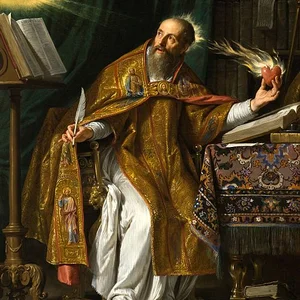
Jerome spent most of his life writing and dictating. The reed pen (a sharpened reed) and rolls or quires of parchment were his daily tools, with which he produced a colossal body of work from his scriptorium in Bethlehem.

The codex — a book of bound leaves, which was in the process of supplanting the scroll at that time — was the medium of the Vulgate that Jerome translated and revised without rest. It was both the tool and the outcome of all his work.

Renaissance and medieval artists consistently depicted Jerome with a skull resting on his desk, a symbol of meditation on death and the vanity of earthly things — central themes of his ascetic spirituality.

For drafts, quick notes, and teaching, Jerome used wax-coated tablets on which one wrote with a stylus and which could then be smoothed over and reused — the equivalent of our modern notebooks.

The long nights of work in the scriptorium or cave were lit by simple olive oil lamps. Jerome mentions his nocturnal vigils devoted to study in several of his letters.

As a committed ascetic, Jerome practiced bodily mortification, symbolized by the wearing of a hair shirt (a rough garment made of horsehair or coarse wool) and a rope belt, bearing witness to his contempt for bodily comforts.
School Curriculum
Vocabulary & Tags
Key Vocabulary
Daily Life
Morning
Jerome rose before dawn to recite Vigils and Lauds with the monks of his monastery. After communal prayer, he would retire to his scriptorium — a small, purpose-fitted cell — to dictate to a secretary or write by his own hand the translation in progress, making the most of the morning light.
Afternoon
His afternoons were devoted to consulting texts in Hebrew, Greek, and Latin: Jerome would compare versions, question his Jewish interlocutors about the precise meaning of Hebrew words, and draft his commentaries. He also received visitors and disciples who came to learn from him.
Evening
In the evening, after Vespers and a frugal meal, Jerome would dictate letters to correspondents from across the world or correct the copies made during the day. He retired early, but often took up his studies again by the light of an oil lamp, dismissing the need for sleep.
Food
Jerome followed a strictly ascetic diet: raw or cooked vegetables, legumes, barley or wheat bread, water, and occasionally a little wine mixed with water. He forbade himself meat, undiluted wine, and refined foods, which he associated with bodily vice and spiritual laxity.
Clothing
He wore a coarse woolen tunic (typically brown or grey), a rope belt, and simple leather sandals. He had long since abandoned the fine woolen togas and elaborate vestments of Roman clerics, which he viewed as symbols of worldly vanity.
Housing
In Bethlehem, Jerome occupied a monastic cell carved into the rock or built of dry stone, adjoining the church and scriptorium of the monastery he had founded with the help of the Roman noblewoman Paula. The community also included a hospice for pilgrims passing through the Holy Land.
Historical Timeline
Period Vocabulary
Visual Style
Esthétique des enluminures médiévales et de l'iconographie chrétienne primitive : cellule de moine baignée d'une lumière chaude, ambiance studieuse et ascétique, palette de terres, d'or byzantin et de parchemin ivoire.
Sound Ambience
Atmosphère monastique et studieuse du scriptorium de Bethléem au IVe siècle : silence entrecoupé de chants liturgiques, bruit du calame sur le parchemin, vent des collines de Judée.
Liens externes & ressources
Références
Œuvres
La Vulgate (Biblia Sacra Vulgata)
382–405
Epistulae (Lettres)
370–419
De Viris Illustribus (Des hommes illustres)
393
Commentaires bibliques
386–420
Chronicon (adaptation de la Chronique d'Eusèbe)
380–381
Adversus Helvidium (Contre Helvidius)
383