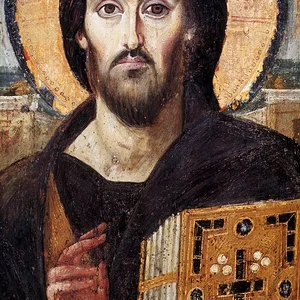

Jewish preacher from Galilee and founder of Christianity. His teachings on love, forgiveness, and the Kingdom of God transformed the course of human history. Crucified around 30 AD, he is considered by Christians to be the risen Son of God.
Jesus Christ(5 av. J.-C. — 30)
Jesus Christ
Royaume d'Hérode
8 min read
Frequently asked questions
Famous Quotes
« Love one another as I have loved you.»
« Render unto Caesar the things that are Caesar's, and unto God the things that are God's.»
« I am the way, the truth, and the life.»
Key Facts
- Born around 4–6 BC in Bethlehem, in Judea under Roman rule
- Baptized by John the Baptist around 28 AD, marking the beginning of his public ministry
- Crucified in Jerusalem around 30 AD under the governor Pontius Pilate
- His teachings are recorded in the four Gospels (Matthew, Mark, Luke, and John)
- Christianity, born from his preaching, became the official religion of the Roman Empire in 380 AD
Works & Achievements
A foundational discourse recorded in the Gospel of Matthew, containing the Beatitudes and the Lord's Prayer. It summarizes Jesus's ethical teaching on love, forgiveness, and justice.
Allegorical stories designed to convey moral and spiritual teaching (the Good Samaritan, the Prodigal Son, the Sower). This innovative teaching method made a lasting impression on all who heard it.
The ethical heart of his teaching: to love God with one's whole being and to love one's neighbor as oneself. This principle profoundly shaped Western moral philosophy.
Jesus chose twelve disciples (the apostles) to form the core of his community, in symbolic reference to the twelve tribes of Israel. This structure gave rise to the Christian Church.
Although Jesus wrote nothing himself, his words and deeds were gathered into the gospels and epistles. This body of writings, translated into more than 3,000 languages, is the most widely distributed book in history.
Anecdotes
At the baptism of Jesus by John the Baptist in the Jordan River, around 28–29 AD, witnesses reported a vision and a heavenly voice according to the Gospels. This event marks the beginning of his public life and itinerant ministry in Galilee.
Jesus recruited his disciples from ordinary people: fishermen from the Sea of Galilee such as Simon Peter, Andrew, James, and John, whom he called with the words 'Come, follow me, and I will make you fishers of men.' This choice of humble individuals with no formal religious training was highly unusual for a spiritual teacher of the time.
Jesus's entry into Jerusalem, one week before his death, took place on a donkey — a symbol of peace in Jewish tradition — while the crowd waved palm branches. This symbolic gesture deliberately echoed the prophecy of Zechariah concerning the messianic king.
During the trial of Jesus, the Roman governor Pontius Pilate reportedly declared that he found no grounds for condemnation. Crucifixion, a punishment reserved for slaves and those who rebelled against Rome, suggests that Jesus was condemned for political as much as religious agitation.
After the death of Jesus, his disciples initially scattered in fear. It was the proclamation of the resurrection that transformed them into bold preachers willing to die for their faith — a psychological reversal that historians regard as a remarkable historical fact, whatever interpretation one gives it.
Primary Sources
After John was put in prison, Jesus went into Galilee, proclaiming the good news of God. 'The time has come,' he said. 'The kingdom of God has come near. Repent and believe the good news!'
Christus, from whom the name had its origin, suffered the extreme penalty during the reign of Tiberius at the hands of one of our procurators, Pontius Pilatus, and a most mischievous superstition, thus checked for the moment, again broke out not only in Judæa, the first source of the evil, but even in Rome.
He assembled the Sanhedrin of judges, and brought before them the brother of Jesus who was called Christ, whose name was James, and some others. He accused them of having transgressed the law, and condemned them to be stoned to death.
For what I received I passed on to you as of first importance: that Christ died for our sins according to the Scriptures, that he was buried, that he was raised on the third day according to the Scriptures, and that he appeared to Cephas, and then to the Twelve.
They affirmed that the whole of their guilt or error was that they were in the habit of meeting on a certain fixed day before sunrise and singing alternately a hymn to Christ as to a god.
Key Places
A town in Judea where, according to the Gospels of Matthew and Luke, Jesus was born. As a city of David, it gave Jesus messianic legitimacy in the Jewish tradition.
A town in Galilee where Jesus grew up and lived until around the age of thirty. It was there that he was known as the son of the carpenter Joseph — a fact that scandalized his fellow townspeople.
The main setting of Jesus's ministry, where he recruited his first disciples — fishermen by trade — and performed many of the acts recorded in the Gospels. Lakeside villages such as Capernaum served as his bases.
The religious capital of Judaism, where Jesus traveled for major festivals and where he was arrested, tried, and crucified around 30 AD. The Temple stood at the heart of Jewish religious life.
The river where John the Baptist baptized crowds and where Jesus himself received baptism — an event all four Gospels identify as the founding moment of his public ministry.
Typical Objects

Jesus read and commented on the Hebrew Scriptures in synagogues. The Gospels report that he unrolled the scroll of Isaiah in Nazareth to read a messianic prophecy.

Several of his disciples were fishermen on the Sea of Galilee. Jesus used this familiar image to describe his mission: gathering people together as one gathers fish.

At the Last Supper with his disciples, Jesus took bread and wine and gave them a new meaning, establishing the rite of the Eucharist, which remains central to Christianity to this day.

An instrument of torture reserved for slaves and rebels, the cross became the central symbol of Christianity following the crucifixion of Jesus. It is present in churches throughout the world.

A common everyday object in first-century Palestine, Jesus uses it in several famous parables — such as the parable of the wise and foolish virgins — to teach spiritual watchfulness.

Jesus and his disciples walked dozens of miles across Galilee and Judea. Sandals are mentioned in the Gospels as a symbol of humility: John the Baptist said he was not worthy to unfasten them.
School Curriculum
Vocabulary & Tags
Key Vocabulary
Tags
Daily Life
Morning
Jesus would rise before dawn to pray in a solitary place, a practice attested several times in the Gospels. After prayer, he would share a simple meal (bread, olives, figs) with his disciples before setting out on the roads of Galilee.
Afternoon
The afternoon was devoted to teaching: in village synagogues, on the shores of the lake, or on hillsides where crowds would gather. Jesus healed the sick, answered questions from scribes and Pharisees, and spent time with those on the margins of society.
Evening
In the evening, Jesus and his disciples would stop at the homes of welcoming hosts. Meals were important moments of teaching and fellowship. He was known for eating with tax collectors and people of ill repute, which scandalized the religious authorities.
Food
Typical diet of first-century Palestine: barley or wheat bread, fish from the Sea of Galilee (often grilled), olives and olive oil, figs, dates, lentils, and legumes. Watered-down wine was the common drink; meat was rare and associated with feasts.
Clothing
Jesus wore the typical dress of a devout first-century Jew: an inner tunic (chiton) of linen or wool, an outer cloak (himation) that also served as a blanket at night, and leather sandals. The Gospels specifically mention his seamless tunic, a symbolic detail carried on in tradition.
Housing
Jesus had no fixed home during his ministry, as he himself said: 'Foxes have dens and birds have nests, but the Son of Man has no place to lay his head.' He was hosted by sympathetic families, notably in Capernaum at the home of Simon Peter, and at the house of Martha, Mary, and Lazarus in Bethany.
Historical Timeline
Period Vocabulary
Visual Style
Style mêlant iconographie byzantine dorée et réalisme archéologique du Proche-Orient antique, avec des teintes chaudes de calcaire, de lin et de lumière méditerranéenne.
Sound Ambience
Ambiance sonore de la Galilée et de la Judée du Ier siècle : troupeaux, lac, foules rurales, chants liturgiques hébreux et murmures en araméen.
Liens externes & ressources
Références
Œuvres
Le Sermon sur la montagne
vers 28-30 apr. J.-C.
Les paraboles
vers 28-30 apr. J.-C.
Le Notre Père
vers 28-30 apr. J.-C.
Fondation de la communauté des douze apôtres
vers 28 apr. J.-C.
Le dernier repas (Cène)
vers 30 apr. J.-C.