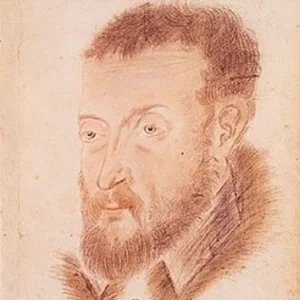

French Renaissance poet (1522–1560), co-founder of the Pléiade, a group of humanist writers. He theorized the defense of the French language and composed major lyric collections exploring love, exile, and melancholy.
Joachim du Bellay(1522 — 1560)
Joachim du Bellay
France
10 min read
Frequently asked questions
Famous Quotes
« France, mother of arts, of arms, and of laws»
« Happy the man, like Ulysses, who has made a fine journey»
Key Facts
- 1549: Publication of 'The Defence and Illustration of the French Language', the founding manifesto of the Pléiade
- 1550: Composition of 'Rustic Games' (Jeux rustiques), a collection of poems
- 1552–1557: Stay in Rome as secretary to Cardinal Jean du Bellay, which inspired his 'Regrets'
- 1558: Publication of 'The Regrets' (Les Regrets), his masterpiece of melancholic poetry
- Close collaboration with Pierre de Ronsard to renew French poetry
Works & Achievements
Founding literary manifesto of the Pléiade, asserting the dignity of French against Latin and setting out the program for an ambitious national poetry. This theoretical prose text revolutionized thinking about language and literature in France.
First collection of Petrarchan sonnets in French, dedicated to a mysterious 'Olive' inspired by Ariosto and Petrarch. The work inaugurates the genre of the amorous canzoniere in France and concretely illustrates the principles of the Defence.
A sequence of sonnets composed in Rome, meditating on the greatness and ruin of the Roman Empire as a metaphor for human fragility. This collection would profoundly influence European poetry, notably Shakespeare, who translated it into English.
Du Bellay's masterpiece, a collection of 191 sonnets composed in Rome, blending nostalgia for his native Anjou, satirical criticism of the Roman court, and melancholic meditations on exile. The sonnet 'Heureux qui comme Ulysse' is one of the most celebrated poems in all of French literature.
A collection of Latin and French poems in an Anacreontic vein, celebrating nature, simple pleasures, and rural life. It demonstrates du Bellay's dual mastery, capable of writing with equal excellence in both Latin and French.
A verse satire of court poets who seek royal favor by sacrificing their creative authenticity. An autobiographical and polemical text, it expresses the bitterness of a poet who felt marginalized despite his talent.
Anecdotes
Joachim du Bellay was born around 1522 at the château de La Turmelière, in Anjou, into a noble but modest family. Orphaned at a very young age, he was taken in by his elder brother, who neglected his education for several years. It was only at the age of twenty that he truly began his studies — a late start that would mark him deeply and foster in him a sense of inferiority toward other, better-trained poets.
In 1547 or 1548, du Bellay chanced upon Pierre de Ronsard at an inn in Perche during a journey. The two young men discovered a shared passion for ancient poetry and decided to enroll together at the Collège de Coqueret in Paris, run by the humanist Jean Dorat. From this friendship was born the Brigade — the future Pléiade — which would go on to transform French literature.
In 1553, du Bellay left for Rome as secretary to his cousin Cardinal Jean du Bellay. He had hoped to find glory and inspiration there, but instead found himself overwhelmed with thankless administrative tasks. Disillusioned by the reality of Rome and longing for his native Anjou, he channeled that feeling of exile into the sonnets of Les Regrets and Les Antiquités de Rome — his two masterpieces, published upon his return in 1558.
Du Bellay suffered from a progressive hearing loss that worsened over the years, gradually isolating him from the world and darkening his final years. Back in Paris after Rome, he lamented in his verses that he was not given his due recognition at court, living in financial hardship despite his reputation. He died in Paris in January 1560, at only 37 years old, probably of a stroke, leaving behind a considerable body of work for so brief a time on earth.
In 1549, du Bellay published in just a few weeks the Défense et illustration de la langue française, a true literary manifesto that shook the world of letters. In it, he argued that French was a language as noble as Latin and Greek, capable of rivaling the Ancients if poets enriched it with neologisms and learned imitation. This provocative text — which harshly criticized poets of the previous generation such as Marot — caused a scandal and launched the Pléiade's poetic revolution.
Primary Sources
He who wishes to produce work worthy of praise in his vernacular, let him leave the labor of translation, principally of poets, to those who, from a laborious and little profitable endeavor — I dare say even useless, indeed harmful to the growth of their language — rightly carry off the glory of the industrious.
Happy the man who, like Ulysses, has made a fine journey, / Or like that hero who won the Golden Fleece, / And then returned, full of experience and wisdom, / To live among his kin the rest of his days!
Newcomer, who seeks Rome in Rome / And perceives nothing of Rome in Rome, / These old palaces, these old arches you see, / And these old walls — that is what is called Rome.
If our life is less than a single day / In the eternal, if the turning year / Drives our days away with no hope of return, / If all things born are destined to perish…
I have no wish to delve into the bosom of nature, / I have no wish to seek out the spirit of the universe, / I have no wish to sound the hidden depths, / Nor to trace the fair architecture of the heavens.
Key Places
Birthplace of du Bellay around 1522, rooted in the gentle landscape of the Loire Valley. The nostalgia for this native 'little Liré' lies at the heart of the sonnet 'Heureux qui comme Ulysse' and runs throughout the entire work of the Regrets.
An institution led by the humanist Jean Dorat, where du Bellay joined Ronsard around 1547–1548 to study Greek and Latin letters. It was here that the Brigade was born — the future Pléiade group — and where the poetic project of the Défense took shape.
Du Bellay stayed in Rome from 1553 to 1557 as secretary to his cousin the cardinal, housed in a palace near the Vatican. It was in this grand yet disappointing setting that he composed the Regrets and the Antiquités de Rome, masterpieces of humanist melancholy.
Du Bellay wandered the ancient ruins of the Forum, a living meditation on the fall of empires and the power of time. These ruins directly inspired the Antiquités de Rome, in which he questions the permanence of greatness in the face of destruction.
Du Bellay lived in Paris after his return from Rome, frequenting the literary circles of the Left Bank and the printers who published his collections. He died there in January 1560, in the modesty and bitterness of a glory he felt had gone insufficiently recognized.
Typical Objects

A daily instrument of the humanist poet, the trimmed quill enables the meticulous writing of sonnets on parchment or laid paper. Du Bellay composed his collections by hand, tirelessly correcting and recopying his verses in his Roman or Parisian apartments.

The Latin poets are the absolute models of the Pléiade: Du Bellay reads and rereads Virgil and Horace to enrich his style and craft his learned imitations. These printed books, often annotated in the margins, are the fundamental tools of his poetic method.

The printing press, a recent technique spread since Gutenberg, allows Du Bellay to publish and distribute his collections in Paris as early as 1549. Without the printed word, the Pléiade's revolution could not have reached the vast public of educated readers.

Du Bellay discovers Rome in 1553 and wanders among its ruins, fascinated by the vanished grandeur of the Empire. Maps and plans of the city allow him to locate the ancient monuments he evokes in the Antiquities of Rome.

An emblematic musical instrument of the French Renaissance, often associated with the lyric poetry that the poet could have set to music. The Pléiade conceived of poetry as inseparable from song and melody.

An indispensable light source for working at night, at a time when the window and the candle defined the space of intellectual work. Du Bellay, suffering from increasing deafness, often retreated into the nocturnal study of his books and verses.
School Curriculum
Vocabulary & Tags
Key Vocabulary
Tags
Époque
Daily Life
Morning
Du Bellay rises early, often before dawn, to take advantage of the quiet conducive to study. He reads and annotates ancient texts — Virgil, Ovid, Petrarch — before beginning to compose his verses. In Rome, he must also dispatch the cardinal's administrative correspondence before the day is fully underway.
Afternoon
The afternoon is devoted to his duties as secretary: drafting diplomatic letters, attending audiences, managing the cardinal's ecclesiastical affairs. In Paris, Du Bellay frequents the colleges and literary salons, discussing poetry with Ronsard and the other members of the Pléiade. He also visits printers to oversee the publication of his works.
Evening
In the evening, freed from daily tasks, Du Bellay returns to his writing desk by candlelight to polish his sonnets. He sometimes attends gatherings of the Pléiade, where debates are held on the rules of the sonnet, the ode, and the imitation of the Ancients. Suffering from deafness, he cherishes solitary reading and melancholic contemplation.
Food
The diet of a cardinal's secretary in Rome is relatively abundant: white bread, roasted meats, fish, vegetables, Italian fruits, wines from Latium. In France, the Angevin cuisine of his childhood — Loire fish, cheeses, wines from Touraine — nourishes his nostalgia as much as his body. Like many humanists, he eats frugally during periods of intense work.
Clothing
Du Bellay wears the attire of a learned Renaissance gentleman: a dark velvet doublet, hose, a short cape and a ruff at the collar — understated but of quality. As the cardinal's secretary, he sometimes adopts Italian-style clothing, more colourful in nature. His position as a nobleman of the robe demands a dignified appearance, distinct from common dress yet without the extravagance of great courtiers.
Housing
In Rome, Du Bellay lodges in the palace of Cardinal Jean du Bellay, a vast residence near the Vatican furnished with libraries and sumptuous reception halls. In Paris, he occupies a modest apartment on the Left Bank, close to the university colleges. The contrast between the splendour of Rome and the austerity of his personal life feeds his melancholy and his sense of social injustice.
Historical Timeline
Period Vocabulary
Visual Style
Un portrait intime dans la veine des peintres Clouet : velours sombre, lumière dorée de la chandelle, regard mélancolique d'un humaniste entre Paris et Rome.
Sound Ambience
Un mélange de silence studieux et de rumeurs urbaines — Paris lettré et Rome monumentale — où la plume du poète gratte au rythme des cloches et du vent sur les pierres antiques.
Liens externes & ressources
Références
Œuvres
Défense et illustration de la langue française
1549
Les Antiquités de Rome
1558
Les Jeux rustiques
1558
Le Poète courtisan
1559