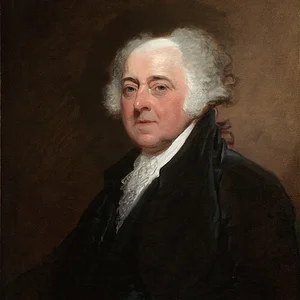

John Adams (1735-1826) was an American lawyer, diplomat, and statesman, one of the Founding Fathers of the United States. Vice President under George Washington, he became the second President of the United States (1797-1801). A key figure of the American Revolution, he contributed to the drafting of the Constitution.
John Adams(1735 — 1826)
John Adams
États-Unis, Treize colonies
8 min read
Frequently asked questions
Famous Quotes
« Facts are stubborn things.»
« Our Constitution was made only for a moral and religious people. It is wholly inadequate to the government of any other.»
Key Facts
- 1735: Born in Braintree, Massachusetts
- 1776: Participates in the Continental Congress and supports the Declaration of Independence
- 1783: Negotiates the Treaty of Paris ending the American Revolutionary War
- 1789-1797: First Vice President of the United States under George Washington
- 1797-1801: Second President of the United States
- 1826: Dies on July 4th, the same day as Thomas Jefferson
Works & Achievements
This foundational text denounces the Stamp Act and asserts that freedom of conscience and expression are inalienable natural rights; it established Adams as a major political thinker in the colonies.
An influential pamphlet written at the request of several delegates to the Continental Congress, proposing a model of republican government based on separation of powers and regular elections.
Adams was its principal author; it is the oldest written constitution still in force in the world and served as a model for the federal Constitution of 1787.
A sweeping three-volume work analyzing ancient and modern republics to justify the American system of mixed government and balance of powers.
A series of essays published in the Gazette of the United States, analyzing revolutions and human nature; they were poorly received as too conservative and too close to aristocratic ideas.
More than 150 letters exchanged with Jefferson after their reconciliation, forming an extraordinary testament to the ideals, doubts, and political vision of the Founding Fathers.
Anecdotes
John Adams was one of the rare Founding Fathers who never owned enslaved people, firmly convinced that slavery was incompatible with the ideals of liberty he championed. This stance created tensions with some of his Southern allies, most notably Thomas Jefferson.
Adams and Jefferson, fierce political rivals, reconciled in their later years and maintained a remarkable correspondence of more than 150 letters between 1812 and 1826. In an extraordinary coincidence, both men died on the same day — July 4, 1826 — exactly 50 years after the signing of the Declaration of Independence.
During his presidency, Adams became the first occupant of the White House in Washington D.C., moving in November 1800 while the building was still under construction. He wrote his wife Abigail a celebrated letter expressing his wish that only honest and wise men would ever inhabit this house — a phrase later engraved on the mantelpiece of the State Dining Room.
In 1770, at great risk to his legal career, Adams agreed to defend the British soldiers charged in connection with the Boston Massacre, believing that every accused person deserved a fair defense. His skillful arguments secured the acquittal of most of the soldiers and stood as a powerful testament to his deep commitment to the rule of law.
Appointed ambassador to France and then to Great Britain in the 1780s, Adams became the first official representative of the United States to be received by King George III — the very monarch against whom the Americans had just fought a war. The meeting was tense but conducted according to diplomatic protocol.
Primary Sources
I pray Heaven to bestow the best of Blessings on this House and all that shall hereafter inhabit it. May none but honest and wise Men ever rule under this roof.
The people in America have now the best opportunity and the greatest trust in their hands that Providence ever committed to so small a number since the transgression of the first pair.
Liberty cannot be preserved without a general knowledge among the people, who have a right, from the frame of their nature, to knowledge, as their great Creator, who does nothing in vain, has given them understandings.
The foundation of every government is some principle or passion in the minds of the people. The noblest principles and most generous affections in our nature then have the fairest chance to support the noblest and most generous models of government.
You and I ought not to die before we have explained ourselves to each other.
Key Places
Adams's birthplace and primary residence, his family farm known as Peacefield was the retreat to which he withdrew after his presidency and where he died in 1826.
Seat of the Continental Congress, it was here that Adams took part in the decisive debates leading to the Declaration of Independence in 1776 and played a central role in the founding of the Republic.
Adams spent time in Paris as a diplomat and took part in crucial negotiations with France and Great Britain that led to the recognition of American independence in 1783.
In The Hague, Adams negotiated an important treaty of amity and commerce between the United States and the Dutch Republic in 1782, as well as a vital Dutch loan to help finance the War of Independence.
Adams was the first president to reside in the White House, moving in November 1800; he lived there only a few months before leaving office in 1801.
Liens externes & ressources
See also
Related Characters
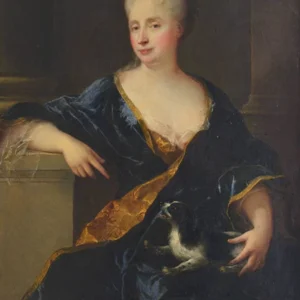
Anne Thérèse de Marguenat de Courcelles, marquise de Lambert
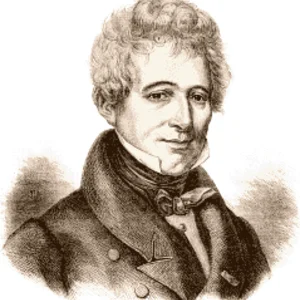
Barthélemy de Lesseps
1766 — 1834
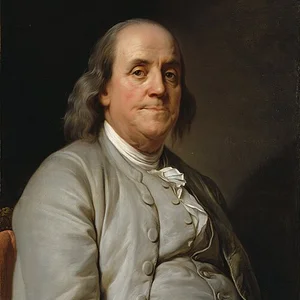
Benjamin Franklin
1706 — 1790
Camille Desmoulins
1760 — 1794
Cardinal Mazarin
1602 — 1661
Charles XII of Sweden