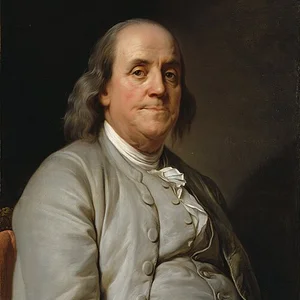

An 18th-century American statesman, scientist, and writer, Benjamin Franklin is one of the Founding Fathers of the United States. The inventor of the lightning rod, he contributed to drafting the Declaration of Independence and negotiated the Franco-American alliance.
Benjamin Franklin(1706 — 1790)
Benjamin Franklin
États-Unis, Amérique britannique
8 min read
Frequently asked questions
Famous Quotes
« An investment in knowledge pays the best interest.»
« In this world, nothing is certain except death and taxes.»
« Tell me and I forget. Teach me and I remember. Involve me and I learn.»
Key Facts
- 1706: born in Boston into a modest artisan family
- 1752: kite experiment demonstrating the electrical nature of lightning, leading to the invention of the lightning rod
- 1776: participated in drafting the United States Declaration of Independence
- 1778: negotiated the Franco-American Treaty of Alliance in Paris, decisive for the American victory
- 1787: participated in the Constitutional Convention that drafted the United States Constitution
Works & Achievements
An annual almanac published under the pseudonym 'Richard Saunders', famous for its moral and practical maxims. Distributed at 10,000 copies per year, it made Franklin's fortune and spread his ideas throughout the colonies.
A collection of his scientific discoveries on electricity, translated into French, German, and Latin. This work earned him an international reputation and his election to the Royal Society of London.
Franklin was one of the five members of the committee tasked with drafting the Declaration, alongside Thomas Jefferson. His contribution helped refine the founding text of American democracy.
A major diplomatic agreement he negotiated with Minister Vergennes, committing France to the side of the United States against Great Britain. This alliance proved decisive in securing the American victory in the War of Independence.
An unfinished autobiographical account tracing his rise from the son of a craftsman to a statesman of universal renown. Considered the first great narrative of the 'American Dream', it is still studied in high schools around the world.
Franklin, at 81, was the oldest signatory of the American Constitution. His final speech at the Convention in favor of unanimous adoption was pivotal in overcoming the last remaining resistance.
Anecdotes
In 1752, Benjamin Franklin conducted his famous kite experiment during a thunderstorm in Philadelphia. By attaching a metal key to his kite's string, he proved that lightning was electrical in nature, paving the way for the invention of the lightning rod.
Franklin was an avid chess player and became one of the first known players in North America. In 1786, he wrote 'The Morals of Chess', an essay arguing that chess teaches foresight, circumspection, and perseverance — virtues useful to any statesman.
During his time in Paris as ambassador (1778–1785), Franklin became a celebrity in high society. Parisians were captivated by him: portraits, medallions, and even hats 'à la Franklin' were sold throughout the city. Voltaire himself embraced him publicly at the Académie des sciences in 1778.
Franklin was one of the few Founding Fathers to have signed all four of the United States' founding documents: the Declaration of Independence (1776), the Treaty of Alliance with France (1778), the Treaty of Paris (1783), and the U.S. Constitution (1787) — a testament to his remarkable political longevity.
The son of a candlemaker and entirely self-taught, Franklin left school at age ten but never stopped learning. He taught himself French, Spanish, Italian, and Latin, and was elected a fellow of the Royal Society of London and a member of the Académie royale des sciences in Paris.
Primary Sources
Having emerged from the poverty and obscurity in which I was born and bred, to a state of affluence and some degree of reputation in the world, and having gone so far through life with a considerable share of felicity...
Make a small cross of two light strips of cedar... To the top of the upright stick of the cross is to be fixed a very sharp pointed wire, rising a foot or more above the wood.
Early to bed and early to rise, makes a man healthy, wealthy and wise. — Lost time is never found again.
You are so kind that you have decided I deserve paradise. In that case, we shall meet in that happy world and love one another still.
I confess that there are several parts of this constitution which I do not at present approve, but I am not sure I shall never approve them... I doubt too whether any other Convention we could obtain, may be able to make a better Constitution.
Key Places
The city where Franklin settled at age 17 and built his entire professional life. Philadelphia was the center of his activities as a printer, scientist, and statesman, and it is where he died in 1790.
Franklin's residence during his years as American ambassador to France (1778–1785). It was from Passy that he conducted the crucial diplomatic negotiations for the Franco-American alliance and the Treaty of Paris.
Franklin's birthplace, where he was born in 1706 and gained his first experience in printing at his brother James's shop. Boston represents his humble origins and his rise through hard work and the pursuit of knowledge.
The building where the Declaration of Independence was signed in 1776 and where the Constitutional Convention was held in 1787. Franklin played a central role there in shaping the foundations of American institutions.
The learned institution where Franklin was elected a foreign associate member and where he presented his work on electricity. It was in its halls that he met Voltaire and the greatest philosophers of the Enlightenment.
Typical Objects

Franklin invented the lightning rod in 1752 after demonstrating the electrical nature of lightning. This pointed metal rod, connected to the ground, protected buildings and ships from fires caused by lightning strikes.

Franklin learned the printing trade as a child and owned his own press in Philadelphia. Through it, he published the Pennsylvania Gazette and Poor Richard's Almanack, building his reputation as a writer and thinker.

The hemp kite to which Franklin attached a metal key during the 1752 storm has become one of the most iconic symbols in the history of science. This simple yet daring experiment revolutionized our understanding of electricity.

Franklin invented bifocal glasses around 1784 to address his own simultaneous farsightedness and nearsightedness. This practical invention showcases his genius for finding simple solutions to everyday problems.

In 1741, Franklin designed a cast-iron stove more efficient than traditional fireplaces, distributing heat more effectively while consuming less wood. He refused to patent it, wishing his invention to benefit everyone freely.

In 1761, Franklin invented an original musical instrument made of rotating glass bowls played by touching them with wet fingers. Mozart and Beethoven both composed for this fascinating instrument, known as the glass armonica.
School Curriculum
Vocabulary & Tags
Key Vocabulary
Tags
Daily Life
Morning
Franklin was a committed early riser, waking around five in the morning. He devoted his mornings to study, reading, and correspondence, often while taking an air bath — a hygienic practice he considered excellent for his health. In Philadelphia, he would then oversee his printing shop.
Afternoon
His afternoons were dedicated to business affairs, political meetings, or scientific experiments in his study. In Paris, he received diplomats and philosophers, played chess, or strolled through the gardens of Passy, beloved by Parisians who greeted him with great respect.
Evening
Franklin's evenings were lively and intellectually engaged. In Philadelphia, he frequented his discussion club, the Junto, which he had founded to debate philosophy and politics. In Paris, he shone in the literary salons, conversing with Voltaire, Turgot, and the Encyclopédistes over a glass of Burgundy wine.
Food
Franklin had relatively frugal eating habits for a man of his standing, true to his maxims on temperance. He nonetheless enjoyed fine French cuisine during his time in Paris and was particularly fond of cider and wine. In his youth, he was temporarily vegetarian in order to save money to buy books.
Clothing
Franklin deliberately dressed simply and plainly, refusing the powdered wig and embroidered garments fashionable at European courts. In Paris, he wore a fur robe and a marten-fur cap, which set him apart from the aristocracy and delighted Enlightenment philosophers as a symbol of American republican simplicity.
Housing
In Philadelphia, Franklin lived in a comfortable red-brick house typical of colonial architecture, with a garden and a study filled with scientific instruments. In Paris, he resided in the elegant Hôtel de Valentinois in Passy, made available by a French admirer, surrounded by gardens overlooking the Seine.
Historical Timeline
Period Vocabulary
Visual Style
Style mêlant la sobriété puritaine coloniale américaine et le raffinement des salons rococo parisiens, avec une palette chaude de parchemin, d'ocre et de bleu nuit évoquant l'ère des Lumières.
Sound Ambience
Ambiance sonore mêlant l'atelier d'imprimerie colonial de Philadelphie et les salons parisiens des Lumières, avec l'électricité des orages qui traversa la vie scientifique de Franklin.
Liens externes & ressources
Références
Œuvres
Poor Richard's Almanack
1732-1758
Expériences et observations sur l'électricité
1751
Déclaration d'indépendance des États-Unis (co-rédaction)
1776
Traité d'alliance franco-américaine
1778
Mémoires (Autobiography)
1771-1790
Constitution des États-Unis (participation)
1787