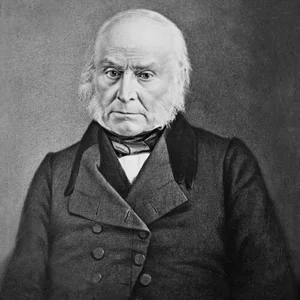

Son of President John Adams, John Quincy Adams was the sixth President of the United States (1825–1829). A seasoned diplomat, he negotiated the Treaty of Ghent (1814) ending the Anglo-American War and helped formulate the Monroe Doctrine. He later championed the rights of enslaved people as a congressman.
John Quincy Adams(1767 — 1848)
John Quincy Adams
États-Unis, Amérique britannique
7 min read
Frequently asked questions
Famous Quotes
« Liberty is the only value worth living for.»
« Wherever the standard of freedom and independence has been unfurled, there will America's heart, her benedictions, and her prayers be.»
Key Facts
- 1767: Born in Braintree, Massachusetts, son of John Adams, future president
- 1814: Negotiates the Treaty of Ghent, ending the War of 1812 against Great Britain
- 1817–1825: Secretary of State, architect of the Monroe Doctrine (1823)
- 1825–1829: Sixth President of the United States
- 1841: Successfully defends the African captives of the Amistad before the Supreme Court
Works & Achievements
Negotiated by Adams on behalf of the United States, this treaty ended the War of 1812 against Great Britain by restoring pre-war borders, consolidating American sovereignty.
Negotiated as Secretary of State, it secured the acquisition of Florida and established the boundary with Spain extending to the Pacific Ocean, paving the way for continental expansion.
Although proclaimed under President Monroe's name, the doctrine was primarily drafted by Adams. It declared that the Americas could no longer be colonized by European powers.
A journal kept for 68 years, spanning the period from the American Revolution to the eve of the Civil War. An exceptional historical source published by his son Charles Francis Adams.
An eight-hour address before the Supreme Court defending the African captives aboard the Amistad, winning their freedom and marking a pivotal moment in the struggle against slavery.
Correspondence with his mother, an iconic figure of America's founding, revealing his reflections on diplomacy, democracy, and republican values.
Anecdotes
At just 14 years old, John Quincy Adams accompanied his father to Europe as secretary and interpreter on diplomatic missions. He already mastered French, Latin, and Greek, impressing European courts with his intellectual maturity.
After his presidency, Adams was elected as a representative to Congress for Massachusetts — the only former president to have done so. He served there for 17 years, tirelessly fighting against the 'gag rule' that prohibited any debate on slavery in Congress, until its repeal in 1844.
Adams personally argued before the Supreme Court on behalf of the African captives from the Amistad ship in 1841, at the age of 73. His eight-hour defense helped secure their freedom, in one of the most landmark legal cases of 19th-century America.
An avid walker and swimmer, Adams took a bath in the Potomac every morning, sometimes naked at dawn. Journalist Anne Royall, knowing he refused to grant her an interview, sat on his clothes and refused to return them until he answered her questions — he obliged from the water.
Adams kept a personal diary for 68 years, from 1779 until his death in 1848, covering more than 14,000 handwritten pages. This exceptional document remains an irreplaceable primary source on the early American Republic and the major political figures of the era.
Primary Sources
I am a man of reserved, cold, austere, and forbidding manners; my political adversaries say, a gloomy misanthropist, and my personal enemies, an unsocial savage.
The American continents, by the free and independent condition which they have assumed and maintain, are henceforth not to be considered as subjects for future colonization by any European powers.
I know of no law, or constitutional principle, of this country, by which these men can be reduced to a state of slavery, or by which our courts can take jurisdiction of their case.
No matter what the subject is, if a citizen of this republic comes to a member of Congress and asks him to present a petition, it is his duty to do it.
Key Places
Adams's birthplace and the cradle of the Adams family. The birthplace (Adams National Historical Park) is today a national memorial site.
Adams served here as a representative for 17 years after his presidency, leading his fight against slavery and for the right of petition. He died there on February 23, 1848.
The city where Adams negotiated the 1814 peace treaty ending the Anglo-American War, one of his greatest diplomatic achievements.
The official residence where Adams lived as president from 1825 to 1829, and where he planted an orchard and kitchen garden, pursuing his passion for natural sciences.
Adams served here as U.S. Minister Plenipotentiary from 1809 to 1814, forging crucial diplomatic ties with Tsar Alexander I during the Napoleonic Wars.
Typical Objects

Adams kept his diary for 68 uninterrupted years, accumulating more than 14,000 pages. This daily journal served as both a tool for moral and intellectual reflection and a historical record.

An indispensable instrument for the diplomat and man of letters, Adams wrote voluminous correspondence, speeches, and his memoirs every day using a trimmed quill pen.

A central working tool for the Secretary of State who negotiated decisive border treaties, most notably the Adams-Onís Treaty of 1819 defining the territorial boundaries with Spain.

As president and later congressman, Adams wore the strict black formal dress of 19th-century American republican ceremony, reflecting a Puritan austerity inherited from his family.

Passionate about science, Adams was an ardent advocate for a national American observatory. He owned observation instruments and championed the creation of public scientific institutions before Congress.

Educated at Harvard and deeply learned, Adams surrounded his desk with volumes in Latin, Greek, French, and English, ranging from classics of political philosophy to legal treatises.
School Curriculum
Vocabulary & Tags
Key Vocabulary
Tags
Daily Life
Morning
Adams rose before dawn, often around 5 a.m., beginning his day with prayer and Bible reading. He would then take a swim in the Potomac or go for a long walk, firmly convinced that physical exercise was essential to mental health.
Afternoon
His afternoons were devoted to affairs of state or congressional business depending on the period: receiving delegations, drafting speeches and diplomatic dispatches, and scholarly reading in Latin or Greek. Adams ate a modest midday meal, often at his desk.
Evening
Evenings were dedicated to writing in his diary — an unwavering daily ritual — as well as reading and correspondence. During his presidency, he occasionally hosted official guests at formal dinners, but preferred the company of books to that of fashionable society.
Food
Adams followed a plain and simple diet typical of the New England Puritan tradition: roasted meats, seasonal vegetables, cornbread, and cider or water. He maintained his own kitchen garden at the White House and was wary of the excesses of the table.
Clothing
Adams wore the strict black attire of republican representation: a dark buttoned frock coat, waistcoat, breeches or trousers as they came into fashion, and a high white cravat. His appearance was neat but deliberately free of ostentation, reflecting his republican convictions.
Housing
Son of one president and himself another, Adams lived in fine residences: the White House from 1825 to 1829, then the family estate of Peacefield in Quincy, Massachusetts — a stone-and-brick manor inherited from his father. He kept a vast library at its heart, the center of his intellectual life.
Historical Timeline
Period Vocabulary
Visual Style
Portrait austère dans le style fédéral américain, inspiré de Gilbert Stuart : teintes profondes de marine et de charbon, lumière chiaroscuro sur un visage empreint de conviction morale.
Sound Ambience
L'ambiance sonore du Washington fédéral du XIXe siècle : débats parlementaires, plumes grattant le papier, carrosses sur les pavés et cloches d'église dans la capitale naissante.
Liens externes & ressources
Références
Œuvres
Traité de Gand
24 décembre 1814
Traité Adams-Onís (traité transcontinental)
22 février 1819
Doctrine Monroe (rédaction principale)
2 décembre 1823
Mémoires (Diary of John Quincy Adams)
1779-1848
Plaidoirie pour l'affaire Amistad
Février-mars 1841
Lettres à Abigail Adams
1795-1818
See also
Related Characters
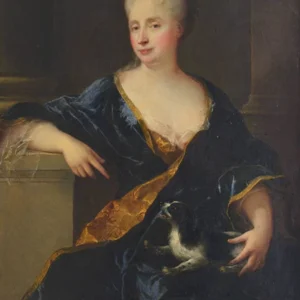
Anne Thérèse de Marguenat de Courcelles, marquise de Lambert
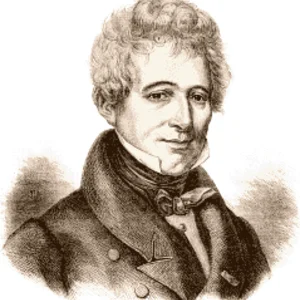
Barthélemy de Lesseps
1766 — 1834
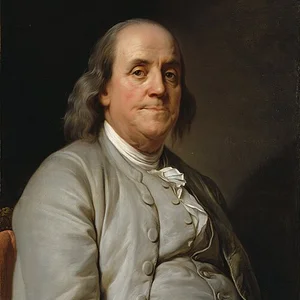
Benjamin Franklin
1706 — 1790
Camille Desmoulins
1760 — 1794
Cardinal Mazarin
1602 — 1661
Charles XII of Sweden