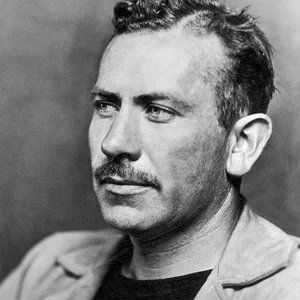

American novelist born in 1902 in California, a major figure of 20th-century social literature. He depicted the outcasts of the Great Depression and received the Nobel Prize in Literature in 1962.
John Steinbeck(1902 — 1968)
John Steinbeck
États-Unis
6 min read
Frequently asked questions
Famous Quotes
« The writer is delegated to declare and to celebrate man's proven capacity for greatness of heart and spirit.»
Key Facts
- Born on February 27, 1902, in Salinas, California
- Published Of Mice and Men in 1937
- Won the Pulitzer Prize in 1940 for The Grapes of Wrath (1939)
- Awarded the Nobel Prize in Literature in 1962
- Died on December 20, 1968, in New York
Works & Achievements
Steinbeck's first major success, tenderly and humorously portraying a band of misfits in Monterey.
A short novel about two migrant farm workers dreaming of a farm of their own. It has become a classic studied around the world.
A masterpiece following the exodus of a ruined farming family to California. Winner of the 1940 Pulitzer Prize and a symbol of the Great Depression.
A moral tale about a poor fisherman whose discovery of a precious pearl brings him misfortune. A brief and universal story.
A warm and poetic portrait of Monterey's cannery district and its inhabitants — poor but free.
A sweeping family saga set in the Salinas Valley, a retelling of the biblical story of Cain and Abel. Steinbeck considered it his most ambitious work.
A travel narrative across the United States in the company of his dog. An intimate portrait of 1960s America.
Anecdotes
In his youth, Steinbeck worked a string of odd jobs: farmhand on California ranches, laborer in a sugar refinery, estate caretaker. Those years spent alongside day laborers would feed his entire body of work about the working poor.
In 1939, his novel “The Grapes of Wrath” caused such an uproar that it was banned and even publicly burned in Kern County, California, where the story takes place. The big landowners accused Steinbeck of lying and of spreading communist propaganda.
In 1960, at nearly 58, Steinbeck crossed the United States in a custom-fitted pickup truck he named “Rocinante,” after Don Quixote's horse. His only companion was his French poodle, Charley, and he recounted the journey in “Travels with Charley.”
The title “Of Mice and Men” comes from a poem by the Scotsman Robert Burns: “The best-laid plans of mice and men often go awry.” Steinbeck chose this line to announce from the very title that the two heroes' dream would fail.
When he received the Nobel Prize in Literature in 1962, Steinbeck doubted he deserved it himself: asked by a journalist whether he thought he was a good choice, he answered honestly, “Frankly, no.”
Primary Sources
And the great companies did not know that the line between hunger and anger is a thin line.
A guy who's got somebody, who looks out for somebody else, feels less like chucking the whole thing and walking away.
I hold that a writer who does not passionately believe in the perfectibility of man has no dedication nor any membership in literature.
I learned very early that you don't take a trip; a trip takes you.
Cannery Row in Monterey, California, is a poem, a stink, a grating noise, a quality of light, a tone, a habit, a nostalgia, a dream.
Key Places
Steinbeck's hometown, at the heart of a rich farming valley. It inspires the setting of several of his novels, including *East of Eden*.
A harbor and sardine-cannery district on the California coast. Steinbeck sets *Cannery Row* and *Sweet Thursday* there.
Steinbeck attends classes here on and off during the 1920s, never earning a degree. Here he feeds his taste for literature and biology.
The great road linking the Midwest to California, which Steinbeck nicknames the “mother road” in *The Grapes of Wrath*. Okie families traveled it to flee the Dust Bowl.
A small coastal town on Long Island where Steinbeck owns a house in his later years. It is from here that he sets off on his *Travels with Charley*.
A great metropolis where Steinbeck lives for part of his life and where he dies in 1968. The city represents the opposite pole to his native California.
Typical Objects

The writer's everyday tool, on which Steinbeck typed out his novels. Yet he also wrote long first drafts by hand, in pencil.

Steinbeck wrote his first drafts in pencil and went through dozens a day, sharpened by hand. He always kept a stash of them on his desk.

A pickup truck fitted out as a mobile home, in which Steinbeck crossed the United States in 1960. He named it after Don Quixote's horse.

An old car overloaded with furniture and families, a symbol of "The Grapes of Wrath." Thousands of Okies fled the Dust Bowl for California this way.

An award received in 1962 for his body of work. It honors a novelist who had become the voice of the downtrodden.

Steinbeck kept detailed working journals while writing, notably for "The Grapes of Wrath" and "East of Eden." In them he recorded his doubts and his daily progress.
School Curriculum
Vocabulary & Tags
Key Vocabulary
Tags
Daily Life
Morning
Steinbeck began writing early in the morning, when his mind was fresh and the house was quiet. He set himself a daily goal, sometimes a number of pages, and kept a logbook to track his progress.
Afternoon
In the afternoon, he would reread, revise, or answer his abundant correspondence. He also liked to tinker, walk in nature, or observe the life around him—the raw material for his novels.
Evening
In the evening, Steinbeck read a great deal and gladly welcomed friends, notably the marine biologist Ed Ricketts, with whom he would put the world to rights over a drink. They discussed literature, science, and politics late into the night.
Food
Coming from agricultural California, he enjoyed fresh produce, seafood from Monterey, and simple cooking. A great lover of wine and good food, he often shared his meals with fishermen and laborers.
Clothing
Steinbeck wore plain, practical clothes: canvas shirts, worn jackets, sturdy trousers, much like the workers he kept company with. He shunned high-society elegance and felt ill at ease in formal attire.
Housing
He lived in modest houses in California, near Monterey and Salinas, then in a home in Sag Harbor, on the Long Island coast. He liked dwellings close to the sea, with a shed or a quiet corner for writing.
Historical Timeline
Period Vocabulary
Liens externes & ressources
Références
Œuvres
Tortilla Flat
1935
Des souris et des hommes
1937
Les Raisins de la colère
1939
La Perle
1947
Rue de la sardine (Cannery Row)
1945
À l'est d'Éden
1952
Voyage avec Charley
1962