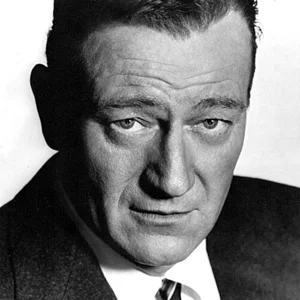

John Wayne was an American actor, director and producer, an iconic figure of the Hollywood western. Nicknamed “Duke,” he embodied the ideal of the cowboy and the rugged American hero in more than 150 films over a five-decade career.
John Wayne(1907 — 1979)
John Wayne
États-Unis
6 min read
Frequently asked questions
Famous Quotes
« Courage is being scared to death, but saddling up anyway.»
« Life is hard; it's even harder when you're stupid.»
Key Facts
- Born on May 26, 1907, in Winterset, Iowa, under the name Marion Robert Morrison.
- Made his breakthrough in 1939 with John Ford's film *Stagecoach*, which launched his career.
- Worked regularly with director John Ford, notably in *The Searchers* (1956).
- Won the Academy Award for Best Actor in 1970 for *True Grit*.
- Died on June 11, 1979, in Los Angeles; received the Congressional Gold Medal posthumously.
Works & Achievements
John Ford's Western that brought him to public attention and truly launched his career as a star.
Under the direction of Howard Hawks, he plays a hard, ambiguous character that revealed the full range of his acting.
A war film that earned him his first Oscar nomination and reinforced his image as a patriotic hero.
John Ford's Western, often cited among the greatest American films; his role as Ethan Edwards is one of his most complex.
Howard Hawks's Western, which became a classic of the genre, in which he plays a besieged sheriff.
A historical epic that he directed, produced, and financed himself, out of passion for this American myth.
His role as the one-eyed marshal Rooster Cogburn, which finally earned him the Oscar for Best Actor.
His final film: he plays an aging gunfighter dying of cancer, a haunting echo of his own life.
Anecdotes
Born Marion Robert Morrison in Winterset, Iowa, in 1907, he was given the nickname “Duke” as a child. It wasn't a title of nobility: he was inseparable from his dog, an Airedale terrier named Duke, and the neighborhood firefighters ended up calling him “Little Duke.” The nickname stuck with him for the rest of his life.
A standout American football player, he earned a scholarship to the University of Southern California (USC). An injury during a bodysurfing session ended his athletic career. He then took a small job as a prop man at the studios, where director John Ford noticed him.
After about a decade spent making obscure “B-movie” westerns, John Ford gave him the lead role in *Stagecoach* (1939). The film made him a star almost overnight, at the age of 32.
At 62, he finally won the Academy Award for Best Actor for *True Grit*, in which he played a grizzled, one-eyed old marshal. As he came up to collect his statuette, he joked: “If I'd known, I'd have put on that eye patch 35 years sooner!”
In 1964, one of his lungs was removed because of cancer. Instead of hiding his illness as the studios advised, he held a press conference to talk about it publicly and encourage people to get screened — a rare gesture at the time. He called the disease “the Big C.”
Primary Sources
“Wow! If I'd known, I would have put this eye patch on 35 years sooner.”
“I believe in white supremacy until the blacks are educated to a point of responsibility.” This statement, which has remained infamous, is today at the heart of critical reassessments of his image.
“Oscar and I have something in common. Oscar made his appearance in Hollywood in 1928; so did I. We're both a little weathered by time, but we're still here.”
Key Places
Small Midwestern town where Marion Morrison was born in 1907. His birthplace is today a museum.
Town in the suburbs of Los Angeles where he grew up after his family moved there. He attended high school in the area.
He earned a football scholarship here before an injury cut short his athletic career and drew him toward the movies.
Natural landscape of red sandstone buttes where John Ford shot many of his westerns with Wayne. The site became the very image of the American West.
Seaside resort where Wayne spent his final years and moored his yacht, the Wild Goose, a converted former minesweeper.
Hospital where he died in June 1979, at age 72, from stomach cancer.
Typical Objects

Wide felt hat with curved brims, John Wayne's trademark on screen. It became the universal symbol of the Hollywood cowboy.

Iconic cylinder revolver of the conquest of the West, nicknamed the “Peacemaker.” Wayne draws it in most of his westerns.

Repeating rifle reloaded with a flick of the wrist. In *True Grit*, Wayne twirls a shortened version during a famous scene.

Black patch worn by Wayne in the role of the one-eyed marshal Rooster Cogburn (*True Grit*). This detail earned him his Oscar and became inseparable from the character.

Sturdy leather saddle, fitted with a horn for coiling the lasso, designed for long rides. A seasoned rider, Wayne did his own riding in his films.

Heavy studio camera that filmed his westerns in blazing colors. The shift from black-and-white to Technicolor accompanied his entire career.
School Curriculum
Vocabulary & Tags
Key Vocabulary
Tags
Daily Life
Morning
On filming days, John Wayne got up before dawn: he had to be at the studio by 5 or 6 a.m. for makeup and costumes. On his outdoor shooting locations, such as Monument Valley, the day often began at sunrise to take advantage of the light.
Afternoon
The afternoon was spent running through takes under scorching heat, on horseback, and sometimes performing certain stunts himself. Off set, he ran his own production company, Batjac, which allowed him to choose his own projects.
Evening
In the evening, he liked to dine with friends from the film world, play chess or cards, and talk late into the night. A heavy smoker, he went through large quantities of cigarettes, a habit that ultimately ruined his health.
Food
His diet was typically American and hearty: steaks, eggs, filling dishes. He also enjoyed alcohol, especially tequila, and smoked Camel cigarettes for decades, until his lung cancer in 1964.
Clothing
On screen, he wore the cowboy's uniform: a Stetson hat, shirt, vest, neckerchief, boots, and gun belt. In life, he stuck to a casual yet elegant style, often inspired by that same imagery of the West.
Housing
After a modest childhood in California, he experienced the wealth of Hollywood's great stars. He ended his life in a sprawling residence in Newport Beach, by the ocean, and owned a yacht, the *Wild Goose*, a former warship converted into a pleasure craft.
Historical Timeline
Period Vocabulary
Liens externes & ressources
Références
Œuvres
La Chevauchée fantastique (Stagecoach)
1939
La Rivière rouge (Red River)
1948
Rio Bravo
1959
Cent dollars pour un shérif (True Grit)
1969