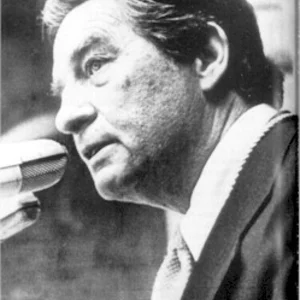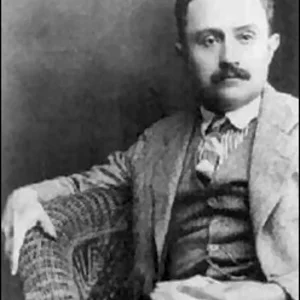

Mexican philosopher, politician, and writer (1882–1959), a towering figure of post-Revolutionary Mexico. As Secretary of Education, he launched a sweeping national literacy program and became the patron of the muralist movement. Author of “La Raza Cósmica,” he developed a theory of a mestizo Latin American identity.
José Vasconcelos(1881 — 1959)
José Vasconcelos
Mexique
7 min read
Frequently asked questions
Famous Quotes
« Por mi raza hablará el espíritu.»
« El exceso de lógica empobrece la imaginación.»
Key Facts
- 1882: born in Oaxaca, Mexico
- 1921–1924: Secretary of Public Education under Obregón; launches a national literacy program
- 1925: publishes “La Raza Cósmica,” a manifesto of mestizo American identity
- 1929: runs for president of Mexico, defeated in a disputed election
- 1937–1938: shifts toward controversial conservative nationalist positions
Works & Achievements
A major philosophical essay in which Vasconcelos theorizes the emergence of a "cosmic race" born from racial mixing in Latin America. A founding work of contemporary Latin American identity, still studied in universities around the world.
A landmark political achievement: in four years, Vasconcelos established thousands of rural schools, trained teachers, and sent mobile teams into isolated villages. This program remains one of the greatest educational initiatives in Mexican history.
The first volume of Vasconcelos's memoirs, considered a masterpiece of Mexican literature. This autobiographical narrative traces his intellectual development and revolutionary commitment in vivid, deeply personal prose.
An essay in which Vasconcelos develops his vision of Ibero-American civilization as an original synthesis of Spanish, indigenous, and African heritages, written in response to the theories of Anglo-Saxon cultural imperialism.
An early philosophical work in which Vasconcelos builds an aesthetic theory grounded in the unity of cosmic energy and the central role of art in human life, laying the foundations for all his later thought.
The second volume of Vasconcelos's memoirs, recounting the revolutionary years and his involvement in the political struggles of the 1910s. A valuable firsthand account of the Mexican Revolution from the inside.
Anecdotes
Appointed Minister of Education in 1921 by President Obregón, Vasconcelos launched one of the largest literacy campaigns in Latin American history. He sent hundreds of itinerant teachers into the most remote rural areas of Mexico aboard trains converted into mobile classrooms — the famous “Misiones Culturales.” In less than four years, thousands of Mexicans learned to read and write.
Convinced that art should serve the people, Vasconcelos entrusted the walls of public buildings to young painters who were then little known: Diego Rivera, José Clemente Orozco, and David Alfaro Siqueiros. This is how the Mexican muralist movement was born — one of the most influential artistic movements of the 20th century. Vasconcelos imposed one constraint, however: the frescoes had to tell the story of the Mexican people, not that of the elites.
In 1929, Vasconcelos ran for president against the official candidate of the ruling party. Convinced he had won, he believed the victory had been stolen from him through massive fraud, and chose exile rather than accept the result. This episode, which he recounted in his memoirs with bitterness, left a lasting mark on his view of Mexican politics.
It was Vasconcelos who chose the motto of the National Autonomous University of Mexico (UNAM): “Por mi raza hablará el espíritu” (The spirit shall speak for my race). This phrase encapsulates his entire philosophy of the “raza cósmica” — the idea that the mestizo peoples of Latin America were destined to create a universal civilization transcending the racial divisions inherited from colonialism.
In his later years, Vasconcelos became increasingly radicalized and made controversial statements, including admiring remarks about European authoritarian regimes. This man who had devoted his life to popular education and mestizo pride ended up taking positions that shocked many of his former admirers, and his complex trajectory remains a subject of debate among Mexican historians.
Primary Sources
“The historical mission of America will be to define, crystallize, and propagate the fifth race — the synthetic race, or integral race — formed from the genius and blood of all peoples, and for that very reason more capable of true brotherhood and a truly universal vision.”
“We were young, we were revolutionaries, we believed that anything was possible. Education, it seemed to us, could transform a country in a generation, if only we applied ourselves with enough passion and method.”
“The school must be the center of national life. It is not merely a room where one learns to read; it is the place where the soul of a people is forged.”
“Ibero-America will not be saved by imitating the Anglo-Saxons, nor by a simple return to indigenous cultures. It will be saved by the living synthesis of all its racial and cultural components.”
Key Places
Birthplace of José Vasconcelos, in the state of Oaxaca in southern Mexico. This region, with its large indigenous population (Zapotecs, Mixtecs), profoundly shaped his thinking on mestizaje and Mexican identity.
Building inaugurated in 1922 where Vasconcelos coordinated major educational reforms and commissioned Diego Rivera to paint more than 230 murals depicting the history of the Mexican people.
Vasconcelos became its first rector when the university was reorganized in 1920, giving it its motto and seal and envisioning it as the intellectual engine of post-revolutionary national reconstruction.
Vasconcelos spent extended periods in Paris during his various exiles. French philosophy and literature had a lasting influence on his thought — he admired them deeply while still championing the distinctiveness of Latin American culture.
The institution Vasconcelos directed from 1948 until his death in 1959. He spent his final years there surrounded by books, continuing to write his memoirs and to champion his ideas on Mexican cultural identity.
Typical Objects

Vasconcelos was an insatiable reader and prolific writer. His personal library held thousands of works on philosophy, literature, and history, all heavily annotated in his hand.

As Minister of Education, Vasconcelos constantly carried draft legislation, school construction plans, and inspection reports — renowned for his exceptional capacity for work.

The Misiones Culturales used train cars converted into mobile classrooms to reach the most isolated villages in Mexico, a living symbol of Vasconcelos's commitment to universal education.

Although Vasconcelos was not a painter himself, he was the patron and intellectual guide of the muralist movement: he chose the themes, negotiated with the artists, and supervised the works on site.

Vasconcelos designed the emblem of the National Autonomous University of Mexico and wrote its motto. That seal, stamped on every Mexican university diploma, remains one of his most visible legacies.

For his literacy program, Vasconcelos had millions of copies of classic texts printed and distributed — *Don Quixote*, the *Iliad*, the *Divine Comedy* — convinced that the people deserved the greatest works of human civilization.
School Curriculum
Vocabulary & Tags
Key Vocabulary
Tags
Daily Life
Morning
Vasconcelos rose early and began his day with intensive reading. During his years as minister, he arrived at his office in the Secretaría de Educación Pública at dawn, reviewing reports from the Misiones Culturales and signing decrees for the construction of new schools.
Afternoon
His afternoons were devoted to visiting school construction sites, meeting with muralists Diego Rivera or Orozco, and receiving officials and teachers who had traveled from across the country. He often traveled by train to inspect literacy programs in rural states.
Evening
In the evenings, Vasconcelos hosted writers, philosophers, and artists at intellectual salons in Mexico City. He wrote his essays and speeches at night, often until the early hours, driven by an energy his contemporaries described as inexhaustible.
Food
Like many educated Mexicans of his era, Vasconcelos enjoyed traditional Mexican cuisine: tamales, mole, corn tortillas. During his stays in Europe, he adapted to local food while retaining a preference for the flavors of his homeland.
Clothing
Vasconcelos dressed as a statesman and intellectual: dark suit, white shirt, and tie, in keeping with the conventions of Mexico's educated bourgeoisie at the turn of the twentieth century. He took care of his appearance, conscious of the public image he was expected to project.
Housing
During his years as minister, he lived in a bourgeois apartment in central Mexico City. His various exiles led him to live in more modest circumstances — sometimes in boarding houses in Paris, Los Angeles, or New York — where he continued to write without pause.
Historical Timeline
Period Vocabulary
Liens externes & ressources
Références
Œuvres
La Raza Cósmica
1925
Programme national d'alphabétisation et Misiones Culturales
1921-1924
Ulises Criollo
1935
Indología
1926
El monismo estético
1918
La Tormenta
1936