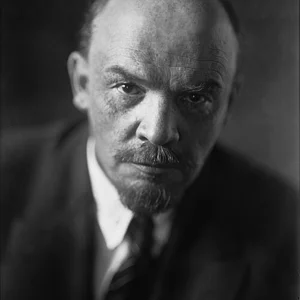

Russian revolutionary and Marxist theorist (1870–1924), Lenin led the Bolshevik Revolution of October 1917 and founded the Soviet Union. He developed Leninism, an adaptation of Marxism to Russian conditions.
Vladimir Lenin
Vladimir Ilyich Ulyanov, known as Lenin
Union soviétique, Empire russe, Russie soviétique
8 min read
Frequently asked questions
Famous Quotes
« Liberty is so precious that it must be rationed.»
« There are decades where nothing happens; and there are weeks where decades happen.»
Key Facts
- 1870: Born in Simbirsk (Russia)
- 1903: Founded the Russian Social Democratic Labour Party (Bolshevik faction)
- October 1917: Led the Bolshevik Revolution and overthrew the Provisional Government
- 1918–1921: Led Soviet Russia through the Civil War and implemented the Red Terror
- 1922: Founded the Union of Soviet Socialist Republics (USSR)
- 1924: Died in Gorki; interred in a mausoleum on Red Square in Moscow
Works & Achievements
The founding text of Leninism, in which Lenin theorizes the organization of a professional, centralized revolutionary party capable of leading the proletariat toward revolution.
A major economic analysis explaining the First World War as an inevitable consequence of monopoly capitalism seeking new markets and territories.
A radical political program demanding the transfer of power to the soviets, an immediate end to the war, and the nationalization of land, steering the Bolsheviks toward revolution.
A theoretical treatise on the nature of the bourgeois state and the necessity of destroying it through revolution in order to establish the dictatorship of the proletariat, as a prelude to a classless society.
The first decrees of Soviet power: the Decree on Peace proposed a general armistice with no annexations or indemnities, while the Decree on Land abolished the private ownership of large estates.
A pragmatic reform temporarily reintroducing market mechanisms to revive a Russian economy exhausted by the civil war and the catastrophic famine of 1921.
Lenin's major political achievement: the Union of Soviet Socialist Republics formally united Russia, Ukraine, Byelorussia, and Transcaucasia under a socialist federation.
Anecdotes
In April 1917, Lenin returned to Russia from Switzerland aboard what became known as the 'sealed train' — carriages that had been negotiated as neutral territory with Germany. The Germans hoped he would stir up chaos in Russia and force the country out of the war. This risky gamble changed the course of world history.
After the failed insurrection attempt of July 1917, Lenin was forced to flee Petrograd in disguise: he shaved his beard, put on a wig, and passed himself off as a locomotive driver. He hid in Finland until October, continuing to write his political texts in secret.
On August 30, 1918, Lenin was seriously wounded by two bullets in an assassination attempt carried out by Fanny Kaplan, a Socialist-Revolutionary militant. One of the bullets remained lodged in his shoulder until his death and had a lasting impact on his health. The attack triggered the Red Terror against opponents of the Bolshevik regime.
Lenin had a passion for the outdoors and particularly loved picking mushrooms during his rare moments of relaxation in the countryside. Those close to him recall that he could set aside affairs of state for a while to enjoy this simple activity, which he had practiced since childhood in Simbirsk.
Lenin spoke fluent German, French, and English, and could also read Latin and Greek. During his years of exile in Europe, he was a devoted regular at the libraries of Geneva, Paris, London, and Zurich, filling dozens of notebooks as he prepared his theoretical works.
Primary Sources
Give us an organization of revolutionaries, and we will overturn the whole of Russia!
The war being waged by the Provisional Government of Lvov and Co. is an imperialist predatory war by reason of the capitalist nature of that government; it cannot end in a truly democratic, non-coercive peace without the overthrow of capital.
The state is a product and a manifestation of the irreconcilability of class antagonisms. The state arises where, when and insofar as class antagonism objectively cannot be reconciled.
Imperialism is capitalism at that stage of development at which the dominance of monopolies and finance capital is established; in which the export of capital has acquired pronounced importance.
Comrade Stalin, having become Secretary-General, has unlimited authority concentrated in his hands, and I am not certain whether he will always be capable of using that authority with sufficient caution.
Key Places
Lenin's birthplace, where he grew up in a family of teachers and was deeply marked by the execution of his brother Alexander in 1887.
The epicenter of the 1917 revolutions; it was from the Smolny Institute that Lenin directed the Bolshevik October uprising and formed the first Soviet government.
Lenin's main city of exile between 1914 and 1917, where he frequented the cantonal library and wrote *Imperialism* before returning to Russia aboard the sealed train.
The seat of Soviet power from March 1918; Lenin established the Bolshevik government there and lived in a modest apartment until his illness.
The country estate where Lenin withdrew during his prolonged illness and where he died on 21 January 1924 after three successive strokes.
Lenin stayed here several times during his exile, frequented the British Museum library, and met Trotsky; it was in London that the 2nd Congress of the RSDLP was held in 1903.
Typical Objects

A symbol of his identification with the proletariat, Lenin often wore the flat cap of the working class rather than the bourgeois hat, visually asserting his allegiance to the laboring masses.

Lenin filled dozens of notebooks with theoretical and political notes, written in several languages, accumulated in European libraries during his years of exile.

*Das Kapital* and Marx's writings were his fundamental reference; he annotated them extensively and built his entire political thought upon this theoretical foundation.

A formidable orator, Lenin wielded public speech as a political weapon; his appearances at the podium of the Petrograd Soviet or Red Square galvanized the revolutionary crowds.

A decisive strategic instrument during the October Revolution: seizing the Petrograd telegraph exchange allowed the Bolsheviks to control the flow of information and coordinate their actions across the entire country.

After the assassination attempt of 1918, Lenin and the Bolshevik leaders were placed under permanent close protection; the handgun symbolizes the violence and insecurity that defined the entire revolutionary period.

Founded in 1912, this Bolshevik newspaper was the party's central propaganda tool; Lenin published numerous articles in it and closely controlled its editorial line from abroad.
School Curriculum
Vocabulary & Tags
Key Vocabulary
Tags
Daily Life
Morning
Lenin rose early, around seven o'clock, and invariably began with reading newspapers and political reports. He would then draft articles, letters, or theoretical notes, sometimes working for hours on end with remarkable concentration.
Afternoon
Afternoons were devoted to Central Committee meetings, interviews with foreign delegates or people's commissars, and directing state affairs from his spartan office in the Kremlin. He often dictated instructions and speeches to his secretary Fotiyeva.
Evening
Evenings sometimes saw Lenin attend the opera or concerts, which he genuinely enjoyed — Beethoven in particular — though he resisted letting himself be too moved by them. He frequently discussed matters with Nadezhda Krupskaya or close comrades before returning to his reading late into the night.
Food
Lenin followed a simple, frugal diet and gave little thought to food. He enjoyed black bread, cabbage soup (*shchi*), and mushrooms picked in the countryside. During the years of the civil war, he shared the food rationing imposed on the population and refused any special dietary privileges.
Clothing
He wore plainly cut suits — bourgeois in form but worn casually — often paired with the flat worker's cap that had become his visual trademark. His clothes were functional and well-worn, kept in order by Krupskaya; he attached little importance to his appearance.
Housing
In exile, he lived in modest rented lodgings, often one or two rooms shared with Krupskaya, moving frequently between countries (Switzerland, France, England, Poland). At the Kremlin, he occupied a small, austerely furnished apartment, refusing all ostentatious luxury despite pressure to move somewhere more comfortable.
Historical Timeline
Period Vocabulary
Visual Style
Esthétique constructiviste soviétique des années 1917-1924 : affiches de propagande en rouge et noir à fort contraste, photographies documentaires des meetings révolutionnaires, compositions géométriques héritées de Rodchenko et El Lissitzky.
Sound Ambience
L'univers sonore de Lénine mêle le fracas des révolutions de rue à Petrograd, le cliquetis des télégraphes bolcheviques, les trains à vapeur de l'exil européen et les chants révolutionnaires des masses ouvrières russes.
Liens externes & ressources
Références
Œuvres
Que faire ?
1902
L'Impérialisme, stade suprême du capitalisme
1916
Les Thèses d'Avril
avril 1917
L'État et la Révolution
1917
Décrets sur la paix et sur la terre
octobre 1917
Nouvelle Politique Économique (NEP)
1921
Fondation de l'URSS
30 décembre 1922