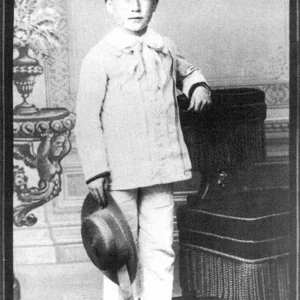

Joseph Meister is known for being the first human successfully vaccinated against rabies by Louis Pasteur in 1885, when he was only 9 years old. This historic vaccination marked a decisive turning point in the history of modern medicine.
Joseph Meister(1876 — 1940)
Joseph Meister
France
7 min read
Frequently asked questions
Key Facts
- 1876: Joseph Meister is born in Steige, Alsace
- July 6, 1885: Severely bitten by a rabid dog, he is brought to Louis Pasteur
- July 6–16, 1885: Pasteur administers a series of 13 injections of the experimental rabies vaccine
- Joseph Meister survives and becomes the first human cured of rabies through vaccination
- He later worked as a gatekeeper at the Institut Pasteur in Paris until his death in 1940
Works & Achievements
Joseph Meister was the first human being to survive thanks to Pasteur's rabies vaccine. This event became the founding symbol of modern vaccination and preventive medicine on a worldwide scale.
Meister's survival triggered a wave of popular and scientific support that made it possible to fund the construction of the Institut Pasteur. His recovery was the decisive argument for more than two million donors around the world.
For forty-five years, Joseph Meister watched over the Institut Pasteur as concierge and caretaker. He welcomed thousands of visitors and protected the tomb of his benefactor, embodying in living form the gratitude owed to science.
Anecdotes
On July 4, 1885, nine-year-old Joseph Meister was attacked by a rabid dog near his village of Geiswiller in Alsace. He suffered fourteen deep bites to his hands, legs, and thighs. His desperate mother decided to take him to Paris as a last resort: to consult the renowned scientist Louis Pasteur.
Pasteur was not a physician, which made the situation legally and ethically delicate. Convinced that the boy would die without intervention, he nonetheless decided to administer his experimental vaccine, which had never been tested on a human being. From July 6 to 16, 1885, Joseph received thirteen injections of rabbit spinal cord material, progressively less attenuated. He survived and remained in perfect health.
Grateful to the man who had saved his life, Joseph Meister became a caretaker at the Institut Pasteur in Paris, a position he held for nearly forty-five years. He watched over the place like a sanctuary and gladly accompanied visitors to the crypt where his benefactor lay at rest.
In June 1940, German soldiers who had just occupied Paris arrived at the Institut Pasteur and demanded that Joseph Meister open Pasteur's crypt. Devastated at the thought of allowing the tomb of the man to whom he owed his life to be desecrated, he took his own life on June 24, 1940. His tragic death is often cited as a final act of absolute devotion to Pasteur's memory.
Primary Sources
A 9-year-old boy, Joseph Meister, bitten on July 4 by a rabid dog, was brought to me on July 6 by his mother. [...] Today, three and a half months after the accident, his health is perfect.
The commission acknowledges that M. Pasteur's anti-rabies treatment, administered to Joseph Meister, prevented the development of rabies in this child, who had been fatally bitten by a dog confirmed to be rabid.
July 7, 1885, second inoculation. The child is doing well, sleeping well, eating well. No signs of infection. Confidence in the progress of attenuation.
Sir, my son has been bitten by a rabid dog and we no longer know who to turn to. We have been told that you alone might be able to save him. We place our trust in your science and your kindness.
Key Places
Birthplace of Joseph Meister, located in Alsace, which had been annexed by the German Empire after 1871. It was near this village that he was attacked by a rabid dog on July 4, 1885.
The laboratory where Louis Pasteur had been conducting his research on rabies since 1882. It was here that Joseph Meister was brought by his mother, and where the thirteen vaccine injections were administered to him in July 1885.
Founded in 1888 through an international fundraising campaign largely sparked by Meister's recovery, the Institut Pasteur became Joseph Meister's workplace and home until his death in 1940.
The vault where Louis Pasteur has rested since 1895, located beneath the Institut Pasteur. Joseph Meister served as its devoted guardian, and it was before this crypt that the final chapter of his life played out in June 1940.
It was before this prestigious institution that Pasteur presented, on October 26, 1885, the results of Meister's vaccination — announcing to the world humanity's first victory over rabies.
Typical Objects

The instrument Pasteur used to inject the rabies vaccine into Joseph Meister. In the nineteenth century, these glass-and-metal syringes were flame-sterilized before each use and stood at the cutting edge of experimental medicine.

Pasteur's vaccine was prepared from the spinal cords of rabbits inoculated with the rabies virus, then dried over several days to weaken its virulence. These fragile vials contained the very substance that saved Joseph Meister's life.

Pasteur meticulously recorded every injection, the child's reactions, and his clinical observations in his notebooks. These notebooks, preserved at the Bibliothèque nationale de France, bear witness to the rigorous, meticulous monitoring of Meister's treatment.

A symbol of Joseph Meister's role as guardian of the Institut Pasteur. These keys represented his mission to watch over the place and the memory of the man who had saved his life — a loyalty he carried until his death.

The central tool of Pasteurian microbiology, used to observe bacteria and infected tissues. Without it, developing the rabies vaccine and understanding the mechanisms of the disease would not have been possible.

Joseph Meister was wearing the typical clothing of a rural Alsatian child at the time of the attack: a linen smock, short trousers, wool stockings, and wooden clogs. Alsace was then under German administration following the defeat of 1871.
School Curriculum
Vocabulary & Tags
Key Vocabulary
Daily Life
Morning
The son of an Alsatian grocer, young Joseph started his days early, helping at the family shop before heading to the village school. Like all children from rural backgrounds in Alsace in the 1880s, his mornings were shaped by household chores and lessons sometimes taught in German since the annexation.
Afternoon
After school, children played in the village lanes or along the fields and footpaths. It was during one of these ordinary afternoons, on July 4, 1885, that Joseph was attacked by a rabid stray dog — a dramatic accident that would change the history of medicine.
Evening
Evenings in the Meister household, like those of many modest Alsatian families, unfolded by the light of oil lamps. After the attack and the long journey to Paris, Joseph's evenings were for a long time marked by medical care, Pasteur's observations, and the anguish of waiting.
Food
In rural Alsace at the end of the nineteenth century, food was simple and hearty: sauerkraut, potatoes, rye bread, smoked bacon, and garden vegetables. Meat was reserved for Sundays and holidays. Well water or spring water was the everyday drink, sometimes replaced by milk or a little local beer.
Clothing
Joseph Meister wore the typical clothes of Alsatian children from modest backgrounds: a coarse linen smock over a shirt, short trousers, woollen stockings, and wooden clogs for everyday wear. On Sundays, neater clothes were put on, sometimes adorned with the embroidery of the traditional Alsatian costume.
Housing
The Meister family lived in a half-timbered house typical of Alsatian villages, with a large common room serving as kitchen and living area, heated by a tiled stove. The bedrooms were small, children often shared a bed, and the kitchen garden supplied part of the family's food.
Historical Timeline
Period Vocabulary
Liens externes & ressources
Références
Œuvres
Première vaccination antirabique humaine réussie
6-16 juillet 1885
Catalyseur de la souscription internationale pour l'Institut Pasteur
1885-1888
Gardiennage et préservation de la mémoire pasteurienne
1895-1940