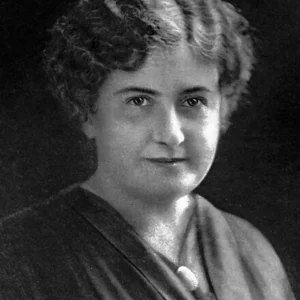

Italian physician and educator
Maria Montessori(1870 — 1952)
Maria Montessori
royaume d'Italie, Italie
8 min read
Frequently asked questions
Key Facts
- En 1896, Maria Montessori devient l'une des premières femmes médecins d'Italie après avoir étudié à l'université de Rome malgré les obstacles liés à son genre.
- En 1907, elle ouvre la première « Casa dei Bambini » (Maison des enfants) dans un quartier populaire de Rome, où elle expérimente sa méthode pédagogique avec de jeunes enfants.
- Entre 1907 et 1920, sa méthode se diffuse rapidement dans le monde entier, avec l'ouverture d'écoles Montessori aux États-Unis, en Europe et en Asie.
- En 1929, elle fonde l'Association Montessori Internationale (AMI) à Berlin pour coordonner le développement de sa pédagogie à l'échelle mondiale.
- Exilée par le régime fasciste de Mussolini dans les années 1930, elle continue à former des enseignants et à développer sa méthode depuis l'Espagne, l'Inde et les Pays-Bas.
Works & Achievements
Founding work of Montessori pedagogy, describing the sensorial materials, the prepared environment, and the role of the educator as a guide. Translated into more than twenty languages, it remains the definitive reference for the method.
Extension of the method to elementary school children (ages 6–12), introducing materials for mathematics, grammar, and geography. Montessori lays the groundwork here for what would become cosmic education.
An essay in which Montessori presents her vision of the child as bearer of a spiritual and creative potential unrecognized by adults. One of her most accessible and widely read texts around the world.
Her major work of maturity, grounded in her observations in India, describing how children from 0 to 6 years absorb their environment first unconsciously, then consciously. The theoretical foundation of all Montessori 0–6 teacher training.
The first concrete application of the method, opened in a social housing block in Rome for children aged 3 to 6 from working-class families. Its immediate and well-documented success launched the Montessori movement on an international scale.
Organization founded in Berlin with her son Mario to coordinate teacher training and ensure fidelity to the method. The AMI today has training centers in more than 110 countries.
Anecdotes
In 1896, Maria Montessori became one of the first women to obtain a medical degree in Italy, at the University of Rome. To be admitted to anatomy classes, she had to dissect cadavers alone in the evenings, as mixed-gender presence was considered indecent by her professors.
While observing children considered 'mentally deficient' at Rome's psychiatric asylum, Montessori noticed that they picked up bread crumbs not out of hunger, but out of a need to manipulate objects. She then understood that these children suffered from a lack of stimulation, not an innate incapacity.
On January 6, 1907, Montessori opened her first 'Casa dei Bambini' in the disadvantaged neighborhood of San Lorenzo in Rome. She furnished it with small tables and chairs sized for children, appropriate educational materials, and let children freely choose their activities — a total revolution for the time.
In 1929, Montessori founded the Association Montessori Internationale (AMI) in Berlin with her son Mario. When fascist and Nazi regimes banned her schools in the 1930s, she left Europe for India, where she developed her ideas during World War II and trained thousands of teachers.
At the end of her life, Montessori was nominated three times for the Nobel Peace Prize (1949, 1950, 1951), in recognition of her commitment to the child as the foundation of a peaceful society. She died in 1952 in the Netherlands, at the age of 81, in the midst of working on new educational projects.
Primary Sources
«The child possesses within himself a psychic life that is only waiting to develop. Our duty is not to teach him, but to offer him an environment where this life can freely flourish.»
«The freedom we give to the child is not the absence of rules; it is the freedom to choose one's activity within a prepared environment that naturally guides toward the good and the beautiful.»
«The child is not a vessel that we fill, but a spring that we allow to flow. The absorbent mind of the child from 0 to 6 years acquires everything in its surroundings without effort and without fatigue.»
«Education is the most powerful weapon for peace in the world. If humanity wishes to save itself, it is through the child that it will find its way.»
Key Places
Birthplace of Maria Montessori, on August 31, 1870. The family home is today a museum retracing the early years of the educator.
Site of the first Casa dei Bambini, opened on January 6, 1907 in the working-class district of San Lorenzo. It is here that the Montessori method took shape with children of the people.
University where Montessori obtained her medical degree in 1896 and where she later taught hygiene and pedagogical anthropology. A symbolic place of her dual scientific and educational vocation.
City where Montessori settled in the 1930s and where the Association Montessori Internationale, founded in 1929, is based. The AMI still trains certified educators from around the world there today.
Montessori trained thousands of Indian teachers between 1939 and 1946, stranded by the war. In this context, she developed her concept of 'Cosmic Education' for children aged 6 to 12.
Typical Objects

Montessori herself designs wooden objects with graduated dimensions that children manipulate independently to develop their senses and logic. Each piece fits in only one place, making errors visible without adult intervention.

Cardboard boards on which the letters of the alphabet are cut out in sandpaper, allowing the child to trace the shape with their fingers. This multisensory approach prepares for writing and reading simultaneously.

In the Casas dei Bambini, children wear small aprons adapted to their size, a symbol of their autonomy and real activity. Montessori insists on practical clothing that allows independence in everyday gestures.

Montessori remains a physician throughout her life and applies scientific rigor to the observation of children, measuring their progress like a clinician. Her medical observation notebooks are at the origin of her pedagogical method.

Montessori develops wooden puzzle-maps representing the continents and countries, which children manipulate to learn geography in a concrete way. These materials still exist in Montessori classrooms around the world.

Montessori has furniture made to the dimensions of children aged 3 to 6, revolutionizing school furnishing. This adapted furniture allows the child to organize their own workspace and move their belongings with complete autonomy.
School Curriculum
Vocabulary & Tags
Key Vocabulary
Daily Life
Morning
Montessori rises early and devotes her mornings to careful observation of the children in the Casa dei Bambini, notebook in hand, recording every behavior without intervening. She checks that the prepared environment is in order and that the sensorial materials are complete and in good condition before the children arrive.
Afternoon
The afternoon is reserved for writing, international correspondence, and conference preparation. Montessori often receives educators, journalists, and notable figures from around the world who come to observe her method, which she explains with scientific rigor and great passion.
Evening
In the evenings, Montessori reads extensively — medicine, psychology, philosophy — and takes detailed notes in her personal journals. She maintains a dense correspondence with educational reformers, politicians, and European and American intellectuals.
Food
Montessori follows a simple, Mediterranean diet — bread, vegetables, cheeses, olive oil — in keeping with her interest in hygiene and public health, which she teaches at the university. She places great importance on regular mealtimes and their educational dimension for children.
Clothing
Montessori wears long, understated dresses typical of educated Italian bourgeois women of the Belle Époque — black, dark grey, or burgundy — with immaculate white collars. Her attire reflects her status as a doctor and woman of science who must constantly assert herself in a male-dominated world.
Housing
In Rome, Montessori lives in bourgeois apartments in the city center, close to the university and her schools. After 1934, she lives in exile in Amsterdam in a modest working home, surrounded by books, pedagogical files, and prototypes of sensorial materials under development.
Historical Timeline
Period Vocabulary
Visual Style
Esthétique chaleureuse et épurée de l'Italie du début du XXe siècle — bois naturel, lumière méditerranéenne, matériel sensoriel géométrique aux tons naturels sur fond de murs crème.
Sound Ambience
Ambiance sonore douce et active d'une Casa dei Bambini romaine du début du XXe siècle, mêlant le travail autonome des enfants et les sons de la ville populaire de San Lorenzo.
Liens externes & ressources
Références
Œuvres
Il Metodo della Pedagogia Scientifica
1909
Pedagogia Scientifica — L'Autoeducazione
1916
The Secret of Childhood (Il Segreto dell'Infanzia)
1936
The Absorbent Mind (La Mente del Bambino)
1949
Casa dei Bambini de San Lorenzo
1907
Fondation de l'Association Montessori Internationale (AMI)
1929