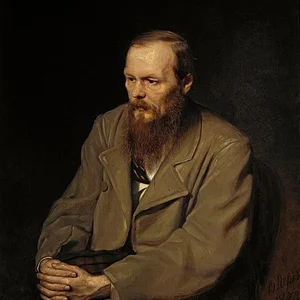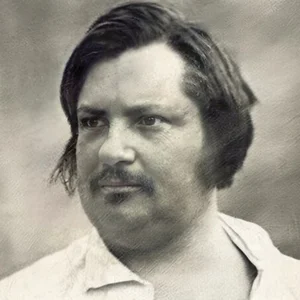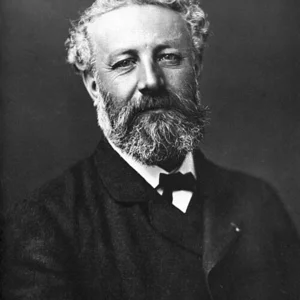

A French writer of the 19th century, Jules Verne is considered the father of science fiction. His adventure novels blending exploration, technology, and imagination captivated generations of readers and continue to influence literature and cinema.
Jules Verne(1828 — 1905)
Jules Verne
France
7 min read
Frequently asked questions
Famous Quotes
« Science, my lad, is made up of mistakes, but they are mistakes which it is useful to make, because they lead little by little to the truth.»
« Everything a man can imagine, other men can make real.»
Key Facts
- 1863: Publication of 'Five Weeks in a Balloon', his first major literary success
- 1870: Publication of 'Twenty Thousand Leagues Under the Seas', a landmark work of speculative fiction
- 1873: Publication of 'Around the World in Eighty Days'
- 1874–1905: Prolific output of approximately 60 science fiction and adventure novels
- Prediction of future technologies: submarines, electric vehicles, space travel
Works & Achievements
The first novel in the 'Extraordinary Voyages' series, it launched Verne's collaboration with Hetzel and established his formula: adventure, science, and geography intertwined.
An imaginary exploration of the Earth's depths showcasing Verne's enthusiasm for geology and the emerging natural sciences.
A visionary novel describing a space journey by cannon, foreshadowing with uncanny accuracy certain real aspects of twentieth-century lunar missions.
Verne's masterpiece, imagining the submarine Nautilus and the mysterious Captain Nemo, iconic figures in world literature.
A worldwide success featuring Phileas Fogg in a race against the clock, symbolizing the acceleration of the world in the age of railways and steam.
A scientific Robinsonade in which castaways rebuild a civilization through their technical knowledge, a hymn to progress and resourcefulness.
An epic adventure set in Tsarist Russia, one of Verne's most popular novels, adapted numerous times for stage and screen.
Anecdotes
At the age of eleven, Jules Verne attempted to secretly board a merchant ship in Nantes to sail to the Indies. His father barely caught up with him at Paimbœuf. Young Jules reportedly promised: 'From now on, I will only travel in dreams.' This promise became the driving force behind his entire literary work.
Jules Verne was a close friend of publisher Pierre-Jules Hetzel, who played a decisive role in his career. Hetzel initially rejected the manuscript of 'Five Weeks in a Balloon', then bought it back and published it in 1863, launching the 'Extraordinary Voyages' series. Without this visionary publisher, Verne might have abandoned literature altogether.
In 1872, Verne settled in Amiens with his family. He led a highly structured life: rising at 5 in the morning, writing until 11, then various other activities. In this way he wrote more than eighty novels, often working on several manuscripts simultaneously, with an almost scientific rigor.
Jules Verne owned a yacht, the Saint-Michel III, aboard which he sailed the Mediterranean and along the European coasts. These sea voyages directly fed into his maritime novels, most notably 'Twenty Thousand Leagues Under the Sea'. He was as much a man of action as a man of letters.
In 1886, Jules Verne was the victim of an attack: his nephew Gaston, suffering from mental illness, fired two revolver shots at him. One of the bullets passed through his ankle and seriously wounded him. He walked with a limp for the rest of his life. This traumatic event noticeably darkened the tone of his later novels.
Primary Sources
We are floating above the African continent; the air is pure, the Victoria moves with the regularity of a clock; the wind is in our favour. We must take advantage of it.
The sea is everything! It covers seven tenths of the terrestrial globe. Its breath is pure and life-giving. It is an immense wilderness where man is never alone, for he feels life quivering at his side.
Mr. Fogg took leave of his colleagues at the Reform Club, went down to his study, gave his instructions to Passepartout, and that very evening he embarked for Dover and Calais.
I work every morning with the same ardour. The sciences obsess me and I seek to make them accessible through storytelling. That is my mission.
Key Places
Jules Verne's birthplace, a major trading port that awakened his fascination with travel and ships from childhood.
Verne moved here to study law and then launched his literary career, mingling with the bohemian and scientific circles of the Second Empire.
The city where Jules Verne settled permanently from 1872 onwards and where he wrote the vast majority of his works. He died there in 1905.
A small seaside resort where Verne often moored his yacht and found inspiration for his maritime tales.
One of the stopovers on his yacht voyages; Verne admired the Nordic landscapes that fed the settings of several of his novels.
Typical Objects

Verne wrote his manuscripts with a quill pen, rising every day at 5 a.m. to write. He filled entire notebooks with scientific notes before turning them into novels.

Passionate about geography and cartography, Verne used globes and maps to meticulously plan the itineraries of his fictional heroes.

Verne read dozens of scientific and geographical publications to research his novels. He cut out and filed articles into thousands of thematic index cards.
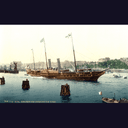
His personal yacht allowed him to sail at sea and experience firsthand the maritime sensations he described in his works.
📷 Domaine public · Wikimedia Commons ↗
Verne had a keen interest in astronomy and celestial physics, passions that inspired 'From the Earth to the Moon' and its sequels.

A symbol of the industrial age and mechanical precision, the watch is a central object in 'Around the World in Eighty Days', where every minute counts.
📷 CC BY-SA 3.0 · Wikimedia Commons ↗School Curriculum
Vocabulary & Tags
Key Vocabulary
Daily Life
Morning
Jules Verne invariably rose at 5 a.m., regardless of the season. He had a light breakfast, then shut himself in his study until 11 a.m., writing his novels with quasi-military discipline. This morning period was for him the most productive and most sacred part of the day.
Afternoon
In the afternoon, Verne read scientific and geographical journals, clipped articles, and fed his documentary files. He occasionally received visitors or took walks around Amiens. On fine days, he would work on refining manuscripts he had already begun.
Evening
Evenings were devoted to social and family life. Verne frequented local clubs in Amiens, played cards, and discussed politics. An avid reader, he often ended his evenings with a book or by reviewing his own printer's proofs.
Food
Verne followed the typical bourgeois diet of the 19th century: meats, soups, and seasonal vegetables. He appreciated good food but ate in moderation. At sea aboard his yacht, he shared simple sailors' meals with his crew.
Clothing
Verne wore the formal attire of the French bourgeoisie: a dark frock coat, waistcoat, cravat, and top hat for outings. Aboard his yacht, he adopted a more practical sailor's outfit — captain's cap and jacket — of which he was visibly proud.
Housing
In Amiens, Verne lived in a comfortable bourgeois house on rue Charles-Dubois, featuring a red-brick corner tower of which he was particularly fond. His study, on the top floor of this tower, was lined with maps and scientific books — a true sanctuary of the imagination.
Historical Timeline
Period Vocabulary
Visual Style
Gravures au trait précis inspirées des illustrations originales de Hetzel, mêlant merveille technologique et paysages épiques dans une palette de sépia, bleu nuit et brun chaud.
Sound Ambience
Un univers sonore entre cabinet de travail bourgeois du XIXe siècle et grands espaces de l'aventure : moteurs à vapeur, ports animés et plume courant sur le papier à l'aube.
Liens externes & ressources
Références
Œuvres
Cinq semaines en ballon
1863
Voyage au centre de la Terre
1864
De la Terre à la Lune
1865
Vingt mille lieues sous les mers
1870
Le Tour du monde en quatre-vingts jours
1872
L'Île mystérieuse
1874