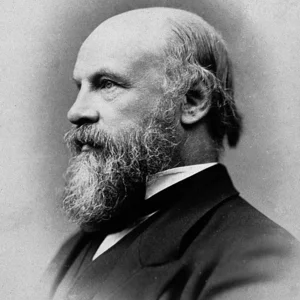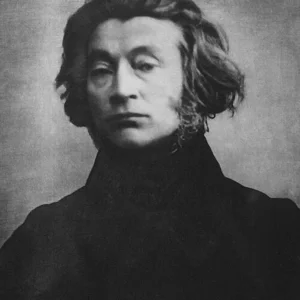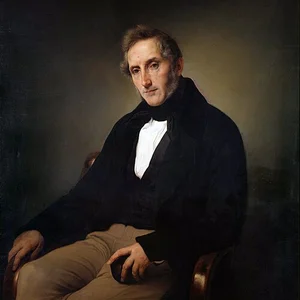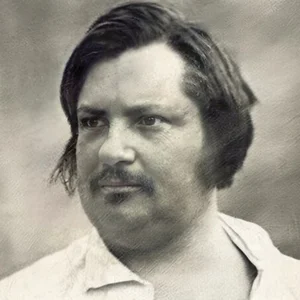

French novelist (1799–1850) and founder of literary realism. He created The Human Comedy, a vast novelistic panorama of French society in the 19th century, comprising more than 90 interconnected works.
Honoré de Balzac(1799 — 1850)
Honoré de Balzac
France
7 min read
Frequently asked questions
Famous Quotes
« Behind every great man, there is a woman who is astonished.»
« The secret of great fortunes with no apparent cause is a forgotten crime, because it was committed cleanly.»
Key Facts
- 1829: Publication of The Chouans, his first major novel, marking the start of his literary career
- 1830–1850: Progressive creation of The Human Comedy, a project to systematically depict French society
- 1831: Publication of The Wild Ass's Skin, a major philosophical and fantastical novel
- 1833–1841: Period of great productivity with the publication of numerous masterpieces (Eugénie Grandet, Father Goriot, Lost Illusions)
- 1850: Death in Paris after a life marked by debt and overwork
Works & Achievements
The first novel signed 'Honoré de Balzac', it tells the story of the War in the Vendée and marks the author's official entry into literature. It is also the first novel integrated into La Comédie humaine.
A fantastical novel in which a young man obtains a magical skin that grants his wishes but shrinks with each desire. This work explores the themes of will, desire, and death.
A striking portrait of a provincial miser and his daughter sacrificed to his greed. One of Balzac's most widely read novels, frequently studied in schools for its critique of bourgeois avarice.
A founding novel of La Comédie humaine, it introduces the device of recurring characters. Goriot, a father sacrificed by his ungrateful daughters, and Rastignac, a young social climber, embody the forces of Parisian society.
A trilogy tracing the rise and fall of a young provincial poet in Paris. It is one of Balzac's most ambitious works on the literary and journalistic world.
A sequel to Lost Illusions, this novel follows Lucien de Rubempré and the mysterious Vautrin through the Parisian underworld. A dizzying plunge into crime and corruption.
A novelistic fresco of more than 90 interconnected novels and short stories, featuring over 2,000 recurring characters. Balzac aimed to do for French society what Buffon had done for the animal kingdom.
Anecdotes
Balzac was a compulsive coffee drinker: he consumed up to 50 cups a day to stay awake during his writing nights. He often worked from midnight to noon without interruption, his pen stopping only when the ink ran out or his fingers went numb.
To escape his creditors — for he was riddled with debt his entire life — Balzac frequently changed addresses and used assumed names. He even had a secret exit built into his apartment on rue Raynouard in Passy so he could slip away discreetly.
The idea of linking all his novels into a single cohesive work, which he would call La Comédie humaine, is said to have come to him in 1833. He reportedly told his sister Laure upon entering her home: 'I am becoming a genius!' — convinced he had found the principle that would make him the equal of Walter Scott.
Balzac wore a white monk's habit while writing. He would begin work at midnight by candlelight, and considered this garment his battle uniform against the blank page.
After an eighteen-year correspondence with the Polish countess Ewelina Hańska, Balzac finally married her in March 1850. He died five months later, exhausted, before he could even enjoy the long-awaited marriage.
Primary Sources
French Society was going to be the historian, I needed only to be the secretary. By drawing up the inventory of vices and virtues, by gathering the principal facts of the passions, by painting characters, by choosing the principal events of Society, by composing types through the combination of traits from several homogeneous characters, perhaps I could manage to write the history forgotten by so many historians, that of manners.
I work like a convict; I am chained to my desk like a galley slave to his rowing bench, and I row with the same ardor, toward the same goal: fortune and glory.
Madame Vauquer, née de Conflans, is an old woman who, for forty years, has kept in Paris a middle-class boarding house established on the rue Neuve-Sainte-Geneviève, between the Latin Quarter and the faubourg Saint-Marceau.
I shall carry La Comédie humaine as Atlas carried the world, and I shall keep it standing by the sole force of my will.
Key Places
Balzac was born in Tours on May 20, 1799. The Touraine region and its landscapes permeate several of his works, notably Le Lys dans la vallée.
Balzac lived on Rue Raynouard in Passy from 1840 to 1847, writing part of La Comédie humaine there. The house is today a museum dedicated to his life and work.
The Latin Quarter and its boarding houses are the setting of Père Goriot. Balzac had himself stayed there and was intimately familiar with these student and impoverished circles.
Balzac regularly stayed with his friend M. de Margonne at this château in the Touraine. It was there that he wrote a large part of Père Goriot and Le Lys dans la vallée.
In this Left Bank neighborhood, Balzac placed several of his characters and observed Parisian society, which fed his work.
Liens externes & ressources
Références
Œuvres
Les Chouans
1829
La Peau de chagrin
1831
Eugénie Grandet
1833
Le Père Goriot
1835
Illusions perdues
1837-1843
Splendeurs et misères des courtisanes
1838-1847
La Comédie humaine (ensemble de l'œuvre)
1842