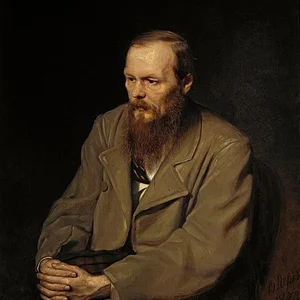

Russian writer
Fyodor Dostoevsky(1821 — 1881)
Fyodor Dostoevsky
Empire russe
8 min read
Frequently asked questions
Famous Quotes
« La beauté sauvera le monde.»
« Aimer quelqu'un, c'est le voir tel que Dieu a voulu qu'il soit.»
« Si Dieu n'existe pas, tout est permis.»
Key Facts
- 1821 : Naissance à Moscou dans une famille de la petite noblesse
- 1849 : Condamné à mort pour activités révolutionnaires, gracié au dernier moment et déporté au bagne de Sibérie
- 1866 : Publication de Crime et Châtiment, chef-d'œuvre de la psychologie romanesque
- 1880 : Publication des Frères Karamazov, son œuvre testamentaire sur la foi et la liberté
- 1881 : Mort à Saint-Pétersbourg, funérailles nationales
Works & Achievements
Dostoevsky's first epistolary novel, hailed upon publication as a major work by the critic Belinsky. It inaugurates the central theme of his oeuvre: the dignity of the humiliated and oppressed in an indifferent society.
An autobiographical account of his years in a Siberian labor camp, presented as a fictional testimony. A human document of rare intensity, it reveals the soul of the Russian people through the lives of convicts, and influenced both Tolstoy and Chekhov.
A major psychological novel tracing the murder committed by the student Raskolnikov and his path toward redemption. The first great psychological crime novel in world literature, it explores guilt, conscience, and faith.
A novel in which Dostoevsky attempted to portray an absolutely good man — Prince Myshkin — confronted with the violence and corruption of the world. An exploration of epilepsy, beauty, and the impossibility of sainthood on earth.
A visionary political novel inspired by a real revolutionary murder organized by Sergei Nechaev. Dostoevsky describes with prophetic precision the totalitarian excesses of revolutionary nihilism.
A coming-of-age novel recounting the identity quest of a young illegitimate man searching for his place in Russian society. Less celebrated than his other masterworks, it foreshadows the themes of The Brothers Karamazov.
Dostoevsky's final novel and spiritual testament, considered one of the greatest novels in world literature. It stages parricide, faith, doubt, and human freedom through three brothers of opposing characters.
Anecdotes
In 1849, Dostoevsky was arrested for revolutionary activities and sentenced to death. On December 22, he was already standing before the firing squad, blindfolded, when a messenger from the Tsar arrived to commute the sentence to hard labor in Siberia. This macabre staging, orchestrated by Nicholas I to terrorize dissidents, marked Dostoevsky forever and profoundly shaped his work.
Dostoevsky was a compulsive gambler and lost his entire fortune several times in European casinos. In Wiesbaden in 1865, he gambled and lost so desperately that he had to sell his clothes and beg his friends to send him money for food. This painful addiction directly inspired his novel The Gambler, which he dictated in under a month to his future wife Anna Snitkina in order to honor a publishing contract.
To write The Gambler in just twenty-six days and avoid losing the rights to all his novels, Dostoevsky hired a twenty-year-old stenographer, Anna Grigoryevna Snitkina. They worked at a frantic pace, and at the end of the contract, Dostoevsky proposed to her. Anna accepted and became his indispensable companion, managing his finances and protecting him from himself until his death.
Dostoevsky had suffered from epilepsy since adolescence, an illness he concealed as much as possible. Yet he described with unsettling precision the luminous auras that precede seizures — those moments of intense bliss that he attributed to Prince Myshkin in The Idiot. He often wrote at night to avoid having seizures in front of witnesses, working by candlelight until dawn.
Primary Sources
Life is everywhere, life is within us, and not in the external world. There will be people around me, and to be a man among men, and to remain so always, whatever the adversities, not to lose heart or be cast down — that is the meaning of life.
The Russian people need beauty. Without beauty, they cannot live. I believe the secret of Russian life lies there.
I am working on a novel that will be my best, perhaps the most important of everything I have written. I am speaking of the Karamazovs. This novel is my answer to everything I have been reproached with.
Pushkin alone had a presentiment of the Russian people, of their universal soul. He belongs not only to Russia — he belongs to all of humanity.
Key Places
The city where Dostoevsky spent most of his adult life and where most of his novels take place. The dark alleyways, decrepit buildings, and white light of Saint Petersburg's white nights form the backdrop of Crime and Punishment.
Dostoevsky was imprisoned here for four years (1850–1854) under appalling conditions, alongside common criminals. This traumatic experience inspired The House of the Dead and radically transformed his vision of humanity.
Dostoevsky lived here for several years with his wife Anna during his European exile (1867–1871). He visited the Old Masters Gallery and was captivated by Raphael's Sistine Madonna, which he saw as a symbol of a beauty that saves the world.
Dostoevsky gambled at the roulette tables here on several occasions and suffered some of his worst financial losses. It was largely in Wiesbaden that he conceived and developed the novel The Gambler.
It was in the doctors' residence of Moscow's military hospital that Dostoevsky was born and spent his childhood. This modest neighborhood, between grey courtyards and hospital gardens, instilled in him a deep sense of compassion for the humble.
Typical Objects

Dostoevsky wrote with a goose or steel quill, often for hours at night, filling entire notebooks with dense handwriting. Anna would transcribe his pages neatly the following day to send to publishers.

European casino roulette was a consuming obsession for Dostoevsky for nearly ten years. He believed he had found a foolproof system for winning, yet invariably lost down to his last kopeck.

During his four years at the Omsk prison camp, the only reading permitted to Dostoevsky was a Bible given to him by Decembrist women. He read it cover to cover many times over, and it shaped his vision of Christ as the ideal of suffering humanity.

Like all Russian intellectuals of his era, Dostoevsky drank very strong black tea from metal-framed glasses called podstakanniki. He prepared it himself at the samovar during his long nights of writing.

A heavy smoker, Dostoevsky allowed himself strong tobacco cigarettes throughout his nocturnal writing sessions. This habit, combined with epilepsy and precarious living conditions, contributed to the ruin of his health.

Dostoevsky's preparatory notebooks, held in the Saint Petersburg archives, show novel plans covered in drawings, character diagrams, and scene variants. He methodically constructed his complex plots before dictating.
School Curriculum
Vocabulary & Tags
Key Vocabulary
Daily Life
Morning
Dostoevsky woke up late, around ten or eleven o'clock, exhausted from his nights of writing. He began the day with a glass of very strong black tea prepared in the samovar, sometimes accompanied by a bread roll. His wife Anna would read him his mail and handle letters from publishers while he slowly came to.
Afternoon
The afternoon was devoted to walks through the streets of Saint Petersburg, which served as observation of working-class environments — markets, taverns, tenement back courtyards. He visited intellectual friends, debated politics and religion, sometimes until evening. He mentally prepared his scenes during these wanderings.
Evening
The night was his true working time. He settled at his desk after the family dinner, lit candles and cigarettes, and wrote until two or three in the morning, sometimes until dawn. He often dictated to Anna, who stenographed at great speed, then transcribed the following morning while he slept.
Food
Dostoevsky's diet was simple and often insufficient during periods of debt: cabbage soup (shchi), buckwheat porridge (kasha), black bread, pickled herring. In more prosperous periods, he enjoyed boiled meat and Russian pastries. He drank enormous quantities of black tea and strong coffee to stay awake at night.
Clothing
Dostoevsky dressed soberly, without particular elegance — dark frock coat, waistcoat, tie often poorly knotted. In the Siberian winter, he wore a shapka and a large military greatcoat inherited from his years as a soldier. His neglected appearance contrasted with the care he gave to his literary reputation.
Housing
Dostoevsky lived in modest and often poorly heated apartments in Saint Petersburg, frequently changing lodgings to flee creditors. The rooms cluttered with books, newspapers, and manuscripts resembled the dwellings of his characters. At the end of his life, he moved into a more comfortable apartment on Kuznechny Lane, where he died.
Historical Timeline
Period Vocabulary
Visual Style
Réalisme sombre et expressif de la peinture russe du XIXe siècle : intérieurs misérables éclairés à la bougie, visages tirés d'une intensité psychologique extrême, palette de bruns, gris et jaunes blafards.
Sound Ambience
Ambiance sonore nocturne de Saint-Pétersbourg au XIXe siècle : cloches d'église, pas sur les pavés gelés, samovar, plume qui gratte le papier et vent dans les ruelles sombres.
Liens externes & ressources
Références
Œuvres
Les Pauvres Gens
1846
Souvenirs de la maison des morts
1862
Crime et Châtiment
1866
Les Démons
1872
L'Adolescent
1875
Les Frères Karamazov
1880