
Peerage person ID=695563
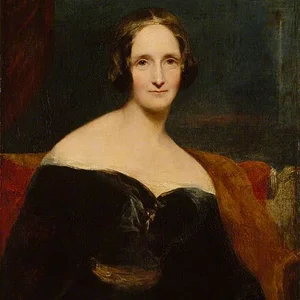
Mary Shelley(1797 — 1851)
Mary Shelley
Royaume-Uni
8 min read
Frequently asked questions
Famous Quotes
« Rien n'est aussi douloureux pour l'esprit humain qu'un grand et soudain changement.»
« Mon imagination, sans qu'on l'y invitât, me posséda et me guida.»
Key Facts
- 1797 : Naissance à Londres, fille de la philosophe féministe Mary Wollstonecraft et du penseur William Godwin.
- 1814 : Fuite romantique avec le poète Percy Bysshe Shelley, qu'elle épousera en 1816.
- 1816 : Rédige Frankenstein lors d'un séjour à la Villa Diodati (Genève) pendant l'« Année sans été ».
- 1818 : Publication de Frankenstein ou le Prométhée moderne, premier grand roman de science-fiction.
- 1826 : Publication de The Last Man, roman dystopique visionnaire.
- 1851 : Décès à Londres à l'âge de 53 ans.
Works & Achievements
Mary Shelley's first and most celebrated novel, considered the founding text of science fiction. It raises ethical questions about the artificial creation of life and the creator's responsibility toward their creature.
A dystopian novel set at the end of the 21st century, depicting the gradual extinction of humanity through a worldwide epidemic. Poorly received upon publication, it is now recognized as a masterpiece of post-apocalyptic literature.
A historical novel set in 14th-century medieval Italy. Mary Shelley develops a reflection on power and tyranny, demonstrating her mastery of novelistic genres beyond the realm of the fantastical.
A short autobiographical novel exploring depression and grief, written after the deaths of her children. Deemed too dark by her father William Godwin, it remained unpublished during Mary Shelley's lifetime and was not released until the 20th century.
A series of literary biographies commissioned for the Cabinet Cyclopædia. Mary Shelley displays remarkable erudition throughout, contributing to the dissemination of European culture in England.
A complete edition of Percy Shelley's poems, annotated and prefaced by Mary. This monumental work preserves her husband's writings and secures his place in the Romantic literary canon.
Anecdotes
During the summer of 1816, Mary Godwin — not yet Shelley — found herself at the Villa Diodati on the shores of Lake Geneva with Percy Shelley, Lord Byron, and John Polidori. Relentless rain caused by the eruption of Mount Tambora confined them indoors. Byron issued a challenge: each must write a ghost story. It was thus that the idea for Frankenstein was born, in the mind of an eighteen-year-old woman.
Mary Shelley was the daughter of two celebrated philosophers: William Godwin, father of modern anarchism, and Mary Wollstonecraft, author of 'A Vindication of the Rights of Woman'. Her mother died eleven days after her birth, and Mary grew up reading her works at her grave in St Pancras Churchyard. This intense relationship with death and creation would profoundly shape her novel.
Percy Shelley encouraged Mary to develop her nightmare story into a novel. Published in 1818, Frankenstein; or, The Modern Prometheus first appeared anonymously, preceded by a preface written by Percy. Most readers assumed a man was the author. It was not until 1823 that the second edition revealed Mary Shelley's name.
In 1814, Mary eloped to Europe with Percy Shelley, a married man, accompanied by her half-sister Claire Clairmont. This bold journey — which scandalized respectable London society — took her through Switzerland and Germany, and introduced her to the city of Ingolstadt, which she chose as the setting for Doctor Frankenstein's experiments.
Following the death of Percy Shelley, who drowned in 1822, Mary declined several marriage proposals and devoted her life to editing and publishing her husband's works. She raised their son Percy Florence alone while continuing to write novels, short stories, and biographical essays to support them.
Primary Sources
I saw the pale student of unhallowed arts kneeling beside the thing he had put together. I saw the hideous phantasm of a man stretched out, and then, on the working of some powerful engine, show signs of life.
Write my story. Read. Walk. Talk with Lord Byron and Shelley. Write.
I am sadly deficient in the self-sufficiency which is necessary to withstand the world — I feel every unkindness acutely.
It is not singular that, as the daughter of two persons of distinguished literary celebrity, I should very early in life have thought of writing. As a child I scribbled; and my favourite pastime during the hours given me for recreation was to write stories.
Key Places
It is in this villa overlooking Lake Geneva that Mary conceived Frankenstein during the summer of 1816. The place has become a symbol of the birth of modern fantasy and science fiction literature.
Mary grew up in this working-class district of London, between her father William Godwin's house and St Pancras Cemetery where her mother is buried. It is in this neighbourhood that she learned to read at the grave of Mary Wollstonecraft.
Mary and Percy settled in this Italian coastal town in 1822. It is there that Percy Shelley drowned during a storm. The place represents both the beauty of Romantic Italy and Mary's personal tragedy.
Bavarian city chosen by Mary Shelley as the setting for Doctor Frankenstein's experiments, in reference to its university founded in 1472. She places there the secret laboratory where the creature comes to life.
Mary Shelley spent the last years of her life in this Victorian London neighbourhood, under the care of her son Percy Florence. It is there that she died in 1851, surrounded by her manuscripts and her husband's works.
Typical Objects

Mary Shelley wrote all her novels and journals with a quill pen, an everyday tool in the intellectual life of the 19th century. She wrote Frankenstein largely by hand, encouraged by Percy to transform her nightmare into a literary work.

Galvani's work on animal electricity and experiments conducted on the bodies of condemned men captivated Mary Shelley's generation. These works of 'natural philosophy' — the forerunner of modern science — directly fuelled the imaginative world of Frankenstein.

Mary Shelley often wrote at night, by the light of an oil lamp, once the other members of the household had fallen asleep. This nocturnal atmosphere reappears in the clandestine laboratory scenes featuring Victor Frankenstein.

Mary kept a diary from adolescence, partly written together with Percy. This diary is a valuable historical source on her life, her reading, and the genesis of her works. It reveals in particular the exact circumstances of the night at the Villa Diodati.

Life on the shores of Lake Geneva and later in Italian ports placed the sailing boat at the heart of Mary's daily existence. Navigation is a central metaphor in Frankenstein, and it was during a sailing trip that Percy Shelley lost his life.

Mary Shelley kept a portrait of her mother, a feminist philosopher she never knew, close at hand. She read and reread her works throughout her life, drawing on them in her own reflections on the condition of women and the act of creation.
School Curriculum
Vocabulary & Tags
Key Vocabulary
Tags
Daily Life
Morning
Mary rises early, often before the other members of the household. She has a light breakfast — tea, bread and butter — then devotes the morning to reading, particularly philosophy, natural sciences, or Latin and Greek classics she studies on her own.
Afternoon
The afternoon is reserved for writing, the central activity of her life. Mary works with a quill on large sheets of paper, often in a shared sitting room with Percy and their friends. Walks along the lakeshore or through the English countryside punctuate these working sessions.
Evening
Evenings at the Villa Diodati or during literary gatherings are animated by passionate intellectual discussions on philosophy, politics and science. Mary reads aloud, listens to poetry, and sometimes plays the piano or cards with her hosts.
Food
Mary Shelley's table is simple and frugal: tea in abundance, bread, cheeses, boiled vegetables and cold meats. During her travels in Italy, she discovers Mediterranean cuisine — pasta, olive oil, local wines — which she praises in her letters.
Clothing
Mary Shelley wears the white or lavender muslin Empire-style gowns typical of the English Regency, with high waists and modest necklines. When travelling she adopts more practical attire, with wool shawls and ankle boots. After her widowhood, she dresses mostly in black or dark grey.
Housing
Mary lives in lodgings that are often rented and temporary — Swiss lakeside villas, Roman or Florentine apartments, London townhouses. The interiors are sober but cluttered with books, manuscripts and portraits. The library is always the central room.
Historical Timeline
Period Vocabulary
Visual Style
Le style visuel de l'univers de Mary Shelley conjugue l'esthétique romantique britannique — portraits au clair-obscur dramatique, robes empire blanches, bibliothèques sombres — avec les paysages alpins et lacustres qui ont inspiré Frankenstein.
Sound Ambience
L'univers sonore de Mary Shelley mêle les tempêtes romantiques du lac Léman aux bruits feutrés de l'écriture nocturne, du feu de cheminée et des discussions intellectuelles — une atmosphère à la fois intimiste et chargée d'électricité créatrice.
Liens externes & ressources
Références
Œuvres
Frankenstein or The Modern Prometheus
1818
The Last Man
1826
Valperga
1823
Mathilda
1820 (publié en 1959)
Lives of the Most Eminent Literary and Scientific Men
1835-1839
Poetical Works of Percy Bysshe Shelley (édition critique)
1839