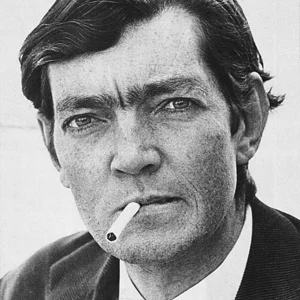

Argentine writer born in Brussels in 1914 and died in Paris in 1984. A major figure of the "boom" in Latin American literature, he is famous for his fantastic short stories and his experimental novel *Hopscotch*.
Julio Cortázar(1914 — 1984)
Julio Cortázar
France, Argentine
6 min read
Frequently asked questions
Famous Quotes
« Nothing is lost if you have the courage to proclaim that all is lost and that you must start over.»
Key Facts
- Born on August 26, 1914 in Brussels to Argentine parents
- Settles permanently in Paris in 1951, where he works as a translator for UNESCO
- Publishes in 1963 *Rayuela* (*Hopscotch*), a novel with a non-linear structure that the reader can read in multiple orders
- His short story *The Devil's Drool* inspires Antonioni's film *Blow-Up* (1966)
- Dies on February 12, 1984 in Paris
Works & Achievements
First collection of short stories published under his name; here he establishes his art of the everyday fantastic, as in "House Taken Over".
Collection containing now-classic stories, including "Axolotl" and "Continuity of Parks".
Collection including "The Pursuer", a tribute to Charlie Parker, and "The Daughters of the Virgin", source for the film *Blow-Up*.
Collection of playful, poetic short texts inventing a bestiary of fanciful beings, the cronopios and the famas.
His masterpiece: an "open" novel with multiple possible readings, considered one of the summits of the Latin American "boom".
Short story collection confirming his mastery of time, the double, and the strange.
Engaged novel mixing fiction and newspaper clippings; awarded the Prix Médicis étranger, the prize money of which he donated to Latin American resistance.
Anecdotes
In 1946, the young Cortázar sent his short story "House Taken Over" (Casa tomada) to a literary magazine edited by Jorge Luis Borges. Impressed, Borges published it and had it illustrated by his own sister, the painter Norah Borges. It was one of the first major encouragements of his career.
His novel *Hopscotch* (Rayuela, 1963) can be read in two ways: in the normal order of chapters, or by jumping from one to another according to a "table of directions" provided by the author, like hopping squares of a hopscotch drawn on the ground. The reader thus becomes almost a co-author of the story.
His short story "The Droolings of the Devil" (Las babas del diablo) inspired Italian filmmaker Michelangelo Antonioni's film *Blow-Up* (1966), which won the Palme d'Or at Cannes. The story of a photographer discovering a troubling detail while enlarging a snapshot fascinated both artists.
A jazz enthusiast, Cortázar was inspired by the genius of saxophonist Charlie Parker for his character in "The Pursuer" (El perseguidor). He liked to say that he wrote following the rhythm and improvisation of music, like a be-bop musician.
An excellent translator, Cortázar translated into Spanish the complete prose works of Edgar Allan Poe for the University of Puerto Rico. This long work on tales of anguish and mystery deeply nourished his own taste for the fantastic and the strange.
Primary Sources
"Would I find the Sibyl? So many times it had been enough for me to lean, coming along the Rue de Seine, over the arch that gives onto the Quai de Conti..."
"To climb a staircase, one begins by lifting that part of the body situated on the bottom right, almost always wrapped in leather or suede, and which, with rare exceptions, fits exactly on the step."
"The novel always wins on points, while the short story must win by knockout."
"We liked the house: besides being spacious and old, it kept the memories of our great-grandparents."
Key Places
Birthplace of Cortázar in 1914; his Argentine parents were living there when World War I broke out.
Neighborhood where Cortázar spent his childhood and adolescence after the family's return to Argentina.
City where he taught, wrote his first texts, and published "House Taken Over" before leaving for Europe.
Adopted city from 1951 onward: he lived there, worked as a translator for UNESCO, wrote *Hopscotch*, and died there in 1984.
Village where Cortázar bought a country house, a summer retreat for writing away from the Parisian bustle.
City he visited regularly after the 1959 revolution, marking his engagement alongside Latin American intellectuals.
Typical Objects

The everyday tool of the writer and translator, on which Cortázar typed short stories, novels, and thousands of pages of translations for UNESCO.

A gourd container with a metal straw used to drink yerba mate infusion. A symbol of Argentine identity that Cortázar took with him into exile in Paris.

Jazz, especially Charlie Parker's be-bop, accompanied Cortázar's writing and directly inspired several of his short stories.

The children's game where you hop from square to square up to "Heaven" gives its title and structure to the novel *Hopscotch*: you can read it by skipping chapters just as you skip squares.

Companions of long Parisian writing nights, omnipresent in the writer's iconography as in many intellectuals of his time.

Notebooks and drafts where Cortázar amassed fragments, quotes, and ideas, the raw material of his collage-books like *Hopscotch* or *A Manual for Manuel*.
School Curriculum
Vocabulary & Tags
Key Vocabulary
Tags
Daily Life
Morning
In his apartment in the Latin Quarter, the morning began with coffee and reading the mail, which was often plentiful. Cortázar then turned to his translations for UNESCO, a regular job that ensured his freedom as a writer.
Afternoon
The afternoon was divided between bread-and-butter translations and personal short story writing. He also enjoyed strolling along the Seine, browsing at the booksellers' stalls, and watching passersby, a source of inspiration for his Parisian stories.
Evening
In the evening, Cortázar frequented jazz clubs, listened to his records, and met up with other exiled Latin American writers. When night fell, he wrote at length, cigarette in hand, until the early hours.
Food
Faithful to his origins, he drank Argentine mate at all hours. He also appreciated French cuisine, wine, and long meals of discussion among friends and writers.
Clothing
Tall (nearly 1.93 m) and with a surprisingly youthful face, he had the sober look of the Parisian intellectual: jackets, sweaters, and simple shirts, often with a beard later in life.
Housing
He lived in modest apartments in Paris, near the Latin Quarter and the Seine. Later, he acquired a country house in Saignon, Provence, a writing refuge far from the city.
Historical Timeline
Period Vocabulary
Liens externes & ressources
Références
Œuvres
Bestiaire (Bestiario)
1951
Fin d'un jeu (Final del juego)
1956
Cronopes et Fameux (Historias de cronopios y de famas)
1962
Marelle (Rayuela)
1963
Tous les feux le feu (Todos los fuegos el fuego)
1966
Le Livre de Manuel (Libro de Manuel)
1973