
Justinian was a Byzantine emperor who reigned from 527 to 565. He is famous for codifying Roman law in the Justinian Code and for conquering vast territories. His reign marks the height of the Byzantine Empire.
Justinian(482 — 565)
Justinian
Empire byzantin
7 min read
Frequently asked questions
Key Facts
- 527: accession to the throne of the Byzantine Empire
- 528–534: drafting of the Justinian Code, a systematic compilation of Roman law
- 532: Nika revolt in Constantinople, suppressed by General Belisarius
- 537: completion of the Hagia Sophia basilica
- 565: death of Justinian after 38 years of reign
Works & Achievements
Major codification of Roman law in four parts, which laid the foundations of most European legal systems. This legislative monument is still studied in law schools today.
Cathedral built in five years in Constantinople after the destruction of the former basilica. It was the largest Christian church in the world for nearly a millennium.
Led by General Belisarius, this lightning campaign ended the Vandal kingdom in less than a year and restored Roman dominion over the western Mediterranean.
A long and costly military campaign that allowed Justinian to retake Italy from the Ostrogoths. It considerably exhausted the empire's human and financial resources, however.
Justinian took advantage of internal strife within the Visigothic kingdom to seize the Spanish Mediterranean coast, bringing the empire to its greatest extent since the fall of Rome.
A vast fortification program along the empire's borders, particularly against the Sasanian Persians. These military construction projects testify to Justinian's systematic defense policy.
Anecdotes
In 532, a terrible riot broke out in Constantinople: the Nika revolt. The city burned and Justinian, in a panic, considered fleeing by ship. It was his wife Theodora who dissuaded him with a now-famous line: 'Purple is the finest of shrouds.' Justinian stayed, crushed the revolt, and consolidated his power.
Justinian married Theodora, a woman of humble origins who had been an actress and mime — professions considered disreputable at the time. To make the marriage possible, he had the law changed that prevented senators from marrying women of low social standing. Theodora became one of the most influential empresses in Byzantine history.
In 541, an outbreak of bubonic plague swept through the empire from Egypt. Justinian himself contracted the disease and barely survived. This 'Plague of Justinian' killed millions and durably weakened the empire, casting doubt over all of its military conquests.
After the old basilica was destroyed during the Nika revolt, Justinian ordered the construction of a new Hagia Sophia in record time: just five years. At its inauguration in 537, he reportedly declared upon entering the building: 'Solomon, I have surpassed you!' — a reference to the Temple of Jerusalem.
Justinian barely slept. His contemporaries nicknamed him 'the emperor who never sleeps'. He worked through the night, studying legal and theological files until dawn, and his historian Procopius reports that he was sometimes seen wandering alone through the palace corridors by lamplight, like a crowned ghost.
Primary Sources
Justinian was by nature cunning and cruel, quick to conceal his thoughts, never angry for any serious reason, but always affable and smiling during the most wicked acts.
We have decided to set forth in a brief compilation all the imperial constitutions scattered across the ancient codes... so that no one need search for the law through countless volumes.
By divine authority, we have governed our empire, and we have striven to bring it to perfection in times of war as in times of peace.
Belisarius, general of Emperor Justinian, crossed with his army the strait toward Africa, and in less than a year he had put an end to the Vandal kingdom that had lasted for a century.
The two greatest gifts that God, in His heavenly goodness, has granted to men are the priesthood and the empire: the one serves divine things, the other governs and tends to human affairs.
Key Places
Capital of the Byzantine Empire and imperial residence of Justinian. It was here that he governed, ordered the reconstruction of Hagia Sophia, and suppressed the Nika revolt.
Architectural masterpiece commissioned by Justinian and inaugurated in 537. Its dome, 31 meters in diameter, remained the largest in the world for nearly a millennium.
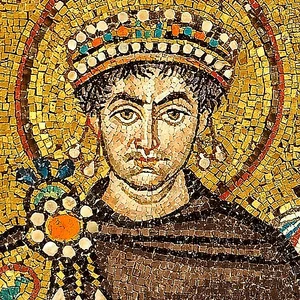
Former capital of the Ostrogothic kingdom, reconquered by Belisarius in 540. The Basilica of San Vitale houses the famous mosaic depicting Justinian and his court, a major iconographic document.
City reconquered from the Vandals in 533 by the general Belisarius. Its capture allowed Justinian to restore Roman dominion over North Africa.
Presumed birthplace of Justinian, in Dardania. He had an entire city built on this site, named Justiniana Prima in honor of his origins.
Typical Objects

Large rigid scarf of gold and precious stones worn during major ceremonies. It is clearly visible in the San Vitale mosaic in Ravenna depicting Justinian in majesty.

Monumental collection in 50 books compiling centuries of Roman jurisprudence. Justinian had it drafted in just three years by a commission of ten jurists led by Tribonian.

Justinian is depicted in the Ravenna mosaic holding a large offering plate (paten), emphasizing the fusion of imperial power and religious authority in the Byzantine Empire.

Byzantine crown adorned with pearls and pendants (prependoulia) hanging over the cheeks. A symbol of celestial power delegated to the emperor, it distinguishes Justinian from ancient Roman emperors.

Justinian was renowned for personally working on legal texts, annotating his jurists' drafts. These writing instruments symbolize his obsession with law and administration.

Procopius reports that Justinian worked until dawn, lit by a simple lamp. This everyday object embodies his reputation as an 'insomniac emperor' entirely devoted to governance.
School Curriculum
Vocabulary & Tags
Key Vocabulary
Tags
Daily Life
Morning
Justinian rose before dawn, often after only a few hours of sleep. He began his day with prayers and the reading of religious offices, then received his secretaries and senior officials at daybreak to deal with the affairs of the empire. Morning audiences were governed by a rigid protocol.
Afternoon
The afternoon was devoted to meetings of the imperial council, to studying draft legislation with his jurists — notably Tribonian — and to receiving foreign ambassadors. Justinian personally engaged in the theological debates tearing the Church apart, summoning bishops and patriarchs.
Evening
In the evening, Justinian often continued working alone or with Theodora, drafting novellae (new laws), reviewing military dossiers, or discussing strategy. He ate frugally and went to bed late, earning his reputation as the 'crowned insomniac' reported by Procopius.
Food
Justinian was renowned for his dietary sobriety, in stark contrast to the splendour of his court. He often made do with vegetables, bread, and water, fasting regularly out of religious devotion. Official banquets, however, were lavish: roasted meats, Mediterranean fish, Greek wines, and exotic fruits.
Clothing
In public, Justinian wore the full imperial regalia: the purple silk chlamys (a colour reserved for the emperor), the jewel-encrusted gold loros on great feast days, and the diadem adorned with pearls and pendants. In everyday life, he wore silk garments in more subdued colours, the silk industry having been introduced to Byzantium during his reign.
Housing
Justinian resided in the Great Palace of Constantinople, a vast complex of buildings stretching from the Hippodrome to the Bosphorus. The imperial apartments were adorned with coloured marbles, gilded mosaics, and silk hangings. The Chrysotriklinos, an octagonal throne room crowned by a dome, was the symbolic heart of imperial power.
Historical Timeline
Period Vocabulary
Visual Style
Le style visuel de l'époque de Justinien s'inspire des grandes mosaïques de Ravenne : fonds d'or, figures hiératiques en pourpre impériale, et splendeur byzantine mêlant art romain tardif et influences orientales.
Sound Ambience
L'univers sonore de Justinien mêle les chants liturgiques grecs de Sainte-Sophie, les rumeurs du palais impérial et les clameurs du peuple de Constantinople sur l'Hippodrome.
Liens externes & ressources
Références
Œuvres
Corpus Juris Civilis (Code Justinien, Digeste, Institutes, Novelles)
529–534 apr. J.-C.
Basilique Sainte-Sophie (Hagia Sophia)
532–537 apr. J.-C.
Reconquête de l'Afrique du Nord (Campagne vandale)
533–534 apr. J.-C.
Reconquête de l'Italie (Guerre gothique)
535–554 apr. J.-C.
Reconquête du sud de l'Espagne (Hispanie)
554 apr. J.-C.
Construction de la forteresse de Dara et réseau de fortifications orientales
vers 530 apr. J.-C.