 flip
flipBaroness's Oysters and Grapes
Baroness's Oysters and Grapes
Why this dish? Toward the end of her life, ravaged by illness and barely able to eat, Karen Blixen is said to have subsisted on very little: oysters, grapes, biscuits, and champagne. This briny, delicate snack evokes the elegant asceticism of the great lady of Danish letters.
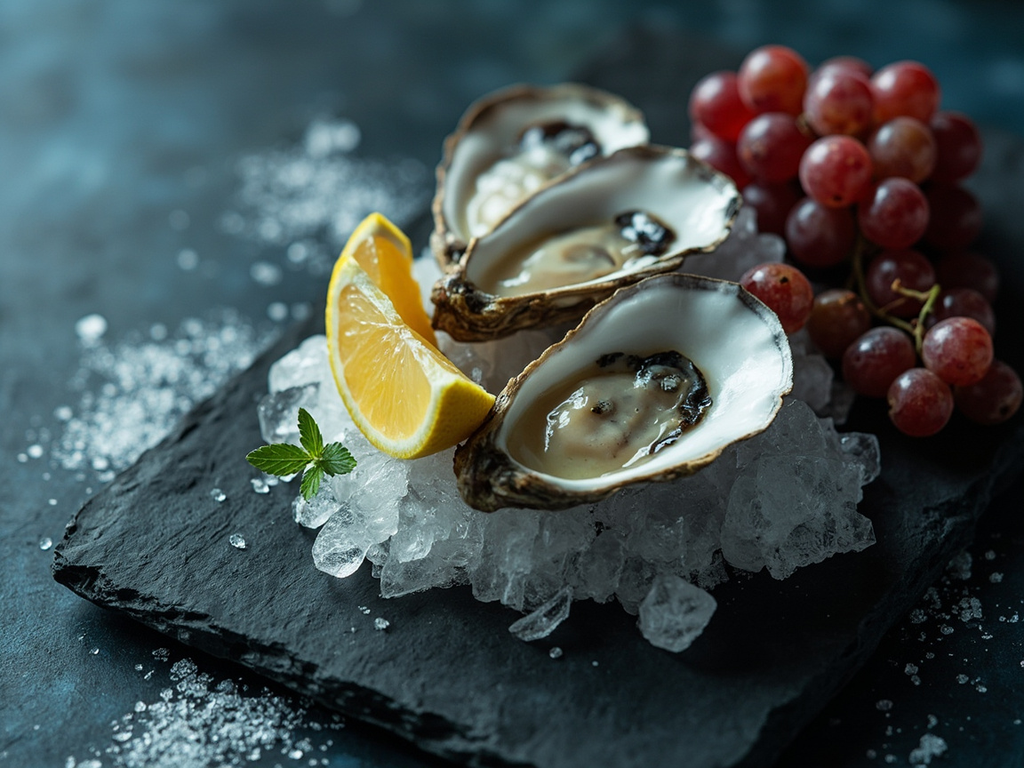
A few fresh oysters served on ice, brightened with a squeeze of lemon, and a bunch of fresh grapes — a minimalist snack, briny and tart, both remedy and refinement.
People are surprised that I hardly eat anymore. But what can you do: the body, at the end, becomes demanding and capricious like a difficult old friend. Only the purest pleasures remain — a few oysters drawn from the cold sea, a bunch of grapes, and a glass of champagne to wash it all down. An artist, I am told, can live on air and fresh water; I add the salt of the ocean and the sugar of the vine, and that suffices for me to tell another story.
- •Fresh oysters — half a dozen (briny base)
- •Lemon — a wedge (acidity)
- •Fresh grapes — a small bunch (sweetness)
Baroness's Oysters and Grapes
A few fresh oysters served on ice, brightened with a squeeze of lemon, and a bunch of fresh grapes — a minimalist snack, briny and tart, both remedy and refinement.
Why this dish? Toward the end of her life, ravaged by illness and barely able to eat, Karen Blixen is said to have subsisted on very little: oysters, grapes, biscuits, and champagne. This briny, delicate snack evokes the elegant asceticism of the great lady of Danish letters.
People are surprised that I hardly eat anymore. But what can you do: the body, at the end, becomes demanding and capricious like a difficult old friend. Only the purest pleasures remain — a few oysters drawn from the cold sea, a bunch of grapes, and a glass of champagne to wash it all down. An artist, I am told, can live on air and fresh water; I add the salt of the ocean and the sugar of the vine, and that suffices for me to tell another story.
Ingredients (period version)
- Fresh oysters — half a dozen (briny base)
- Lemon — a wedge (acidity)
- Fresh grapes — a small bunch (sweetness)
Ingredients
- Fresh oysters (no. 3) — 6 (briny base)
- Lemon — 1/2 (acidity)
- White or black grapes, well chilled — 1 small bunch (sweetness)
- Crushed ice — for plating (freshness and presentation)
- Buttered rye bread (optional) — 2 thin slices (accompaniment)
Method
- Carefully shuck the oysters with a knife, preserving their liquor; check for shell fragments.
- Arrange them on a bed of crushed ice in a shallow dish.
- Rinse the bunch of grapes and place it alongside, intact.
- Serve with lemon wedges and, if desired, thin slices of buttered rye bread.
- Enjoy the oysters plain or with a squeeze of lemon, alternating with fresh grape berries.
How it was made : Oysters, abundant and inexpensive in Northern Europe in the 19th and early 20th centuries, were eaten raw, simply opened and lemoned. For a convalescent or a tired palate, these liquid, fresh, easy-to-swallow foods were preferred over heavy dishes.
The contemporary twist : Present the oysters on a large frosted slate platter, the bunch of grapes placed like a Flemish still life, with a flute of brut champagne as a nod to the baroness.
Sources : Judith Thurman, Isak Dinesen: The Life of a Storyteller, 1982
Karen Blixen · Charactorium