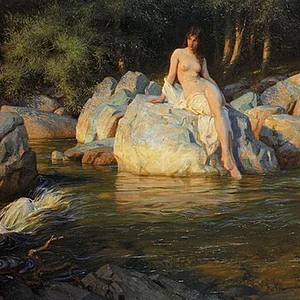

The kelpie is a supernatural creature from Scottish folklore, most often appearing in the form of a horse that haunts lochs and rivers. It lures unwary travellers onto its back before dragging them underwater to drown and devour them.
Kelpie
Kelpie
6 min read
Frequently asked questions
Key Facts
- A creature of Scottish folklore appearing mainly in the form of a water horse that haunts lochs and rivers
- Its skin is said to be cold as death and sticky to the touch, preventing its victims from breaking free once they have climbed onto its back
- The myth served as a warning to discourage children from approaching dangerous bodies of water
- In the 21st century, two monumental horse sculptures (The Kelpies, 2013) in Falkirk pay tribute to this legend
- A recurring figure in Scottish popular culture, sometimes associated with the Gaelic word “each-uisge” (water horse)
Works & Achievements
A poem that ranks among the earliest known literary mentions of the water-kelpies haunting the fords of Scotland.
An ethnographic collection recording popular beliefs, including those relating to the water-kelpie.
A reference work describing in detail the water-horse and the each-uisge of the Scottish lochs.
A scholarly dictionary of British folklore that establishes the modern definition of the kelpie.
A film adaptation that spread the figure of the Scottish water-horse worldwide.
Monumental 30-metre steel sculptures near Falkirk, among the largest equine statues in the world.
Anecdotes
In Highland folklore, all of the kelpie's power is said to reside in its bridle: whoever manages to seize it can subdue the creature and force it to work. The MacGregor clan of Glenstrae is said to have long kept a “kelpie's bridle” as a good-luck talisman.
It is said that the water-horse's skin is strangely sticky. A traveller who climbs onto its back finds himself glued fast, unable to dismount, while the beast charges toward the loch to drag him beneath the water.
The legend of the Loch Garve kelpie explains why one corner of the lake never freezes in winter: the creature is said to have carried off a mason to build a chimney at the bottom of the water, in order to warm the home of its cold-natured wife. The heat of the hearth is said to keep the ice from forming.
Scottish parents used kelpie tales as a warning: children were told that the creature lurked near rivers and fords, to discourage the reckless from venturing close to deep and dangerous waters.
In 2013, sculptor Andy Scott completed “The Kelpies,” two 30-metre-high steel horse heads near Falkirk. Modelled on real Clydesdale draught horses, they pay tribute both to the legend and to the working horses of industrial Scotland.
Primary Sources
Then water-kelpies haunt the foord, / By your direction, / An' nighted trav'llers are allur'd / To their destruction. (Then water-kelpies haunt the ford, at your command, and travellers caught out by nightfall are lured to their doom.)
A collection of Aberdeenshire popular beliefs describing the “water-kelpie” that haunts watercourses and deceives travellers by taking the shape of a horse.
A description of the “each-uisge” and the water-horse of the lochs, whose adhesive skin holds its victims fast and which, it is said, leaves nothing of them but the liver floating at the water's edge.
The kelpie is a water spirit of the Scottish rivers, appearing most often as a horse; whoever bridles it can compel it, but mounting its back without a bridle leads to drowning.
Key Places
Vast loch in the Highlands, long associated with tales of water horses and lake beasts in Scottish folklore.
Loch in the north of Scotland, setting of the famous kelpie legend in which the creature is said to have kept a corner of the water free of ice.
Park home to the two 30-metre steel horse heads sculpted by Andy Scott, a modern tribute to the creature.
Mountainous region in the north of Scotland, the cradle of Gaelic oral traditions where kelpie tales circulated.
Island in the Inner Hebrides whose lochs are tied to the legends of the each-uisge, the fierce water horse, a close cousin of the kelpie.
Typical Objects

According to belief, all the kelpie's power is contained in its bridle. Whoever seizes it can command the creature and force it to serve.

The kelpie most often appears in the guise of a handsome grey or black horse, grazing at the water's edge the better to lure weary travellers.

The water-horse's skin is said to be supernaturally sticky: the victim who climbs onto its back becomes stuck fast and can no longer get off.

The MacGregor clan of Glenstrae is said to have kept a kelpie's bridle as a protective charm, passed down as an object of luck and power.

In the legend of Loch Garve, the kelpie is said to have had a chimney built at the bottom of the loch to warm its dwelling, which is why one corner of the loch never freezes.
School Curriculum
Vocabulary & Tags
Key Vocabulary
Daily Life
Morning
At dawn, the kelpie slumbers in the dark depths of its loch or river. When day breaks, it takes the form of a peaceful horse and comes to graze on the damp grass of the banks, where travellers pass by.
Afternoon
During the day, it watches over the edges of fords and riverside paths. Gentle and inviting in appearance, it waits for a weary wanderer to be tempted by its welcoming back.
Evening
As evening falls — the most dangerous time — the kelpie redoubles its cunning. This is the hour when “travellers caught out by night,” as Burns writes, are most easily lured towards the water.
Food
The creature is said to be carnivorous: it devours those it drags beneath the water. Folklore tells that of its human victims, only the liver would remain, floating at the water's edge.
Clothing
The kelpie wears no clothing: it “clothes” itself in its transformations. Its mane, dripping with water and sometimes tangled with reeds and weeds, occasionally betrays its true aquatic nature.
Housing
Its home is the water itself: the deep lochs, rivers and fords of the Highlands. In the legend of Loch Garve, it even builds a hearth at the bottom of the lake to live in.
Historical Timeline
Period Vocabulary
Liens externes & ressources
Références
Œuvres
« Address to the Deil » (Robert Burns)
1786
« Notes on the Folk-Lore of the North-East of Scotland » (Walter Gregor)
1881
« Superstitions of the Highlands and Islands of Scotland » (J. G. Campbell)
1900
« A Dictionary of Fairies » (Katharine Briggs)
1976
« The Kelpies » (Andy Scott)
2013