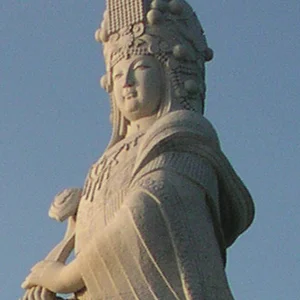

Mazu is the protective goddess of sailors in Chinese tradition. According to legend, she was born around 960 CE in Fujian province under the name Lin Mo, and was deified after her death. Her cult spread across all the coasts of China and into Chinese communities throughout Southeast Asia.
Mazu(960 — 987)
Mazu
dynastie Song
8 min read
Frequently asked questions
Key Facts
- Legendary birth around 960 CE on Meizhou Island, Fujian province
- Deified after her death and incorporated into the Taoist, then Buddhist, pantheon
- Her cult was recognized as an Intangible Cultural Heritage of Humanity by UNESCO in 2009
- More than 1,500 temples dedicated to her exist worldwide, mainly in China and Southeast Asia
- Venerated by tens of millions of devotees, particularly in Taiwan, Macao, and Hong Kong
Works & Achievements
The first shrine dedicated to Mazu, founded shortly after her death by the inhabitants of Meizhou Island. This mother temple is today the center of a network of more than 5,000 Mazu temples spread across the world.
The principal hagiographic text recording the miracles attributed to Mazu, compiled during the Yuan dynasty. It serves as the authoritative source for the cult and codifies the legendary biography of Lin Mo.
A body of ceremonies, offerings, and processions gradually codified around the Mazu cult over several dynasties. These rites are still practiced daily in temples and form a living heritage recognized by UNESCO.
An annual 9-day procession covering 330 kilometers across Taiwan, drawing several hundred thousand devotees. Ranked by National Geographic among the three greatest religious events in the world.
The beliefs and customs of Mazu are officially inscribed by UNESCO on the Representative List of the Intangible Cultural Heritage of Humanity, affirming the global reach of a cult born in Song dynasty China.
Anecdotes
According to legend, the young Lin Mo once fell into a deep trance while weaving, her spirit traveling out to sea to guide her brothers' boats through a storm. Abruptly awakened by her mother before she could save her father, she never recovered from that loss. This episode is regarded as the founding miracle of her cult.
Lin Mo was known throughout Meizhou Island for her ability to predict storms by reading clouds and winds. Fishermen refused to put to sea without first burning incense in her honor. Her reputation quickly spread beyond the island to every shore along the Fujian coast.
According to devotional texts, Mazu appeared during shipwrecks in the form of a red lantern glowing at the top of a mast, guiding vessels to safety. This luminous sign, called "Mazu's fire
was interpreted in maritime culture as a manifestation of the goddess — the same phenomenon that other traditions would explain as the natural occurrence of St. Elmo's fire.
During Admiral Zheng He's third maritime expedition in 1409, the imperial fleet was struck by a ferocious storm. The admiral, a fervent devotee of Mazu, prayed to the goddess, and the fleet survived. In gratitude, Emperor Yongle ordered the restoration of the Meizhou temple and officially elevated the cult, binding Mazu's name to China's great voyages of exploration.
In 1684, after Admiral Shi Lang conquered Taiwan for the Qing dynasty, Emperor Kangxi credited the victory to Mazu's divine protection and bestowed on her the supreme title of Tianhou, Queen of Heaven. This imperial act enshrined Mazu at the very top of the official Chinese pantheon, transforming a local fishermen's goddess into the tutelary patron of an entire maritime empire.
Primary Sources
Off the coast of Korea, a storm nearly swallowed our ships. Suddenly a red light appeared at the mast and the waves grew calm. The sailors cried out that it was the goddess of Meizhou protecting us. I record this marvel here so that it may be brought to the Emperor's attention.
The goddess, born on Meizhou Island in the first year of the Jianlong era, was endowed from childhood with supernatural wisdom. She saved sailors in peril on many occasions, guiding their vessels through storms through her knowledge of winds and ocean currents.
The saint was born on the 23rd day of the 3rd lunar month of the first year of the Jianlong era [960]. As early as age sixteen, she discovered a magic mirror in a well that granted her mystical powers. She devoted her life to easing the hardships of seafarers.
The Holy Mother of the Seas has, through her divine intercession, protected our naval forces during the Taiwan campaign. In recognition of her blessings upon the empire's navigators, We confer upon her the supreme title of Queen of Heaven, Tianhou, so that her cult may be honored in every port of the empire.
Key Places
The legendary birthplace of Lin Mo and site of the first temple dedicated to Mazu, founded after her death in 987. This shrine is the global center of her worship, visited each year by millions of pilgrims from China and Southeast Asia.
One of the oldest and most important Mazu temples on the Chinese mainland, founded during the Song dynasty. Quanzhou was the largest maritime trade port of the Song era, making this temple the spiritual heart of sailors.
One of the oldest temples in Macau, founded in the 16th century and dedicated to Mazu. Its name is the origin of the toponym "Macau
The most celebrated Mazu temple in Taiwan and the starting point of the annual Dajia pilgrimage — a 330-kilometer, 9-day journey. According to National Geographic, it is one of the three largest religious events in the world.
The summit of Meizhou Island from which Mazu is said to have left the earthly world and ascended to the heavens. This site of apotheosis is marked by a colossal statue of the goddess, visible from the sea.
Typical Objects

Imperial headdress adorned with a phoenix, worn by Mazu in all her official iconographic representations. It symbolizes her elevation to the rank of Queen of Heaven (Tianhou) by the Qing emperors.

An emblematic object of Mazu's miraculous apparitions: according to legend, a red light shone at the top of masts to guide ships in peril. Mazu temples are adorned with red lanterns in perpetual homage to this divine sign.

According to hagiographic legend, Lin Mo discovered an enchanted mirror in a well at the age of sixteen. This object is said to have granted her the gift of clairvoyance and the ability to perceive storms from a distance.

A large bronze incense burner placed at the center of every Mazu temple. Before setting sail, fishermen would burn incense and votive papers in it to implore the goddess's protection — a ritual unchanged since the Song period.

A lacquered wooden plaque bearing Mazu's name and titles, installed in the cabin of ships as a protective talisman. Merchants and fishermen never set out to sea without this miniature tablet.

A cylinder containing numbered bamboo strips used in the divinatory rituals of Mazu temples. Sailors would draw these sticks to obtain omens about the weather and the success of their crossings.
School Curriculum
Vocabulary & Tags
Key Vocabulary
Daily Life
Morning
In devotional texts, the young Lin Mo began her days with meditation and the study of Taoist and Buddhist scriptures inherited from her cultivated family. She would go at dawn to the edge of the sea to observe the winds and cloud formations, honing an ability to forecast storms that astonished the fishermen of Meizhou Island.
Afternoon
According to legend, Lin Mo spent her afternoons helping the local people: tending to the sick, advising fishermen on weather conditions, and interceding with the sea spirits. She was often described in a state of trance, her spirit traveling far away to locate ships in distress and guide their return.
Evening
In the evenings, Lin Mo would withdraw to perform purification rituals and commune with the powers of the waters. According to the chronicles, it was during these night vigils that she most easily made contact with the protective spirits of the seas, acquiring the divine wisdom that would make her a tutelary goddess after her death at the age of 27.
Food
Like many saintly figures in Chinese popular tradition, Lin Mo is described in legend as vegetarian, subsisting on rice, vegetables, tofu, and seafood reserved for offerings. This frugality was associated with her spiritual purity and her ability to transcend the needs of the material world.
Clothing
Iconographic representations of Mazu show her dressed in imperial red or blue robes and wearing a phoenix crown, marks of the official titles bestowed upon her by successive dynasties. In her earthly life, she most likely wore the simple dress of women from the Fujian coast — linen garments and a straw hat.
Housing
Lin Mo grew up on Meizhou Island in a modest fisherman's dwelling facing the China Sea. After her apotheosis, her temples — from simple village chapels to grand imperial shrines — were designed as celestial palaces oriented toward the sea, symbolizing her eternal vigilance over all the world's seafarers.
Historical Timeline
Period Vocabulary
Liens externes & ressources
Références
Œuvres
Fondation du Temple de Meizhou (湄洲祖廟)
987
Tianfei Xianyinglu (天妃顯應錄) — Recueil des miracles
XIVe siècle
Corpus rituel du culte Mazu (媽祖祭典)
Xe–XVIe siècle
Pèlerinage de Dajia (大甲媽祖遶境進香)
Tradition millénaire, codifiée aux XVIIIe–XIXe siècles
Inscription UNESCO — Patrimoine culturel immatériel
2009