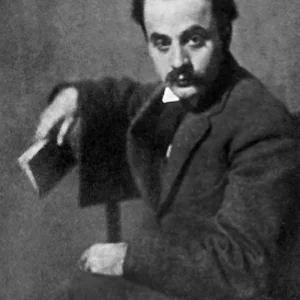

Lebanese poet, writer, and painter (1883-1931), a major figure of Arab émigré literature (Mahjar). Author of the collection of poetic prose The Prophet (1923), one of the most widely read books in the world, he wrote in both Arabic and English.
Khalil Gibran(1883 — 1931)
Khalil Gibran
Empire ottoman, République libanaise sous mandat français, État du Grand Liban
7 min read
Frequently asked questions
Famous Quotes
« Your children are not your children. They are the sons and daughters of Life's longing for itself.»
« And stand together yet not too near together... But let there be spaces in your togetherness.»
« Work is love made visible.»
Key Facts
- Born in 1883 in Bsharri, in Mount Lebanon, then under Ottoman rule.
- Emigrated to the United States in 1895 and settled in Boston, then New York.
- Published The Prophet in 1923, his most famous work, written in English.
- Led the Arab émigré literary movement (al-Mahjar) with the Pen League (1920).
- Died in New York in 1931; he is buried in Bsharri, Lebanon.
Works & Achievements
His very first published work in Arabic, a short poetic essay that heralded his career as a writer.
A collection of tales set in Lebanon, in which he criticizes social injustice and religious power.
Defiant short stories that caused a scandal in the Levant and established him as a voice of revolt.
A tragic love novel, a milestone of modern Arabic prose and of émigré literature.
His first book written directly in English, a collection of parables and aphorisms.
A masterpiece made up of 26 meditations by the sage Al-Mustafa; one of the most widely read books in the world.
A collection of aphorisms and poetic maxims on love, art, and the human condition.
A portrait of Christ seen through 77 voices of imaginary contemporaries, the sum of his spiritual thought.
Anecdotes
Khalil Gibran was born in 1883 in Bsharri, a village perched above the holy Qadisha Valley and the famous Cedars of Lebanon forest. Too poor to attend school, he was taught by his mother, who instructed him in Arabic, Syriac, and music, and fed his imagination with folktales and the Bible.
When the family emigrated to Boston in 1895, a clerk at the American school garbled his name during enrollment: the threefold “Gibran Khalil Gibran” became simply “Kahlil Gibran.” This misspelling would follow him for the rest of his life, and it was under this anglicized name that he became famous around the world.
In Boston, the young Gibran was noticed by the avant-garde photographer and publisher Fred Holland Day, who used him as a model and introduced him to art and photography. Soon after, his meeting with Mary Haskell, a school headmistress, changed his life: she became his patron, funded his art studies in Paris, and corrected his English for years.
Between 1902 and 1903, tuberculosis claimed his mother, his half-brother, and one of his sisters in quick succession. Only his sister Marianna survived alongside him; she worked as a seamstress to support them both while Gibran tried to make his name as an artist.
Published in 1923, “The Prophet” enjoyed only modest success at first, but its sales kept climbing. Translated into more than a hundred languages and embraced by the youth of the 1960s, it has become one of the most widely read books of all time, making Gibran one of the best-selling poets in history after Shakespeare and Lao Tzu.
Primary Sources
Your children are not your children. They are the sons and daughters of Life's longing for itself. They come through you but not from you, and though they are with you, yet they belong not to you.
Work is love made visible. And if you cannot work with love but only with distaste, it is better that you should leave your work.
Half of what I say is meaningless; but I say it so that the other half may reach you.
It was in losing my masks that I became a madman — and it was in that madness that I found both freedom and safety.
Key Places
Gibran's native village, perched above the Holy Valley of the Qadisha and the Cedars forest. A mountain landscape that would haunt all his work.
Immigrant neighborhood where the family settled in 1895. It was there that Gibran discovered Western art and made his first decisive encounters.
School where Gibran returned to study classical Arabic, literature, and the culture of the Levant between 1898 and 1902. There he strengthened his native language as a writer.
Parisian art studio where Gibran trained between 1908 and 1910, thanks to the support of Mary Haskell. There he admired Rodin and Symbolist painting.
Studio apartment he called “the Hermitage,” at 51 West Tenth Street. The center of his creative life and of the gatherings of the Pen League; he died there in 1931.
Former hermitage purchased to house Gibran's tomb according to his wish. Now the Gibran Museum, it preserves his manuscripts and paintings.
Typical Objects

The draftsman's tools that Gibran wielded from his teenage years to sketch faces and bodies. He filled hundreds of sheets with them, from Symbolist nudes to portraits.

A painting technique using ink or diluted colours through which Gibran created his gallery of portraits of famous figures (Rodin, Yeats, Jung). His misty, spiritual style was inspired by Blake and Rodin.

The instruments of the bilingual writer who first composed in Arabic and then in English. With them he wrote poems, prose, and the abundant correspondence he exchanged with Mary Haskell.

A small book of poetic prose in which the sage Al-Mustafa delivers his teachings on love, work, and freedom. An object of meditation read at weddings and funerals all over the world.

A small long-handled vessel for brewing Lebanese-style coffee, strong and fragrant. A symbol of Eastern hospitality that Gibran rediscovered in the salons of the Arab diaspora.

An Eastern water pipe found at the gatherings and literary circles of the émigré community. It accompanied the long evenings of conversation among the Mahjar poets in New York.
School Curriculum
Vocabulary & Tags
Key Vocabulary
Tags
Daily Life
Morning
A night worker, Gibran would rise late in his Greenwich Village studio. He began the day with a strong Lebanese-style coffee and by reading his abundant mail, in particular the letters from Mary Haskell.
Afternoon
In the afternoon, he received friends and models, worked on his wash-drawing portraits, and revised his texts in Arabic and English. He sometimes strolled through the streets of the Village, then a neighborhood of artists and bohemians.
Evening
The evening was his most fertile time for creation: he wrote by lamplight and led the gatherings of the Pen League. Among poets of the Mahjar, these evening sessions mingled literary discussion, tobacco, and drinks.
Food
Attached to the cooking of his childhood, he loved Lebanese dishes and fragrant coffee. But in New York he drank more and more arak and alcohol, which ruined his liver and hastened his death at the age of 48.
Clothing
In his New York life he most often wore the dark Western suit of men of letters. For certain portraits, however, he posed in Oriental dress, asserting his Levantine roots.
Housing
He lived in a modest one-room studio at 51 West Tenth Street, which he called “the Hermitage.” The place was cluttered with books, drawings, manuscripts, and knickknacks—at once dwelling, studio, and refuge.
Historical Timeline
Period Vocabulary
Liens externes & ressources
Références
Œuvres
Al-Musiqah (La Musique)
1905
Les Nymphes des vallées (Ara'is al-Muruj)
1906
Les Esprits rebelles (Al-Arwah al-Mutamarrida)
1908
Les Ailes brisées (Al-Ajniha al-Mutakassira)
1912
Le Fou (The Madman)
1918
Le Prophète (The Prophet)
1923
Sable et écume (Sand and Foam)
1926