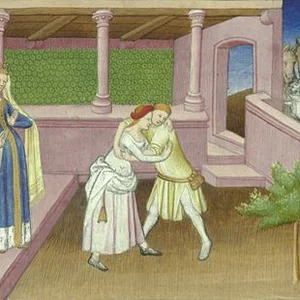

Mongol princess of the 13th century, great-niece of Kublai Khan and daughter of Khan Kaidu. A legendary warrior and wrestler, she challenged her suitors to wrestling matches and remained undefeated, winning horses with each victory.
Khutulun(1260 — 1306)
Khutulun
Empire mongol
7 min read
Frequently asked questions
Key Facts
- Born around 1260, daughter of Khan Kaidu, rival of Kublai Khan
- Renowned as unbeatable in wrestling (köröö), she demanded 100 horses from every suitor she defeated
- She accompanied her father on military campaigns and fought alongside men in battle
- Marco Polo describes her in his travel accounts as a warrior of exceptional strength
- Died around 1306, having played a political role in the succession after her father's death
Works & Achievements
Khutulun challenged hundreds of suitors in traditional Mongolian wrestling (bökh) and remained undefeated according to all sources. This extraordinary athletic achievement earned her a reputation that spread far beyond the borders of the Empire.
Khutulun took an active role in the wars her father waged against Kublai Khan, serving as a cavalry commander. Her effective military role is attested by several Persian chroniclers and by Marco Polo.
According to Rashid al-Din, Kaidu regularly consulted his daughter on military and diplomatic matters. Her influence over the khanate's strategic decisions far exceeded what was expected of a woman of her time.
After her father's death, Khutulun played a decisive role in the succession crisis by supporting her brother Orus against rival claimants. She herself refused the title of khan, choosing instead to exercise indirect influence until her death.
Anecdotes
Khutulun had established an ironclad rule for any suitor wishing to marry her: he had to defeat her in wrestling. If he lost, he would forfeit one hundred horses to her. According to the chronicles, no man ever succeeded in beating her, and she is said to have accumulated more than ten thousand horses over the years.
The Venetian traveler Marco Polo, who stayed at the Mongol court between 1271 and 1292, described Khutulun with great admiration in his travel account. He reported that she would charge alone into enemy ranks during battles, carrying an opponent under each arm as if they were mere lambs, before dragging him back as a prisoner.
During her father Kaidu's military campaigns against Kublai Khan, Khutulun fought by his side at the head of the cavalry. Persian chroniclers Rashid al-Din and Wassaf attest to her active military role — unusual for a woman of the Mongol nobility, even in a society that valued horsemanship and female combat.
After Kaidu's death in 1301, Khutulun actively supported her brother Orus's bid for succession. She declined the offer to become khan in his place, but continued to wield considerable political influence until her own death in 1306, bearing witness to the real power women could hold within the Chinggisid nobility.
Primary Sources
There was in this country a damsel, niece of the Great Khan, whose name was Aïgiarne... She was so strong and so valiant that no man in all her father's kingdom could defeat her in wrestling.
Khutulun, daughter of Kaidu, was of extraordinary bravery and vigor. She took part in her father's battles and carried off prisoners from the midst of enemy ranks.
Kaidu's daughter surpassed most men in the army in courage and skill in combat. Her father consulted her on military and political matters.
Key Places
The heartland of the khanate of Kaidu, Khutulun's father. It was in these steppes and valleys of Central Asia that Khutulun grew up, trained in combat, and spent most of her life.
The former capital of the Mongol Empire, founded by Ögedei Khan. A symbolic site of kurultais and dynastic power struggles, Karakorum was at the center of the conflicts between Kaidu and Kublai Khan.
An important city in Kaidu's khanate along the Silk Road, in the Ili Valley. A cosmopolitan hub where merchants, diplomats, and envoys mingled, it served as a political and commercial center of the territory controlled by Khutulun's family.
A vast grassland plain crossed by Kaidu's armies during his campaigns against Kublai. Khutulun took part in several battles here alongside her father, according to the accounts of Rashid al-Din.
Typical Objects

Made from horn, sinew, and wood, this recurve bow was the primary weapon of the Mongol warrior. Khutulun, trained in combat from childhood, mastered its use on horseback like any Mongol noble of her rank.

A wide belt of leather or thick cloth worn during Mongol wrestling matches. It was around this belt that the decisive grips were seized during the challenges Khutulun issued to her suitors.

A long wraparound robe made of wool or silk, the traditional Mongol garment worn in both summer and winter. Khutulun likely wore a combat-adapted version — shorter and reinforced — during her military campaigns.

A portable circular tent, the defining dwelling of the nomadic Mongols. Kaidu's camp, where Khutulun lived, consisted of hundreds of gers arranged according to a strict hierarchical protocol.

A vessel of wood or precious metal used for drinking koumiss, fermented mare's milk that served as both a ritual and everyday drink among the Mongols. Koumiss consumption was central to the banquets and ceremonies of Kaidu's court.

Protective armor made from overlapping scales of hardened leather or metal, worn in battle. Chronicles confirm that Khutulun took an active part in combat, which implies she wore this distinctive form of armor.
School Curriculum
Vocabulary & Tags
Key Vocabulary
Daily Life
Morning
Khutulun rose at dawn with the camp, her first task being to tend to her horses — her personal wealth and instruments of war. She would then train in archery and acrobatic horsemanship, disciplines practiced daily by Mongol nobles from childhood.
Afternoon
Afternoons were devoted to wrestling exercises (bökh) and planning military campaigns. During peacetime, she participated in her father's councils and oversaw the training of mounted troops, a role attested by chroniclers.
Evening
In the evenings, family members and officers gathered in Kaidu's great yurt around a central fire to share meals, drink kumiss, and deliberate on political affairs. Storytellers and musicians sometimes enlivened these gatherings, which could last well into the night.
Food
The Mongol diet relied primarily on meat (mutton, horse, game) — boiled or dried — and dairy products: kumiss (fermented mare's milk), dried cheese (aaruul), and cream. Grains and vegetables were scarce, obtained through trade along the Silk Road.
Clothing
In daily life, Khutulun wore the deel, a long cross-fastened robe of thick wool cinched with a leather belt, paired with felt and leather boots. In battle, she donned lamellar armor protecting the torso and shoulders, topped with a pointed helmet in keeping with Mongol military tradition.
Housing
Khutulun lived in a large yurt (ger), a mark of high social standing. Kaidu's family yurt was richly adorned with colored felt hangings and rugs, and was transported with each movement of the nomadic army across the steppes of Central Asia.
Historical Timeline
Period Vocabulary
Visual Style
Style inspiré des miniatures persanes médiévales : guerrière mongole en armure lamellaire, palette ocre et rouge profond sur fond de steppe infinie, motifs décoratifs traditionnels.
Sound Ambience
Ambiance sonore des steppes d'Asie centrale médiévale : vent, chevaux au galop, chants gutturaux mongols et bruits de camp militaire nomade.
Liens externes & ressources
Références
Œuvres
Carrière de lutteure invincible
vers 1280-1300
Campagnes militaires aux côtés de Kaidu
vers 1280-1301
Rôle de conseillère politique de Kaidu
vers 1290-1303
Action lors de la succession post-Kaidu
1301-1306