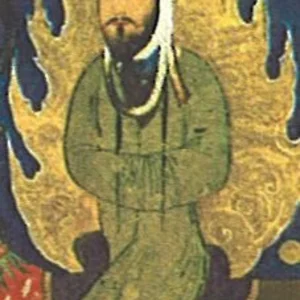

Born around 571 in Mecca, Muhammad is the founder of Islam and the prophet of the Muslim faith. A merchant turned preacher, he received what he believed to be a divine revelation at the age of 40 and united the Arab tribes under a new monotheistic religion.
Muhammad(571 — 632)
Muhammad
9 min read
Frequently asked questions
Famous Quotes
« Seek knowledge, even unto China.»
« The believers are like one body: if one member suffers, the whole body responds with fever and sleeplessness.»
Key Facts
- Around 571: born in Mecca into the Hashemite clan of the Quraysh tribe
- 610: first revelation in the Cave of Hira, beginning of his preaching
- 622: the Hijra — flight from Mecca to Medina, the starting point of the Muslim calendar
- 630: conquest of Mecca and destruction of the idols in the Kaaba
- 632: death in Medina, having united nearly the entire Arabian Peninsula under Islam
Works & Achievements
The collection of revelations received by Muhammad over 22 years, forming the founding sacred text of Islam. Transmitted orally before being written down, it is considered by Muslims to be the direct word of Allah.
The first known constitutional document in the Islamic world, establishing a pact between the Muslim, Jewish, and Arab tribes of Medina. It defined the concept of the umma (community) and the rights and duties of each group.
Muhammad instituted and defined the five fundamental practices: the profession of faith (shahada), prayer (salat), almsgiving (zakat), the fast of Ramadan (sawm), and the pilgrimage to Mecca (hajj).
Through diplomacy, marriage alliances, and military victories, Muhammad succeeded in uniting the previously divided tribes of the Arabian Peninsula under a shared religious and political authority.
Muhammad sent envoys bearing letters to the Byzantine Emperor Heraclius, the Persian Shah Khosrow II, and the King of Ethiopia, inviting them to convert to Islam — a founding act of international Islamic diplomacy.
A speech delivered on Mount Arafat before an immense crowd during Muhammad's final pilgrimage, summarizing the ethical and religious principles of Islam: the equality of believers, respect for women, and the abolition of certain tribal customs.
Anecdotes
Before receiving his first revelation around 610, Muhammad would regularly withdraw alone to the Cave of Hira on Mount Jabal al-Nour, near Mecca, to meditate for days at a time. It was during one of these retreats that, according to Islamic tradition, the angel Gabriel appeared to him and commanded him to 'Read!' — the first word revealed of the Quran.
Muhammad was orphaned at a very young age: his father Abdullah died before his birth, and his mother Amina passed away when he was six. He was then raised by his grandfather Abd al-Muttalib, and later by his uncle Abu Talib, head of the Hashemite clan. This childhood marked by loss and family solidarity profoundly shaped his deep empathy for the most vulnerable.
At 25, Muhammad married Khadijah, a wealthy widow and merchant fifteen years his senior, for whom he worked. According to the sources, it was she who proposed marriage to him. Khadijah was the first to believe in his prophecy and remained his only wife until her death in 619 — a year Muhammad called the 'Year of Sorrow'.
During the conquest of Mecca in 630, Muhammad entered the city without bloodshed and granted a general amnesty to his former persecutors. He circled the Kaaba on horseback and ordered the idols inside it destroyed, transforming this polytheistic shrine into a sanctuary of Islam. This act was seen as the fulfillment of his mission to restore monotheism.
Muhammad was illiterate according to Islamic tradition — something the Quran itself acknowledges by referring to him as the 'unlettered prophet (ummi)'. For his contemporaries, this was proof that the Quran, with its extraordinary literary richness, could not have been his own composition but was indeed a divine revelation.
Primary Sources
Read, in the name of your Lord who created, who created man from a clinging substance. Read! Your Lord is the Most Generous, who taught by the pen, taught man what he did not know.
This is a document from Muhammad the prophet, governing relations between the believers and Muslims of Quraysh and Yathrib, and those who follow them and strive alongside them. They constitute a single community (umma) distinct from all other people.
When Muhammad was forty years old, God honored him by choosing him as a prophet and showed him mercy by appointing him as a messenger. Gabriel came to him bearing God's command while he was in the cave of Hira.
The Messenger of Allah said: 'Islam is built on five pillars: bearing witness that there is no god but Allah and that Muhammad is His messenger, performing prayer, paying zakat, making the pilgrimage to the House, and fasting the month of Ramadan.'
In the name of Allah, the Most Gracious, the Most Merciful. From Muhammad, servant of Allah and His messenger, to Heraclius, ruler of the Romans: Peace be upon him who follows true guidance. I invite you to Islam. Submit to Islam, and you will be safe.
Key Places
Muhammad's birthplace, the center of Arabian caravan trade and home of the Kaaba. It was here that he was born, received his revelation, and returned triumphantly in 630 to establish it as the central sanctuary of Islam.
A cave on a hillside 4 km from Mecca where Muhammad would retreat for meditation. It was here, around 610, that he received the first Quranic revelation from the angel Gabriel.
The city where Muhammad settled after the Hijra of 622, establishing the first Islamic state. Here he organized the Muslim community, died in 632, and was buried — his tomb is housed within the Prophet's Mosque.
Site of Islam's first major battle in 624, where the Muslims defeated a numerically superior Qurayshi army. This victory was interpreted as a divine sign and cemented Muhammad's authority.
A cubic structure at the heart of the Grand Mosque in Mecca, regarded as the 'House of Allah.' Muhammad destroyed the idols within it in 630 and made it the focal point of the Islamic pilgrimage (hajj).
Liens externes & ressources
Références
Œuvres
Le Coran (révélation coranique)
610-632
La Constitution de Médine
622-623
L'organisation des Cinq Piliers de l'islam
622-632
L'unification des tribus arabes
622-632
Les lettres aux souverains étrangers
628
Le sermon du pèlerinage d'adieu
632