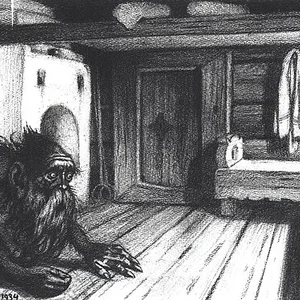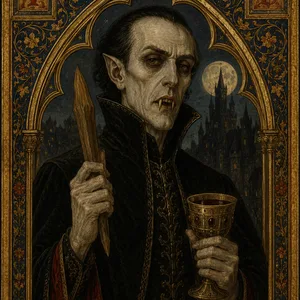

A creature of Eastern European folklore, the vampire is an undead being said to rise from its grave to feed on the blood of the living. This mythological figure, rooted in medieval Slavic and Balkan beliefs, has endured through the centuries to become one of the most powerful archetypes in the Western imagination.
Vampire
Vampire
8 min read
Frequently asked questions
Key Facts
- The earliest written mentions of vampires appear in Slavic and Byzantine chronicles around the 11th–12th century
- In 1721–1722, official Austrian investigations in the Balkans (the cases of Petar Blagojevich and Arnold Paole) documented reported cases of vampirism
- In 1819, John Polidori published 'The Vampyre', the first modern vampire story in Western literature
- In 1897, Bram Stoker created the character of Dracula, inspired by Vlad III the Impaler (15th century), cementing the myth in global culture
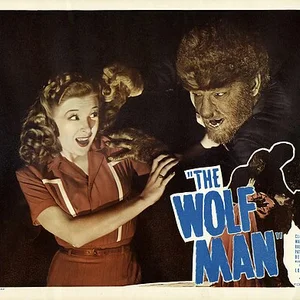
- In 1922, Murnau's film 'Nosferatu' brought the vampire figure to widespread popularity on screen
Works & Achievements
The first scholarly and comparative study of the vampire phenomenon, written by a learned Benedictine monk. The work was considered authoritative throughout the 18th century and helped spread belief in vampires among educated Europeans.
The first Gothic short story to feature an aristocratic, seductive vampire. It established the archetype of the 'Byronic vampire' and directly influenced vampire literature throughout the 19th century.
A precursor to Dracula featuring a female vampire. It introduced the psychological dimension and the play on hidden identity that would become defining codes of the genre.
The founding epistolary novel that established the modern conventions of the vampire (black cape, Transylvanian castle, transformation into a bat). It remains the most influential work in the genre, adapted hundreds of times.
The first unofficial film adaptation of Dracula and a masterpiece of German Expressionism. It established the image of the vampire as a repulsive creature and menacing shadow — a stark contrast to the seductive vampire archetype.
Anecdotes
In 1725 and 1732, two 'vampirism' affairs shook Serbia under Austrian rule: the cases of Petar Blagojevich and Arnold Paole. Austrian military officers wrote official reports describing exhumed corpses with fresh complexions and uncoagulated blood, triggering a genuine panic across Western Europe.
The word 'vampire' entered Western languages in the early 18th century, probably from the Serbian 'vampir'. Before that, the French spoke of 'revenants' or 'ghouls' — similar figures from different traditions. The term spread so rapidly that it already appeared in Diderot and d'Alembert's Encyclopédie in 1765.
The philosopher Voltaire openly mocked the belief in vampires in his Dictionnaire philosophique (1764), ironically comparing it to the practices of the financial 'vampires' of his day — speculators and stock-jobbers — whom he considered far more dangerous than the undead of Slavic folklore.
Empress Maria Theresa of Austria, troubled by vampirism reports coming from her Balkan provinces, tasked her personal physician Gerard van Swieten with investigating the matter. In 1755, he concluded that the phenomenon was explained by a poor understanding of bodily decomposition, and the empress officially banned exhumations tied to these beliefs.
The Vampyre (1819) by John Polidori, Lord Byron's personal physician, is the first modern Gothic story to feature an aristocratic and seductive vampire. Polidori drew directly on Byron's personality to create the character of Lord Ruthven, thereby establishing the archetype of the elegant vampire that would influence all subsequent literature, up to Bram Stoker's Dracula in 1897.
Primary Sources
We found the body of Arnold Paole, dead for forty days, fresh and undecayed, with fresh blood flowing from his eyes, nose, mouth and ears. His shirt, shroud and coffin were stained with coagulated blood.
These vampires were dead men who left their graves to come and suck the blood of the living, either at the throat or at the stomach, after which they returned to their cemeteries. The persons sucked by them grew thin and fell into a languishing condition.
It is well established that reports of vampires and revenants have been widespread in Hungary, Moravia, Silesia and Poland. It is claimed that men who have been dead for some time reappear in certain places, speak, walk about, infest villages, and mistreat both men and animals.
Everything that is reported about vampires is imaginary. These are bodies which, under certain conditions of soil or season, decompose more slowly than usual. Ignorance and superstition have done the rest.
Key Places
Village where the Petar Blagojevich affair broke out in 1725, one of the first 'vampire epidemics' officially documented by the Austrian authorities, which popularized the term 'vampire' across Europe.
Medieval fortress associated in popular imagination with Vlad the Impaler and popularized as 'Dracula's castle' following Stoker's novel, although Vlad most likely never lived there.
Coastal town with medieval abbey ruins where Bram Stoker set Count Dracula's arrival in England in his novel; a real location that Stoker visited and which inspired the gothic atmosphere of the work.
Village where the Arnold Paole case was investigated in 1732; the Visum et Repertum report compiled on-site became the most widely cited official document across Europe on the question of vampirism.
Typical Objects

The primary instrument for destroying a vampire in Slavic folklore: driven into the heart of the undead during ritual exhumations, it was believed to permanently prevent the revenant from leaving its grave.

Used as a universal repellent against vampires in Balkan and Slavic traditions; it was rubbed on doors, windows, and even corpses to prevent their return.

In the Eastern Orthodox and Catholic Christian traditions of affected regions, the cross and holy water were placed on the body of the deceased or inside the coffin to prevent them from becoming a vampire.

To prevent vampirism, suspected individuals were sometimes buried face down or in coffins weighted with stones so they could not dig their way to the surface — archaeological excavations have uncovered such burials across Central Europe.

Balkan folklore attributed to vampires a compulsive obsession with counting: scattering seeds on a grave or inside a house forced them to count every single grain throughout the night, preventing them from causing harm.

In the 19th-century Gothic literary tradition, the vampire casts no reflection in a mirror — a sign of its lack of a soul — making the mirror an instrument for revealing a hidden monstrous nature.
School Curriculum
Vocabulary & Tags
Key Vocabulary
Tags
Daily Life
Morning
According to folklore, the vampire is compelled to return to its grave before sunrise, barred from the world of daylight. Its 'morning' is in fact a return to death's torpor in the cold earth, invisible to the eyes of the living.
Afternoon
During the daylight hours, the creature sleeps a death-like sleep in its coffin, sometimes surrounded by soil from its homeland according to later literary traditions. The village goes about its business, unaware of — or pretending not to know — what slumbers beneath their feet.
Evening
It is at dusk that the vampire awakens. According to Balkan folklore, it quietly leaves its grave to prowl the village alleyways, knock on familiar doors, or slip into houses to feed on the blood of sleeping victims.
Food
The vampire feeds solely on human blood, the ultimate 'life force' in medieval belief. Its victims gradually lose their strength and waste away. Some Slavic traditions add that it can also drain the blood of livestock or bring illness and misfortune upon the living.
Clothing
In original folklore, the vampire appears simply dressed in its burial shroud, pale and with clothes soiled by earth. The image of the vampire in a black cape and elegant suit is an invention of 19th-century Gothic literature, popularized by Lord Ruthven and Count Dracula.
Housing
Its home is the tomb: a grave pit in the village cemetery, sometimes a crypt beneath a rural chapel. Gothic literature would later assign it a crumbling castle perched in inhospitable mountains, reinforcing its isolation and its nature as a cursed aristocrat.
Historical Timeline
Period Vocabulary
Visual Style
Style peinture gothique romantique inspiré des artistes du XIXe siècle : clair-obscur saisissant, paysage carpatique nocturne, palette de bleus nocturnes et de rouges profonds sur fond de brume et de ruines.
Sound Ambience
Ambiance nocturne d'un village médiéval slave : loups, vent froid, cloches d'église étouffées et silence pesant d'un cimetière où quelque chose semble vouloir s'éveiller.
Liens externes & ressources
Références
Œuvres
Dissertations sur les apparitions et les vampires — Dom Augustin Calmet
1746
The Vampyre — John Polidori
1819
Carmilla — Sheridan Le Fanu
1872
Dracula — Bram Stoker
1897