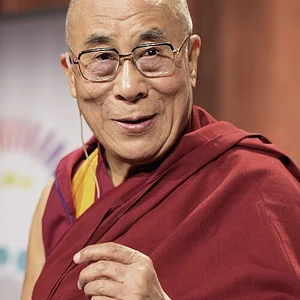

Jiddu Krishnamurti (1895-1986) was an Indian thinker of global stature. Singled out by the Theosophical Society as a future “World Teacher,” he broke with that role in 1929 and spent the rest of his life inviting everyone to free themselves from all spiritual authority.
Krishnamurti
Krishnamurti
6 min read
Frequently asked questions
Famous Quotes
« Truth is a pathless land.»
« It is no measure of health to be well adjusted to a profoundly sick society.»
Key Facts
- Born in 1895 in Madanapalle, in southern India.
- Discovered in 1909 by the Theosophical Society, which saw in him the future “World Teacher.”
- In 1929, he dissolved the Order of the Star in the East and renounced any status as master or guru.
- Travelled and lectured all over the world until his death, without founding any doctrine or dogmatic organization.
- Died in 1986 in Ojai, California.
Works & Achievements
A small book published under his name while he was still a teenager, which made him famous in Theosophical circles.
A foundational act in which he renounces his role as World Teacher and affirms the spiritual autonomy of every individual.
A major work setting out his conception of an education freed from fear and competition.
A foundational book, with a foreword by Aldous Huxley, that spread his thinking on inner freedom worldwide.
Collections of reflections and dialogues that rank among his most widely read texts.
A personal journal revealing his inner life, his relationship with nature, and “the process.”
The creation of schools in India, England, and the United States applying his educational vision.
A series of exchanges between the thinker and the physicist on thought, time, and consciousness.
Anecdotes
In 1909, on the beach at Adyar in India, the theosophist Charles Leadbeater noticed a thin 14-year-old boy and declared that he saw an extraordinary aura around him, without the slightest trace of selfishness. This is how the young Jiddu Krishnamurti, the son of a Brahmin clerk, was chosen to become the future “World Teacher.”
The Theosophical Society created a worldwide Order for him, the “Order of the Star in the East,” bringing together thousands of enthusiastic disciples. But in 1929, before three thousand members gathered in the Netherlands, Krishnamurti dissolved the organization with a phrase that has remained famous: “Truth is a pathless land.”
Krishnamurti refused to be made into a guru or an authority. When admirers wanted to bow down before him, he stopped them, repeating that one should follow no one and that everyone had to be “a light unto oneself.”
At the end of his life, he held dialogues with the physicist David Bohm, one of the great minds of quantum physics. For hours, the Indian thinker and the Western scientist compared their ideas about thought, time, and consciousness.
Krishnamurti founded schools in India, England, and the United States, where the aim was to educate without fear or competition. He liked to tell the students that understanding life mattered more than passing exams.
Primary Sources
Truth is a pathless land, and you cannot approach it by any path whatsoever, by any religion, by any sect.
To transform the world, we must regenerate ourselves; the transformation of the world is brought about by the inner transformation of each individual.
Right education consists in understanding the child as he is, without imposing upon him the image of what we think he should be.
To be afraid is not to live fully; and the function of education is to help each person free themselves from fear.
Key Places
Town in southern India where Krishnamurti was born in 1895, into a family of Telugu Brahmins. It is the starting point of his journey.
World headquarters of the Theosophical Society, where the boy was “discovered” in 1909 and where his training began. A decisive place in his youth.
Californian valley where Krishnamurti settled regularly and lived his inner experience of 1922. He died there in 1986.
Theosophical estate where Krishnamurti dissolved the Order of the Star in 1929 before thousands of followers. The founding moment of his break.
Village in the Swiss Alps where for decades he held large gatherings of talks every summer. A key place for the spread of his thought.
English estate where Krishnamurti founded an international school in 1969, faithful to his vision of education. A major center of his educational work.
Typical Objects

A simple open-air platform from which Krishnamurti addressed thousands of listeners, often beneath the great trees of Ojai or Saanen. He refused any solemn setting or throne.

A device used to record his talks and dialogues, which made it possible to preserve hundreds of hours of his words. These archives are the foundation of the trusts that bear his name.

Collections such as *The First and Last Freedom* or *Education and the Significance of Life*, often transcribed from his talks. They spread his thought throughout the world.

Depending on the place and occasion, Krishnamurti wore either an impeccable Western suit or the Indian kurta and dhoti. This dual wardrobe symbolizes his life between East and West.

Krishnamurti sometimes set down his observations and his connection with nature, as in *Krishnamurti's Notebook*. These writings reveal his inner life.

Known for his punctuality and his quiet elegance, Krishnamurti took care of his appearance and the cleanliness of his surroundings. He saw outward order as the reflection of an inner attentiveness.
School Curriculum
Vocabulary & Tags
Key Vocabulary
Daily Life
Morning
Krishnamurti rose early and often began with a moment of calm and silent observation, sometimes facing the mountains or the garden. He placed great importance on walking and direct contact with nature.
Afternoon
The afternoon might be devoted to public talks or dialogues with visitors, scientists, or educators. When he was not speaking in public, he read, exchanged letters, or rested.
Evening
The evening was quieter, well suited to small conversations and reflection. Krishnamurti valued simplicity and avoided social gatherings and commotion.
Food
A strict vegetarian his entire life, he ate frugally, favoring fruits, vegetables, rice, and simple dishes. He paid attention to the quality and freshness of his food.
Clothing
Depending on the setting, he wore either neat Western attire or traditional Indian clothing such as the kurta. He was known for his understated elegance and impeccable appearance.
Housing
He lived in modest but well-kept residences, notably in Ojai, California, and near his schools. He liked places that were orderly, bright, and surrounded by nature.
Historical Timeline
Period Vocabulary
Liens externes & ressources
Références
Œuvres
Aux pieds du Maître (At the Feet of the Master)
1910
Dissolution de l'Ordre de l'Étoile
1929
De l'éducation (Education and the Significance of Life)
1953
La Première et Dernière Liberté
1954
Le Vol de l'aigle / séries de Commentaires sur la vie
1956-1960
Carnet (Krishnamurti's Notebook)
1961
Fondation des écoles Krishnamurti
1969