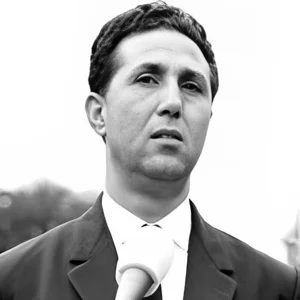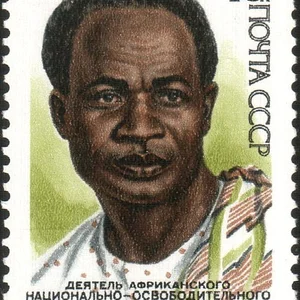

A Ghanaian statesman, Kwame Nkrumah led the Gold Coast to independence and became the first president of Ghana in 1957. A leading figure of Pan-Africanism, he championed the unity of the African continent before being overthrown by a coup d'état in 1966.
Kwame Nkrumah(1909 — 1972)
Kwame Nkrumah
Ghana, Côte-de-l’Or
6 min read
Frequently asked questions
Famous Quotes
« The independence of Ghana is meaningless unless it is linked up with the total liberation of Africa.»
Key Facts
- 1947: returns to the Gold Coast and joins the anti-colonial nationalist movement
- 1949: founds the Convention People's Party (CPP) to demand immediate independence
- 1957: Ghana becomes the first sub-Saharan African country to gain independence, with Nkrumah as Prime Minister
- 1960: the Republic of Ghana is proclaimed, and Nkrumah becomes its first president
- 1966: overthrown by a military coup while on a trip abroad
Works & Achievements
The first sub-Saharan African country freed from the colonial yoke, paving the way for the decolonization of the continent.
Nkrumah was one of the founding fathers of this pan-African institution, the forerunner of the African Union.
A major hydroelectric project intended to industrialize Ghana and supply electricity to the region.
A major work setting out his vision of a politically unified Africa.
An essay denouncing the persistent economic dependence of newly independent states.
The story of his journey, published on the day of independence, which became a classic of anticolonial thought.
A massive expansion of schools, universities, and hospitals to train a Ghanaian elite.
Anecdotes
A poor student, Nkrumah spent ten years in the United States (1935-1945), where he juggled odd jobs — fish seller, shipyard worker, waiter — to fund his studies at Lincoln University and then in Pennsylvania. He would later say that this hardship taught him the dignity of working people.
In 1950, imprisoned by the British after launching “Positive Action” (strikes and non-violent civil disobedience), he kept leading his party from his cell by passing messages written on toilet paper. His party won the 1951 elections, and the English were forced to release him to bring him into the government.
At midnight on 6 March 1957, before an immense crowd in Accra, Nkrumah proclaimed Ghana's independence — the first country in Black Africa to free itself from colonization. He cried out that this freedom was “linked to the total liberation of the African continent,” laying the foundations of Pan-Africanism.
Overthrown by a military coup in February 1966 while on an official visit to Beijing, Nkrumah would never see Ghana again. Guinean president Sékou Touré offered him asylum and symbolically named him “co-president” of Guinea. He died in exile in 1972.
Nicknamed “Osagyefo” (the Redeemer, in the Akan language), Nkrumah gave his country a name drawn from history: “Ghana” recalls the medieval Ghana Empire, anchoring the young nation in a glorious African past, even though that empire actually lay further to the northwest.
Primary Sources
At long last, the battle has ended! And thus Ghana, your beloved country, is free forever. […] Our independence is meaningless unless it is linked up with the total liberation of the African continent.
Seek ye first the political kingdom, and all things shall be added unto you.
We must unite now or perish. […] Africa must unite.
The essence of neo-colonialism is that the State which is subject to it is, in theory, independent and has all the outward trappings of international sovereignty. In reality its economic system and thus its political policy is directed from outside.
Key Places
Village in the south-west of the Gold Coast where Nkrumah was born in 1909.
African American institution where Nkrumah studied theology and philosophy from 1935.
Capital of Ghana, scene of the proclamation of independence in 1957 and the seat of Nkrumah's power.
City where Nkrumah found refuge after the 1966 coup d'état, welcomed by Sékou Touré.
Large dam on the Volta inaugurated in 1965, a symbol of Ghana's modernization project.
Memorial where his remains now rest, repatriated to Ghana after his death in exile.
Typical Objects

Traditional Akan woven cloth with colorful patterns, a symbol of royal prestige. Nkrumah wears it during ceremonies to assert pride in African identity in the face of the West.

An emblem of power evoking the staffs of traditional Akan chiefs. It reinforces Nkrumah's image as the “Redeemer” of the nation.

A red-gold-green banner emblazoned with a black star, the “star of African freedom.” Raised for the first time at independence in 1957.

A black star borrowed from Marcus Garvey's movement, a symbol of the emancipation of Black peoples. It adorns the Ghanaian flag and the national team, the “Black Stars.”

Works such as Africa Must Unite or Neo-Colonialism spreading Pan-Africanist thought. Nkrumah was as prolific a writer as he was a man of action.

A massive hydroelectric dam on the Volta River, a flagship project of Ghana's industrialization. It created one of the largest artificial lakes in the world.
School Curriculum
Vocabulary & Tags
Key Vocabulary
Daily Life
Morning
An early riser and tireless worker, Nkrumah often began his days before dawn by reading reports and correspondence. He devoted his mornings to government meetings and to writing his speeches and books.
Afternoon
His afternoons were filled with official audiences, visits from foreign heads of state, and the opening of projects (schools, factories, dams). He loved to address crowds directly at party rallies.
Evening
In the evening, Nkrumah received advisers and Pan-Africanist intellectuals to debate the future of the continent. A great reader, he often stretched late into the night in his library, pen in hand.
Food
His diet combined traditional Ghanaian dishes — fufu, spicy soups, jollof rice, yam, and plantain — with habits picked up during his years abroad. Temperate by nature, he did not drink alcohol and led a fairly austere personal life.
Clothing
He alternated between the Western suits of statesmen and African garments such as the kente or a plain tunic, depending on the message he wished to convey. This choice of dress asserted both his modernity and his African pride.
Housing
Once in power, he lived in Accra in official residences, notably Flagstaff House, which also served as the presidential seat. Born in a humble village, he had known modest and precarious lodgings in his youth.
Historical Timeline
Period Vocabulary
Liens externes & ressources
Références
Œuvres
Indépendance du Ghana
1957
Fondation de l'Organisation de l'unité africaine (OUA)
1963
Barrage d'Akosombo
1965
Africa Must Unite
1963
Neo-Colonialism: The Last Stage of Imperialism
1965
Ghana: The Autobiography of Kwame Nkrumah
1957
Politique d'éducation et de santé gratuites
1957-1966