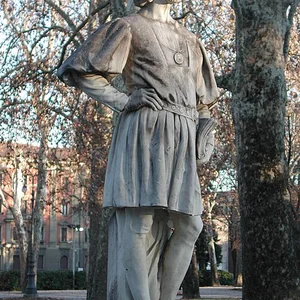

An Italian poet of the Renaissance, Ariosto is the author of Orlando Furioso, a vast epic poem in the Italian language. In the service of the Este court at Ferrara, he became one of the greatest literary figures of his time.
Ariosto(1474 — 1533)
Ariosto
6 min read
Frequently asked questions
Key Facts
- Born in 1474 in Reggio Emilia, Italy
- Enters the service of the House of Este at Ferrara, notably of Cardinal Ippolito d'Este and then of Duke Alfonso I
- Publishes the first version of Orlando Furioso in 1516, a work revised until the definitive edition of 1532
- Orlando Furioso, a chivalric poem, continues Boiardo's Orlando Innamorato and inspires all of European literature
- Died in 1533 in Ferrara
Works & Achievements
An early comedy performed at Ferrara, one of the first great Italian comedies inspired by the Latin theatre of Plautus and Terence.
A comedy of intrigue whose influence was felt across European theatre, notably on Shakespeare.
A vast epic poem in 40 cantos that continues Boiardo's *Orlando Innamorato*; a founding masterpiece of Renaissance chivalric poetry.
Seven satirical poems inspired by Horace, in which Ariosto offers a humorous self-portrait and defends his inner freedom.
A reworked version expanded to 46 cantos, the culmination of nearly thirty years of work, which established Ariosto as the greatest epic poet of his time.
A satirical comedy featuring a fake magician, showcasing Ariosto's comic verve.
A collection of lyric poetry (sonnets, madrigals, canzoni) in the Petrarchan tradition.
Anecdotes
Ariosto spent nearly thirty years writing and polishing *Orlando Furioso*. He published a first version in 1516, then never stopped correcting and expanding it, right up to the definitive edition of 1532, just one year before his death.
Cardinal Ippolito d'Este, his first patron, is said to have received the poem with disdain, scoffing at him: "Master Ludovico, wherever did you find so much nonsense?" Ariosto, offended, eventually left his service for that of Duke Alfonso I.
Sent as governor to the Garfagnana, a mountainous region overrun with brigands, Ariosto confronted bandits for three years. According to a famous legend, when he was captured by a band, he was released with respect as soon as the leader learned that he was the author of *Orlando Furioso*.
With little taste for travel, Ariosto hated long journeys and preferred his native Ferrara. He liked to say that he travelled through his imagination in his poem rather than on the roads — even though he sent his hero Astolfo all the way to the Moon.
Toward the end of his life, Ariosto had a modest house built in Ferrara, which he furnished himself. On it he had a Latin inscription carved, meaning in essence: "Small, but all my own, paid for with my own money, and harming no one."
Primary Sources
Of ladies, knights, of arms, of loves, of courtesies, of bold endeavours I sing, that took place in the days when the Moors crossed the sea from Africa and wrought such havoc in France.
Here Ariosto expresses his refusal to follow Cardinal Ippolito d'Este to Hungary, preferring study and the tranquillity of his homeland to the pomp and servitude of court life.
Parva sed apta mihi, sed nulli obnoxia, sed non sordida, parta meo sed tamen aere domus. (A house small but suited to me, beholden to no one, not squalid, and yet acquired with my own money.)
The first major Italian comedy in prose and later in verse, performed at the court of Ferrara, marking the revival of comic theatre inspired by the Latin tradition.
Key Places
City in Emilia-Romagna where Ariosto was born in 1474, his father being at the time captain of the citadel there.
Capital of the Este duchy, where Ariosto spent most of his life in the service of the court. There he composed his work, had his comedies performed and died in 1533.
Mountainous region of Tuscany of which Ariosto was governor from 1522 to 1525, tasked with maintaining order against the brigands.
Modest house that the poet had built at the end of his life and that he loved deeply, adorned with a Latin inscription celebrating simplicity.
Ariosto undertook law studies there under pressure from his father, before devoting himself fully to literature and Latin.
Typical Objects

The epic poem to which Ariosto devoted nearly thirty years, endlessly revised and expanded. A major work of Italian literature.

The everyday writing instruments of the poet and court secretary. Ariosto used a quill to write his verses, his administrative letters, and his comedies.

The editions of Orlando Furioso were printed in Ferrara, with Ariosto himself overseeing the typesetting. The printing press allowed his poem to be widely distributed.

A winged creature, half horse and half griffin, popularized by Ariosto in Orlando Furioso. A fantastical mount on which his knights roam the world and the sky.

The chivalric imagination of Orlando Furioso is filled with enchanted weapons such as Astolfo's lance or Roland's sword Durandal. Symbols of the courtly ideal.

A collection of poems in terza rima in which Ariosto reflects with irony and sincerity on his life, his troubles as a courtier, and his love of freedom.
School Curriculum
Vocabulary & Tags
Key Vocabulary
Tags
Daily Life
Morning
Rising early in his house in Ferrara, Ariosto often devoted his mornings to writing and to the patient revision of his verses. As secretary and administrator for the Este family, he also had to deal with correspondence and the affairs of the court.
Afternoon
His afternoons were divided between his duties as a ducal official — formalities, audiences, administration — and his literary work. During his years as governor in the Garfagnana, he spent his days settling disputes and dealing with the threat of banditry.
Evening
In the evening, Ariosto returned to the quiet of his study, read the Latin authors he cherished, or tirelessly reworked *Orlando Furioso*. He enjoyed the company of learned friends and the scholarly conversations of the court.
Food
His diet was that of an Italian Renaissance courtier: bread, pasta and soups, meats and poultry, accompanied by the wine and fruit of the rich Po plain. Ariosto described himself as having little appetite and simple tastes.
Clothing
He wore the plain but well-kept clothes of a secretary and scholar: a long robe, a cloth doublet, a cloak, and sometimes the discreet livery of the House of Este when he served the court officially.
Housing
After years of lodging according to his court duties, Ariosto had a modest and comfortable house built in Ferrara, the Casa dell'Ariosto, which he regarded as a haven of peace to call his own.
Historical Timeline
Period Vocabulary
Liens externes & ressources
Références
Œuvres
La Cassaria
1508
I Suppositi (Les Supposés)
1509
Roland furieux (Orlando furioso), première édition
1516
Satires
vers 1517-1525
Roland furieux, édition définitive
1532
Il Negromante (Le Nécromant)
1520
Rime
publiées à titre posthume