
Ladon is a dragon from Greek mythology tasked with guarding the golden apples of the Garden of the Hesperides. Often described as a many-headed creature whose sleep was eternally watchful, he was defeated during the eleventh of the Labors of Heracles.
Ladon
Ladon
6 min read
Frequently asked questions
Key Facts
- Ladon guards the golden apples of the Hesperides, located at the far western edge of the Greek world
- According to Hesiod (Theogony, 8th–7th c. BCE), he is the offspring of the sea deities Phorcys and Ceto; other traditions link him to Typhon and Echidna
- He is sometimes described as having a hundred heads and the ability to speak in many voices (Apollodorus, Library)
- He is slain by Heracles during his eleventh labor, the quest for the golden apples
- After his death, Hera places him in the sky as the constellation Draco, the Dragon
Works & Achievements
Ladon's eternal mission: to protect the tree of golden apples from any intruder, until the arrival of Heracles during his eleventh labour.
The earliest surviving text to mention the serpent guarding the golden apples, set at the edges of the world, child of Phorcys and Ceto.
An epic that shows Ladon slain at the foot of the apple tree, its tail still twitching, the day after its death.
A treatise of mythological astronomy linking the constellation Draco to the guardian of the Hesperides.
A handbook of mythology that fixed the image of the hundred-headed dragon, son of Typhon and Echidna, with its many voices.
A collection that recounts how Hera placed Ladon among the stars, forming the constellation Draco.
Anecdotes
Depending on the author, Ladon does not have the same appearance: the poet Hesiod simply speaks of a “terrible serpent,” while the mythographer Apollodorus credits him with a hundred heads able to speak in all kinds of voices. This shifting creature shows how a single myth can transform over the centuries.
Ladon was said never to truly sleep: with his many heads, he could keep watch over the tree of golden apples without ever closing all his eyes at once. This is what made him the perfect guardian, impossible to lull to sleep or to deceive.
After Ladon's death, the goddess Hera, grateful for his long years of guarding, is said to have placed him in the sky as the constellation Draco, which coils around the celestial North Pole. This was how the Greeks explained the origin of a star pattern visible all year round.
In the Argonautica of Apollonius of Rhodes, the heroes reach the garden of the Hesperides the day after Heracles passed through: they find Ladon struck down at the foot of the apple tree, with only the tip of his tail still twitching, and the nymphs in tears. It is one of the rare scenes in which we “see” the dragon just after its death.
There are two versions of Heracles' eleventh labor: in one, the hero kills Ladon with his arrows in order to pick the apples himself; in the other, he persuades the giant Atlas to fetch them while he holds up the sky in his place. So Ladon's fate changes from one account to another.
Primary Sources
And Ceto bore to Phorcys the terrible serpent who, in the secret places of the dark earth, at its vast boundaries, guards the apples all of gold.
These apples were guarded by an immortal dragon, offspring of Typhon and Echidna, which had a hundred heads and uttered all manner of varied voices.
Only the day before, Heracles had struck down the guardian serpent; by the trunk of the apple tree it lay, and only the tip of its tail still quivered, while the Hesperides wailed.
Many have said that this Dragon guarded the golden apples of the Hesperides; slain by Hercules, he was placed by Juno among the stars, because he kept watch at her command.
Key Places
Marvelous orchard located at the western edges of the world, near the giant Atlas. Ladon watched over the golden apples there day and night, and it was there that he was killed by Heracles.
Mountain range of the far West where the giant Atlas holds up the vault of the sky. Tradition places the garden guarded by Ladon at its foot.
Alternative location of the Garden of the Hesperides according to several ancient authors, who placed the sacred orchard on the coast of present-day Libya.
Ladon's celestial home after his death: Hera is said to have transformed him into a constellation coiled around the North Pole. A mythical place in the sky, with no earthly coordinates.
Typical Objects

Golden fruits growing in the garden of the Hesperides, given by Gaia to Hera as a wedding gift for her marriage to Zeus. They symbolize immortality and divine youth, making them the treasure that Ladon guards.

The sacred tree around which Ladon coils his body to guard the golden apples. It stands at the heart of the garden, at the far western edge of the world.

Arrows dipped in the venom of the Lernaean Hydra, with which, in one version of the myth, Heracles slays Ladon by shooting over the garden wall. Their poison was lethal even to an immortal creature.

A pattern of stars coiled around the celestial North Pole, identified since antiquity with the dragon of the Hesperides, whom Hera placed in the sky after his death. It is visible year-round in the Northern Hemisphere.

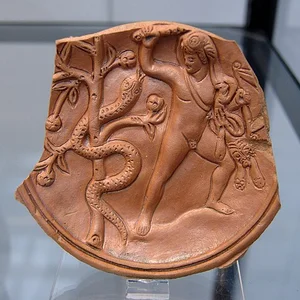
Attic black-figure and red-figure ceramics depicting the garden, the tree, and the coiled serpent. They represent our earliest known "images" of Ladon.
School Curriculum
Vocabulary & Tags
Key Vocabulary
Daily Life
Morning
At daybreak, Ladon remains coiled around the tree of the golden apples, at the heart of the Garden of the Hesperides. Said never to truly sleep, he keeps several of his heads raised to watch the western horizon.
Afternoon
During the day, the Hesperides nymphs sing and tend the orchard under the dragon's watchful eye. No thief can approach the sacred fruit without being instantly spotted by one of his many heads.
Evening
In the evening, where the sun plunges into the Ocean at the edges of the world, Ladon tightens his coils around the trunk. His many voices hiss in the gloom to ward off intruders.
Food
An immortal creature, Ladon is not described as feeding in the manner of mortals: his task is to guard, not to devour. In Diodorus's rationalized version, the "dragon" was supposedly in fact a herdsman, since the Greek word mêla means both apples and livestock.
Clothing
Ladon's body is covered in gleaming serpentine scales, his only "clothing." Depending on the author, he raises a single head or a hundred, and his long body winds like a living rope around the tree.
Housing
His dwelling is the Garden of the Hesperides itself, in the far West, near the giant Atlas and the Ocean. The tree of the golden apples, from which he never strays, serves as his lair.
Historical Timeline
Period Vocabulary
Liens externes & ressources
Références
Œuvres
La garde des pommes d'or des Hespérides
Époque mythologique
Théogonie (Hésiode)
VIIIe–VIIe s. av. J.-C.
Argonautiques (Apollonios de Rhodes)
IIIe s. av. J.-C.
Catastérismes (Ératosthène)
IIIe s. av. J.-C.
Bibliothèque (pseudo-Apollodore)
Ier–IIe s. apr. J.-C.
Astronomica (Hygin)
Ier s. av. J.-C.