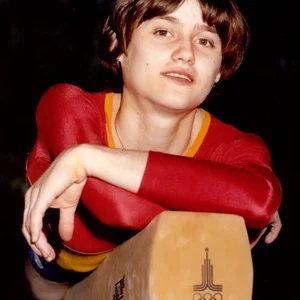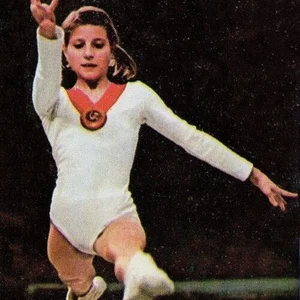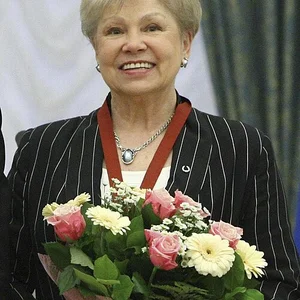

Soviet gymnast, one of the greatest champions in the history of sport. She won 18 Olympic medals between 1956 and 1964, a record that stood unmatched for a long time.
Larisa Latynina(1934 — ?)
Larissa Latynina
Russie, Union soviétique
5 min read
Frequently asked questions
Key Facts
- Born in 1934 in Kherson (Soviet Ukraine)
- 18 Olympic medals in total (9 gold, 5 silver, 4 bronze) across three editions of the Olympic Games (1956, 1960, 1964)
- Held the record for the most individual Olympic medals for 48 years, until Michael Phelps in 2012
- Became coach of the Soviet national gymnastics team after her career
- Died in 2024
Works & Achievements
Latynina's first major Olympic title, in Melbourne, which introduced her to the world.
A second consecutive all-around title, in Rome, confirming her dominance.
Total amassed across three Games (9 gold, 5 silver, 4 bronze), a record not broken until 2012 by Michael Phelps.
Several world championships won, notably the all-around in 1958 and 1962.
As head coach, she led the USSR to Olympic team titles in 1968, 1972, and 1976.
She took part in organizing the gymnastics events at the Moscow Olympic Games.
Anecdotes
At the 1960 Rome Games, Larissa Latynina competed while four months pregnant without anyone knowing. She still won several medals, including gold in the all-around competition. A few months later, she gave birth to her daughter.
Her record of 18 Olympic medals stood for 48 years. It was not broken until 2012, by American swimmer Michael Phelps. Latynina was in fact present in London to witness this historic moment.
Latynina won her medals across three editions of the Games (1956, 1960, 1964), taking the individual all-around title twice in a row, in 1956 and 1960. She remains one of the few gymnasts to have dominated her sport for nearly a decade.
As a child, Larissa first dreamed of becoming a ballet dancer. It was the lack of a dance teacher in her hometown of Kherson that led her to turn to gymnastics, where she revealed an exceptional talent.
After her competitive career, she became coach of the Soviet women's national gymnastics team, which she led to several Olympic team titles between 1968 and 1976.
Primary Sources
Larisa Latynina (USSR) wins the individual all-around competition along with several other titles, confirming Soviet dominance in women's artistic gymnastics.
Latynina retains her individual all-around title and adds new medals to her already exceptional record.
Larisa Latynina: 18 Olympic medals in total (9 gold, 5 silver, 4 bronze), spread across the 1956, 1960 and 1964 Games.
Key Places
Birthplace of Larisa Latynina, in the south of Soviet Ukraine, where she took up gymnastics.
Host of the 1956 Olympic Games, where Latynina won her first individual all-around title.
City of the 1960 Games, where Latynina retained her Olympic title while pregnant.
Host of the 1964 Games, Latynina's final Olympic appearance, where she brought her total to 18 medals.
Soviet capital where Latynina trained and later worked as a coach for the national team.
Typical Objects

A narrow apparatus on which gymnasts perform sequences of balance and acrobatics. It was one of the events in which Latynina excelled.

An apparatus made of two bars set at different heights, used for swinging and release-and-catch moves. A signature discipline of women's gymnastics.

An award given to the top three finishers in an Olympic event. Latynina accumulated 18 of them, a record that went unmatched for a long time.

A close-fitting one-piece garment that allows freedom of movement and makes the lines of the body visible during exercises.

An apparatus the gymnast pushes off after a running approach to perform an acrobatic vault. An event of power and precision.

A magnesium carbonate powder that gymnasts coat their hands with to improve grip and absorb sweat on the apparatus.
School Curriculum
Vocabulary & Tags
Key Vocabulary
Daily Life
Morning
The day of a top-level Soviet gymnast begins early, with a muscle warm-up and stretching. Mornings are devoted to a first intensive training session, focused on flexibility and the repetition of basic figures on each apparatus.
Afternoon
The afternoon is dedicated to a second, more technical training session, where complete routines are performed and every detail is corrected with the coaches. Discipline and repetition were the watchwords of the Soviet sports system.
Evening
The evening is devoted to recovery: treatments, massages, and rest. Latynina also led a family life, raising her children while pursuing her career as a very high-level athlete.
Food
The diet of Soviet athletes was monitored and balanced, rich in proteins and carbohydrates to sustain their effort. Weight control was essential in gymnastics, a sport where lightness aids the execution of the figures.
Clothing
In both training and competition, Latynina wore the tight-fitting leotard characteristic of gymnastics. Outside of it, she dressed simply, in the style of the Soviet era.
Housing
Like the elite athletes of the USSR, she benefited from housing and infrastructure provided by the State, which invested heavily in sport as a tool of national prestige. She lived mainly in Moscow.
Historical Timeline
Period Vocabulary
Liens externes & ressources
Références
Œuvres
Concours général individuel olympique
1956
Concours général individuel olympique
1960
Record de 18 médailles olympiques
1956-1964
Titres mondiaux de gymnastique
1958-1962
Direction de l'équipe nationale soviétique
1966-1977
Organisation de la gymnastique aux JO de Moscou 1980
1980