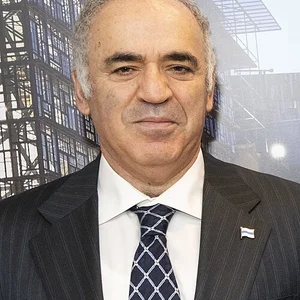

Soviet and later Russian chess player, world champion from 1985 to 2000. Regarded as one of the greatest players in history, he was the youngest world champion of his era and a pioneer in facing artificial intelligence.
Garry Kasparov(1963 — ?)
Garry Kasparov
Russie, Croatie
6 min read
Frequently asked questions
Key Facts
- Born on April 13, 1963, in Baku (Azerbaijan SSR, USSR)
- Became world chess champion in 1985 at age 22 by defeating Anatoly Karpov
- Defeated IBM's Deep Blue supercomputer in 1996, but lost the rematch in 1997
- Held his world title until 2000, dominating the Elo rankings for two decades
- Retired from professional chess in 2005 to engage in political opposition to Vladimir Putin
Works & Achievements
Kasparov held the world title for fifteen years, one of the longest reigns in the modern history of chess.
The first encounter in which Kasparov beat IBM's supercomputer, demonstrating the resilience of human intelligence against the machine.
Kasparov reached a peak Elo rating that long remained a record, a testament to his dominance.
A monumental multi-volume work analyzing the world champions who came before him, a reference for players.
An essay in which Kasparov applies the lessons of chess to decision-making in life and work.
A book devoted to artificial intelligence and the collaboration between humans and machines, drawing on his experience against Deep Blue.
An organization he chairs to defend democratic values against authoritarian regimes.
Anecdotes
In 1985, at just 22 years old, Garry Kasparov defeated Anatoly Karpov to become the youngest world chess champion in history up to that point. Their rivalry, spread across five matches between 1984 and 1990, was one of the most intense ever seen: their first encounter was even called off after 48 games with no clear winner.
In 1996, Kasparov faced Deep Blue, an IBM supercomputer, and won the match. But the following year, in 1997, the upgraded machine took its revenge and beat him: it was the first time a computer had defeated a reigning world champion in a match played under tournament conditions, a sensational event for the entire world.
Convinced that IBM had cheated in 1997, Kasparov demanded a rematch and access to the machine's logs, but in vain. Certain that a human had intervened behind a move that was too “subtle,” he remained bitter for a long time; much later, he acknowledged that the move was probably just a simple bug in the program.
In 1985, during a world tour, Kasparov played a simultaneous exhibition against 32 different chess computers in Germany and beat all 32 of them, demonstrating the human superiority of the era over the machines.
After retiring from professional chess in 2005, Kasparov entered politics, openly opposing Vladimir Putin. Threatened and briefly detained during protests, he eventually went into exile and now lives outside Russia.
Primary Sources
“In chess as in life, progress does not come from repeating what you already know, but from constantly striving to surpass yourself.” In it, Kasparov shares his reflections on decision-making and strategy.
“The defeat against Deep Blue was not the end of the story between man and machine, but the beginning of a new era of collaboration.”
“I am a human being. When I see something that is well beyond my understanding, I'm afraid.”
In it, Kasparov denounces the authoritarian drift of Russian power and calls on democracies not to yield in the face of intimidation.
Key Places
Kasparov's birthplace, then the capital of the Azerbaijan Soviet Socialist Republic. He took up chess there in early childhood.
The nerve center of Soviet chess, where Kasparov trained and played countless games. Later, the setting for his political activism against Putin.
The stage for the 1997 rematch against Deep Blue, held in a Manhattan skyscraper and followed by the whole world.
A major chess city of the USSR where top-level competitions and training sessions took place during Kasparov's career.
Site of the 1987 World Championship match against Karpov, which Kasparov narrowly retained thanks to a win in the very last game.
Typical Objects

A 64-square board on which official games are played. Kasparov spent tens of thousands of hours of analysis and competition on it.

A double clock measuring each player's thinking time. Time management is a decisive component of high-level games.

The standard model of chess pieces used in competition since the 19th century. The king, the centerpiece, embodies the ultimate goal of the game: checkmate.

A chess machine designed by IBM, capable of evaluating 200 million positions per second. A symbol of the clash between human intelligence and computing.

A notebook in which the player records preparations, opening variations and analyses. Kasparov was renowned for the depth and novelty of his theoretical preparation.

A document in which each move is transcribed in official algebraic notation. It allows games to be archived and replayed for study.
School Curriculum
Vocabulary & Tags
Key Vocabulary
Daily Life
Morning
A champion like Kasparov's morning often began with physical exercise and swimming, because he considered being in good physical shape essential for enduring games of five to six hours. This was followed by studying openings and analyzing future opponents.
Afternoon
The afternoon was devoted to long training sessions, either alone or with his seconds (trainers). During competitions, the official games were generally played at this time of day.
Evening
In the evening, after a game, Kasparov and his team would analyze positions late into the night to prepare for the resumption the next day. He also read a great deal, about history and politics.
Food
A demanding athlete, he watched his diet to maintain energy and concentration during long games. A high-level chess game can burn an amount of energy comparable to a sustained physical effort.
Clothing
At tournaments, Kasparov wore a suit and tie, the classic attire required by the etiquette of high-level chess competitions. His polished appearance contributed to his image as a determined fighter.
Housing
Born into a modest family in Baku, he later lived in apartments tied to his status as an elite Soviet athlete, then traveled constantly from capital to capital following the international tournaments.
Historical Timeline
Period Vocabulary
Liens externes & ressources
Références
Œuvres
Titre de champion du monde d'échecs
1985-2000
Victoire sur Deep Blue (premier match)
1996
Plus haut classement Elo de l'époque (2851)
1999
My Great Predecessors (série de livres)
2003-2006
How Life Imitates Chess
2007
Deep Thinking
2017
Fondation de la Renew Democracy Initiative
2017