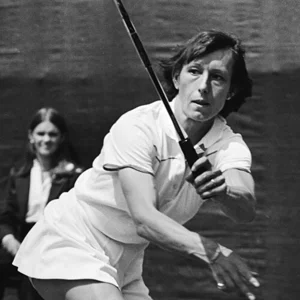

Czechoslovak then American tennis player, considered one of the greatest players in history. She dominated the women's circuit in the 1970s and 1980s, winning a record number of singles and doubles titles.
Martina Navratilova(1956 — ?)
Martina Navrátilová
États-Unis, Tchéquie
5 min read
Frequently asked questions
Key Facts
- Born on October 18, 1956 in Prague (Czechoslovakia)
- Sought political asylum in the United States in 1975, became a naturalized American citizen in 1981
- Won 18 Grand Slam singles titles, including 9 at Wimbledon (a record)
- Holds a record total of 59 Grand Slam titles (singles, doubles, mixed doubles)
- Came out in 1981, becoming a figure for the LGBT cause
Works & Achievements
Her first Grand Slam singles victory, marking the start of a decade of dominance.
A streak of 74 consecutive wins and holding all four major titles at the same time.
An all-time record for victories at the most prestigious tournament in the world.
A candid account of her childhood, her defection and her identity, written with journalist George Vecsey.
An exceptional tally across singles, women's doubles and mixed doubles over more than thirty years.
A mixed doubles win at the US Open at almost 50 years old, a record for longevity.
Anecdotes
In September 1975, at just 18 years old, Martina Navrátilová took advantage of the US Open in New York to request political asylum in the United States. Refusing to return behind the Iron Curtain, she gave up her family and her country: the Czechoslovak authorities immediately stripped her of her citizenship. She would not see her mother again for many years.
Her rivalry with the American Chris Evert is one of the most famous in the history of sport. They faced each other 80 times between 1973 and 1988, with Navrátilová ultimately winning 43 to 37. Fierce opponents on the court, they remained great friends off it.
Between 1982 and 1987, Martina won the Wimbledon tournament six times in a row, on the London grass she adores. With nine singles titles in all, she holds the all-time record for Wimbledon victories, across both men and women.
In 2006, at almost 50 years old, she won the mixed doubles at the US Open, claiming her very last Grand Slam title more than thirty years after her first. She became the oldest champion in the history of the major tournaments.
In 1981, shortly after obtaining American citizenship, Martina publicly came out as gay, at a time when very few athletes dared to do so. This courage cost her advertising contracts but made her a pioneer in the defense of LGBT rights.
Primary Sources
“When I decided to stay in the United States, I knew I might never see my family or my country again. That was the price of freedom.”
Navrátilová announces that she has requested permanent resident status in the United States and that she will not return to Czechoslovakia.
“Tennis was the language that allowed me to speak to the whole world, even when I had not yet mastered English.”
Key Places
Capital where Martina was born in 1956 and where she grew up under the communist regime before going into exile.
Small town near Prague where she spent her childhood and learned tennis on the local courts with her stepfather.
The All England Club, scene of her nine singles titles, where she reigned over the grass courts in the 1980s.
Site of the US Open, where she requested asylum in 1975 and won her final title in 2006.
Region where she settled after her defection and built her new life as an American athlete.
Liens externes & ressources
Références
Œuvres
Premier titre à Wimbledon
1978
Saison record 1983-1984
1984
Neuf titres en simple à Wimbledon
1990
Autobiographie Martina
1985
59 titres du Grand Chelem au total
1974-2006
Dernier titre du Grand Chelem
2006