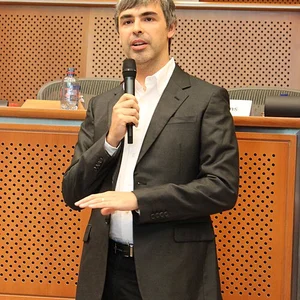

Co-founder of Google with Sergey Brin in 1998, Larry Page revolutionized access to information on the Internet through the PageRank algorithm. He led Google then Alphabet, one of the most highly valued companies in the world.
Larry Page(1973 — ?)
Larry Page
États-Unis
8 min read
Frequently asked questions
Famous Quotes
« If you're not doing some things that seem crazy, you're not thinking big enough.»
« Always deliver more than you promised.»
Key Facts
- 1998: co-founding of Google with Sergey Brin in a garage in Menlo Park
- 1998: invention of the PageRank algorithm, which ranks web pages by popularity
- 2004: Google's Initial Public Offering (IPO) raises $1.67 billion
- 2015: creation of Alphabet Inc., a holding company grouping Google and its subsidiaries
- 2019: resignation from the position of CEO of Alphabet
Works & Achievements
Developed at Stanford, PageRank ranks web pages based on the number and quality of links pointing to them — a revolution compared to existing search engines that relied on simple keyword matching. This algorithm is the intellectual foundation of Google.
Founded with Sergey Brin, Google transforms access to online information and establishes itself as the world's dominant search engine, now processing more than 8.5 billion queries every day.
Launched under Page's leadership, Google Maps revolutionizes digital cartography and navigation, becoming the world's most widely used geolocation application with more than one billion active users.
Google acquires Android Inc. in 2005 and turns it into an open-source mobile operating system. Driven by Page's vision, Android becomes the most widespread operating system in the world, powering more than 70% of smartphones.
Page oversees the launch of this fast and secure web browser, which overtakes Internet Explorer and Firefox to become the most widely used browser in the world, strengthening the Google ecosystem.
A major reorganization of Google into a technology conglomerate bringing together its search, advertising, and innovation subsidiaries (Waymo, DeepMind, Verily). Page serves as its founding CEO until 2019.
Page launches this self-driving vehicle project, a global pioneer in driverless transportation. Waymo is now Alphabet's subsidiary dedicated to autonomous mobility, with robotaxis already in service across the United States.
Anecdotes
Larry Page grew up in a home where computers were everywhere: his father, Carl Page, was a computer science professor at the University of Michigan. By age 6, Larry was printing scientific articles on the family printer, fascinated by technology. This unique environment convinced him early on that computing could change the world.
Originally, the search engine invented by Page and Brin at Stanford was called 'BackRub,' because it analyzed the backlinks between web pages. In 1997, they renamed it 'Google,' a play on 'googol' (the number 1 followed by 100 zeros), to symbolize their ambition to organize a nearly infinite amount of information.
In 1999, Page and Brin tried to sell Google to Excite, one of the dominant internet portals of the time, for just one million dollars. Excite's CEO turned them down, reasoning that Google was too effective: users would find their answers too quickly and leave the site. That decision is widely regarded as one of the greatest strategic blunders in internet history.
In 1998, Page and Brin rented the garage of Susan Wojcicki (future CEO of YouTube) in Menlo Park for $1,700 a month to house their first servers. That modest space is now a legendary address in Silicon Valley, a symbol of how the greatest technological revolutions can be born in the most ordinary of surroundings.
Under Larry Page's leadership, Alphabet launched 'Project Loon,' which involved sending stratospheric balloons to an altitude of 20 km to provide internet access to remote parts of the world. Though the project was shut down in 2021, it exemplifies the 'moonshot' philosophy so dear to Page: attempting seemingly impossible challenges to solve major humanitarian problems, even at the risk of failure.
Primary Sources
Google is designed to crawl and index the Web efficiently and produce much more satisfying search results than existing systems. The prototype with a full text and hyperlink database of at least 24 million pages is available at http://google.stanford.edu/
Don't be evil. We believe strongly that in the long term, we will be better served — as shareholders and in all other ways — by a company that does good things for the world even if we forgo some short term gains.
We did a lot of things that seemed crazy at the time. Many of those crazy things now have over a billion users, like Google Maps, YouTube, Chrome, and Android. And we haven't even gotten to the really crazy things yet.
The citation (link) graph of the web is an important resource that has largely gone unused in existing web search engines. We have created maps containing as many as 518 million of these hyperlinks.
Key Places
Larry Page's hometown, where his father taught computer science at Michigan State University. It is here that he grew up immersed in university tech culture.
Page earned his bachelor's degree in computer engineering here in 1995. This elite research university gave him a rigorous scientific foundation before Stanford.
It was during his PhD at Stanford that Page met Brin and developed PageRank as part of the Stanford Digital Library Project. Google was officially born at Stanford between 1996 and 1998.
Google's first official headquarters in 1998, rented for $1,700 a month. This garage stands as a symbol of the humble, scrappy origins of one of the most powerful companies in the world.
Google's global headquarters since 2004, this 300,000 m² campus has become the template for the tech workplace: open spaces, slides, free cafeterias, and colorful bicycles.
Typical Objects

Google's first servers at Stanford were housed in cases built from LEGO bricks to hold the hard drives — a cheap and ingenious solution that captures the scrappy, make-do spirit of the company's early days.

A central fixture in Google's work culture, the whiteboard symbolizes Page's approach to collective thinking: sketching out algorithms, architectures, and ideas before a single line of code is written.

Championed by Page, Android became the world's most widely used mobile operating system, transforming how billions of people access the internet and Google's services.

Born from the Google Self-Driving Car Project launched in 2009 under Page's direction, the Waymo autonomous vehicle embodies his vision of "moonshots" — bold, ambitious projects meant to fundamentally reshape everyday life.

Unveiled in 2013, these smart glasses represented Page's ambition to weave technology seamlessly into daily life; their commercial failure nonetheless revealed the limits of public acceptance for augmented reality.

Google's physical infrastructure — thousands of servers spread across water-cooled data centers around the world — is the invisible material foundation of the search engine Page built.
School Curriculum
Vocabulary & Tags
Key Vocabulary
Tags
Daily Life
Morning
Larry Page starts his days early, often before 7 a.m., at his Palo Alto estate. An avid sports enthusiast, he regularly goes running or cycling before heading to the Googleplex. He checks his emails while cycling around campus — a mode of transport he established as a cultural norm at Google.
Afternoon
His afternoons are dedicated to strategic meetings with his engineering teams, often held in short, intense sessions — he introduced the rule that every meeting must have a clearly designated decision-maker. Page also devotes part of his time to the "moonshot" projects at Google X labs, visiting the teams working on the self-driving car, Project Loon balloons, and smart glasses.
Evening
Page is known for informal working dinners with researchers, entrepreneurs, and scientific figures. A private man, he steers clear of the Hollywood social scene and prefers intellectual conversation. He also makes time for family life — he is married to Lucinda Southworth, a biomedical researcher, with whom he has two children.
Food
Larry Page is known for eating healthily and relatively plant-forward, in keeping with the pervasive wellness culture of Silicon Valley. The Googleplex cafeterias — widely regarded as among the best in the world and free for employees — were designed under his influence to promote balanced, sustainable eating.
Clothing
Page consistently wears casual attire: jeans, a t-shirt or polo shirt, and sneakers — the standard uniform of Silicon Valley engineers. This informal dress code, which he has maintained since his student days at Stanford, has become a defining feature of Google's culture and a deliberate break from the suits of the traditional business world.
Housing
Page lives in a large estate in Palo Alto, at the heart of Silicon Valley, just a few miles from the Googleplex. He also owns a 59-meter yacht (the *Senses*) and several properties across the United States. Since stepping back from public life in 2019, he has kept a lower profile, splitting his time between New Zealand (where he obtained citizenship) and the United States.
Historical Timeline
Period Vocabulary
Liens externes & ressources
Références
Œuvres
Algorithme PageRank
1996
Moteur de recherche Google
1998
Google Maps
2005
Android (acquisition et développement)
2005-2008
Google Chrome
2008
Alphabet Inc.
2015
Waymo (Google Self-Driving Car Project)
2009