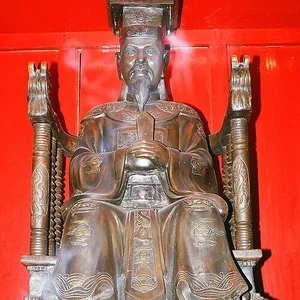

Fifth emperor of Vietnam's Lê sơ dynasty (r. 1460–1497), he promulgated the Hồng Đức legal code and carried out sweeping reforms of the administration, education, and military. He conquered the Kingdom of Champa in 1471, permanently extending Vietnamese territory southward. A prolific poet, he founded the Tao Đàn literary circle and left more than 350 poems in classical Chinese. [1]
Lê Thánh Tông(1442 — 1497)
Lê Thánh Tông
Vietnam
11 min read
Frequently asked questions
Key Facts
- Born on August 25, 1442, the younger son of Emperor Lê Thái Tông and Lady Ngô Thị Ngọc Dao [1]
- Ascended the throne in 1460 following the overthrow of the usurper Lê Nghi Dân by senior ministers [1]
- Promulgated the Hồng Đức Code, Vietnam's first comprehensive major legal codification [1]
- Conquered Champa in 1471 and led campaigns into Laos in 1479, annexing a vast territory stretching from Quảng Nam to Bình Định [1]
- Died on March 3, 1497 at the age of 55 after 37 years of reign, the longest in the Lê sơ dynasty [1]
Works & Achievements
A major legislative corpus promulgated under the influence of Neo-Confucianism, codifying the civil, criminal, and administrative law of Đại Việt. It stands as one of the most significant achievements in Vietnamese legal history. [1]
A systematic map of the kingdom produced after surveying the terrain of mountains and waterways, accompanying the reorganization of the country into 13 thừa tuyên. It is one of the earliest official cartographic documents in Vietnamese history. [1]
More than 350 poems in classical Chinese have survived to the present day, alongside compositions in chữ Nôm. Lê Thánh Tông is regarded as one of the great poets of medieval Vietnamese literature. [1]
A court scholars' association of which Lê Thánh Tông served as supreme leader (Nguyên súy). The Tao Đàn was a hub of poetic production in chữ Hán and chữ Nôm, and a beacon of learned culture throughout Đại Việt. [1]
Lê Thánh Tông established a regular triennial examination system; over 37 years of reign, 12 major examinations were held and admitted more than 500 laureates. He ordered stelae to be erected at the Văn Miếu to honor the doctoral graduates, a practice that continued under subsequent dynasties. [1]
A military campaign personally led by the emperor, resulting in the annexation of Champa territory from Quảng Nam to Bình Định. This geopolitical achievement ranks among the most significant territorial expansions in the history of Đại Việt. [1]
Anecdotes
In 1460, following the assassination of Emperor Lê Nhân Tông by the rebel prince Lê Nghi Dân, the senior ministers Nguyễn Xí and Đinh Liệt organized a counter-coup: they sealed the palace gates, neutralized the rebel guards, and forced Lê Nghi Dân to take his own life. They then chose the young Lê Tư Thành, aged 18, to ascend the throne; he was enthroned on the 18th day of the 6th lunar month of 1460 in the Tường Quang hall, under the reign name Quang Thuận. [1]
According to the *Đại Việt sử ký toàn thư*, after the ceremony in which Lê Thánh Tông transferred the funerary tablet of Emperor Nhân Tông to the Imperial Ancestral Temple (Thái Miếu), the capital had long gone without rain. But the following evening, a heavy rain fell — an event the chroniclers recorded as a favorable omen from Heaven bestowed upon the new sovereign. [1]
In 1462, the son of the powerful minister Nguyễn Xí, named Nguyễn Sư Hồi, anonymously composed a poem falsely accusing four senior dignitaries of treason, then threw it into the street. The plot was uncovered before it could spread. Despite the four ministers' demands that the author be punished, the emperor shielded Sư Hồi out of deference to his father Nguyễn Xí, whose support he still needed to consolidate his newly won throne. [1]
In 1471, Lê Thánh Tông personally led the military campaign against the Kingdom of Champa (Chiêm Thành). This conquest annexed a vast territory stretching from Quảng Nam to Bình Định, marking one of the most decisive stages of the *Nam tiến* — the southward expansion of the Vietnamese people. Despite pressure from Ming China demanding that these lands be returned to Champa, the emperor firmly refused. [1]
A passionate man of letters, Lê Thánh Tông founded the literary circle Tao Đàn and served as its supreme leader (Nguyên súy). He is credited with thousands of compositions in Chinese characters and in the Vietnamese *nôm* script, of which more than 350 classical Chinese poems have survived to this day. The great scholar Phan Huy Chú, writing under the Nguyễn dynasty, described his reign as the most flourishing period of the imperial examinations in all of Vietnamese history. [1]
Primary Sources
« Thiên tư tuyệt đẹp, thần sắc khác thường, vẻ người tuấn tú, nhân hậu, rạng rỡ, nghiêm trang, thật là bậc thông minh xứng đáng làm vua, bậc trí dũng đủ để giữ nước. » (Exceptional natural gifts, extraordinary appearance, elegant bearing, benevolence, brilliance and dignity: here was a prince of intelligence worthy of the throne and of courage sufficient to defend the realm.)
« Vua lập chế độ văn vật khả quan, mở mang đất đai, thực là anh hùng tài lược, Vũ Đế nhà Hán, Thái Tông nhà Đường cũng không hơn được. » (The king established admirable cultural institutions and expanded the territories: he was a hero of great talent whom Emperor Wu of the Han and Taizong of the Tang could not surpass.)
« Từ nay về sau, nếu thấy chiếu chỉ và các việc cung thì không được lén lút tiết lộ cho người ngoài và con thân thích. » (Henceforth, whosoever becomes aware of imperial edicts or palace affairs must not secretly disclose them to outside persons or to their relatives.)
« Khoa cử các đời, thịnh nhất là đời Hồng Đức. » (Of the imperial examinations across all dynasties, the most flourishing were those of the Hồng Đức era.)
More than 350 poems in classical Chinese have been preserved, alongside compositions in chữ Nôm. They bear witness to the intense literary activity of the emperor, head of the Tao Đàn literary circle, and to his dual mastery of both the Sinicized and Vietnamese scholarly traditions. [1]
Key Places
Capital of Đại Việt and seat of Lê Thánh Tông's power for 37 years. It was in the Tường Quang hall of Thăng Long that he was enthroned on the 18th day of the 6th lunar month of 1460; sources note that he had numerous palaces and buildings constructed there. [1]
A major center of Confucian learning where Lê Thánh Tông had the doctoral stelae (*bia tiến sĩ*) erected to honor the laureates of the triennial examinations. It embodies his policy of merit-based advancement and the cultural prestige of his reign. [1]
The home region of Lê Thánh Tông's mother, the concubine Ngô Thị Ngọc Dao, from whom he traced his maternal lineage. It is also the cradle of the Early Lê dynasty, founded by the resistance fighters of Lam Sơn. [1]
A neighboring kingdom conquered in 1471 during a campaign personally led by Lê Thánh Tông. The annexation of the territory from Quảng Nam to Bình Định marked a major step in the *Nam tiến* (southward expansion), despite Chinese pressure to return the lands. [1]
Mountainous western regions against which Lê Thánh Tông conducted campaigns in 1479 to repel incursions by local chieftains and border minorities backed by Ming China. [1]
Typical Objects

Legal corpus promulgated during the Hồng Đức era, codifying the civil, criminal, and administrative law of Đại Việt under Neo-Confucian influence. It regulated life across all levels of society, from peasant to official, and stands as one of the great legislative monuments of Vietnamese history. [1]

Map of the kingdom produced after a systematic survey of mountains and waterways conducted by Lê Thánh Tông and his scholars, accompanying the administrative division of the realm into 13 thừa tuyên. It is one of the first official cartographic documents of Vietnam. [1]

Stone stelae erected on the orders of Lê Thánh Tông at the Văn Miếu (Temple of Literature, Thăng Long) to immortalize the names of laureates from the triennial examinations. The emperor established the rule of a grand examination every three years, and in this way honored more than 500 doctoral graduates. [1]

Poetic manuscripts composed by Lê Thánh Tông: more than 350 poems in Classical Chinese have come down to us, alongside works written in Vietnamese nôm script. They testify to his dual mastery of both the Sinicized and the indigenous literary traditions. [1]

Official documents stamped with the imperial seal through which Lê Thánh Tông issued laws, appointments, and ordinances. The sources notably cite an edict of July 1460 imposing absolute secrecy on palace affairs in order to prevent any further coup d'état. [1]

Military equipment used during the conquest of Chiêm Thành (Champa) in 1471, a campaign that Lê Thánh Tông personally commanded. The sources specify that he led military operations himself, both southward and westward. [1]
School Curriculum
Vocabulary & Tags
Key Vocabulary
Daily Life
Morning
From childhood, Lê Thánh Tông stood out for his love of Confucian classics and his tireless dedication to study, as recorded in the Đại Việt sử ký toàn thư. As emperor, he likely began his day studying the classics and holding audiences at which ministers presented their reports. [1]
Afternoon
The afternoon was devoted to affairs of state: overseeing the administration of the 13 thừa tuyên provinces, managing the imperial examinations, or, during military campaigns, personally commanding operations to the south and west — which the source describes as conducted under his direct leadership. [1]
Evening
In the evening, the emperor gathered with members of the Tao Đàn literary circle to compose and recite poetry in chữ Hán and chữ Nôm. The source notes that he enjoyed studying and debating Confucian classics and dynastic histories, and that he held people of talent and virtue in high regard. [1]
Food
Not documented in the source consulted. [1]
Clothing
Not documented in the source consulted. As emperor of the early Lê court, which was strongly influenced by Ming China — whose model of state organization he explicitly adopted — he almost certainly wore imperial robes in a Sinicized style, though the source provides no specific details. [1]
Housing
Lê Thánh Tông resided in the imperial palace of Thăng Long (present-day Hanoi). The source notes that his contemporaries, as well as historians of the Lê and Nguyễn dynasties, criticized him for constructing numerous palaces and buildings that exceeded in scale the norms of previous reigns. [1]
Historical Timeline
Period Vocabulary
Liens externes & ressources
Références
Œuvres
Bộ Luật Hồng Đức (Code juridique de l'ère Hồng Đức)
règne Hồng Đức (à partir de 1470)
Bản đồ Hồng Đức (Carte géographique de l'Đại Việt)
règne Hồng Đức (XVe siècle)
Corpus poétique en chữ Hán (plus de 350 poèmes conservés)
1460–1497
Tao Đàn (Cénacle littéraire de la cour)
fin du règne (après 1470)
Réforme des examens impériaux (12 sessions triennales)
1463–1493
Conquête du Champa et intégration du Centre-Vietnam
1471